
Blade Application Guides / Application Guide / Paper core manufacturing
Paper Core End Trimming for Accurate Finished Length
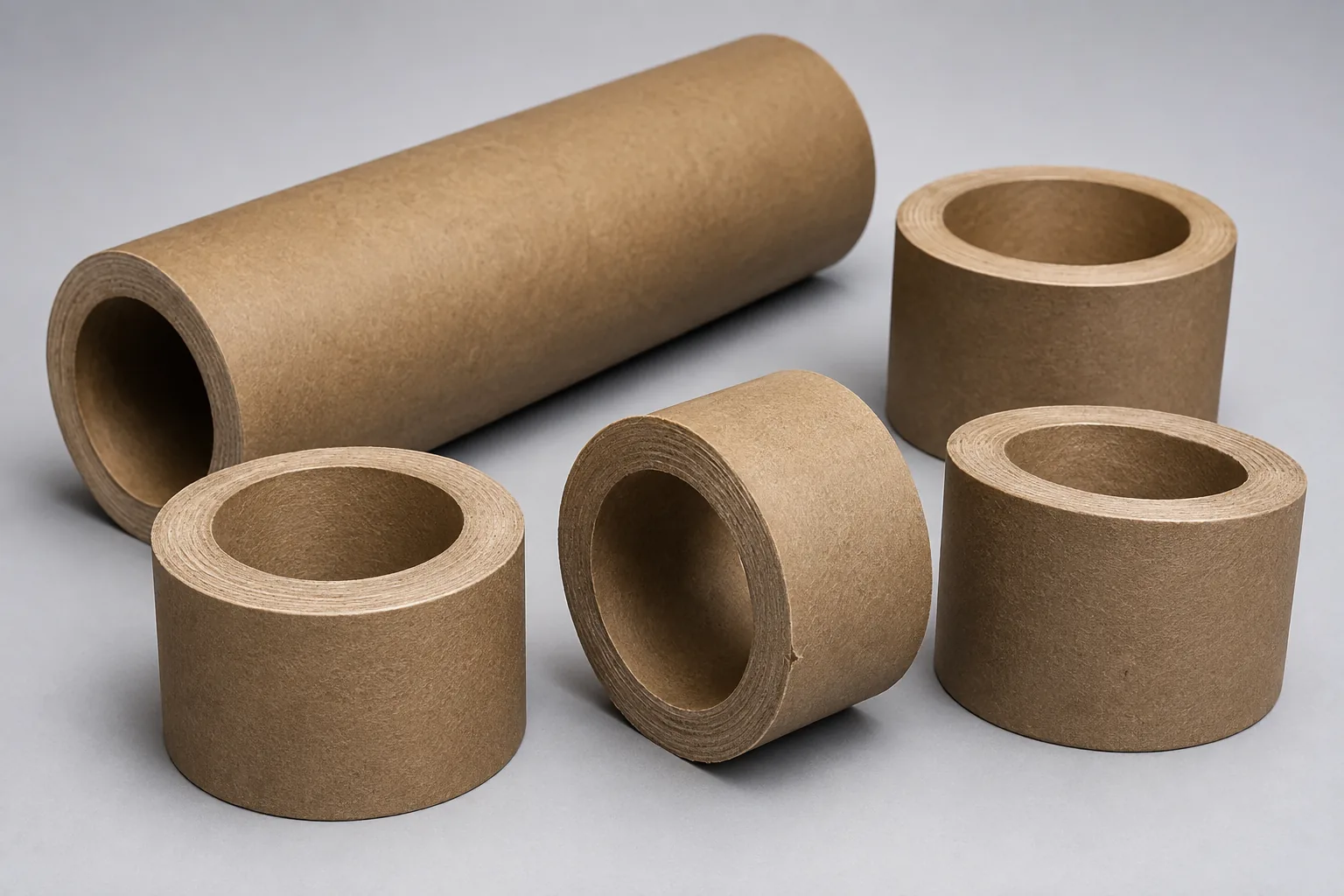
Paper cores often become functional mounting components for film, label, paper or textile rolls. End trimming must control length and squareness without closing the bore, loosening plies or leaving fibers that affect winding hardware.
Updated
Where This Cutting Application Appears
Film and foil winding-core finishing
Core ends are faced before winding so the finished length and bore remain compatible with chucks, shafts and reel handling.
Label and tape core preparation
Short cores are trimmed for narrow rolls, where an angled face can create uneven reel edges or packaging problems.
Textile yarn and nonwoven core refurbishment
Reusable or long cores may be re-faced to remove damaged ends while preserving sufficient length and wall integrity.
End Trimming process boundary
End trimming removes a limited allowance from one or both ends to establish a clean datum, final length or square face; it is not repeated length cutting through the full production run.
End Trimming setup checkpoint
Define the end allowance, finished datum, squareness reference, part support and whether one or both ends must be trimmed before the next dimensional operation.
End Trimming acceptance checkpoint
Measure finished length and end squareness, then inspect the face for deformation, breakout, smearing and a continuous clean datum across the complete section.
Define the Required Cut Result
- Control out-of-square core faces
- Maintain the required geometry for film and foil winding-core finishing
- Protect material integrity during end trimming
- Deliver a cut condition accepted by the next production step
Problems to Diagnose Before Changing the Knife
Out-of-square core faces
Check core support, axial location, rotation, feed alignment and length readings at multiple points around the circumference.
Frayed outer or inner plies
Review paper grade, liner direction, moisture, exit-side support and the relationship between trim allowance and existing end damage.
Bore closure from trimming pressure
Compare wall thickness, clamp and chuck force, internal support, core roundness and recovery after unloading.
Length variation between finished cores
Audit datum faces, stop wear, indexing repeatability, trim on one or both ends and the measurement method used after cutting.
Knife Forms That May Be Considered
| Possible knife form | When it may be considered | What must be confirmed |
|---|---|---|
| Circular core-trimming form | Consider for rotating cores that are faced at one or both ends. | Confirm this form only from the paper cores sample, equipment interface, operating motion and approved drawing. |
| Straight cutoff form | Consider for stationary cores when the equipment provides complete bore and wall support. | Confirm this form only from the paper cores sample, equipment interface, operating motion and approved drawing. |
Information to Send for Technical Review
You do not need to know the exact blade name. Send the available workpiece, machine, current-knife and cut-result information so the application can be reviewed against a drawing or sample.
- Core inside and outside diameter plus roundness range
- Wall thickness, ply construction and liner grade
- New, reused or damaged-core condition before trimming
- One-end or two-end trim sequence and trim allowance
- Chuck, mandrel, clamp and end-support arrangement
- Required finished length, squareness and bore-clearance criteria
- Winding material and downstream shaft or packaging interface
- Existing trimming-part drawing or sample, volume and inspection sampling plan
Questions About This Cutting Application
Why can a paper core measure correctly on one side but not the other?
An angled face, bowed core or inconsistent datum can produce different readings around the circumference. Record measurements at several clock positions on both ends.
How much damaged material should be removed from a reused core?
The trim allowance depends on crush depth, delamination and the minimum usable length. Send representative damaged cores and the downstream length requirement for review.
What causes fibers to project into the core bore?
Inner-liner direction, weak bonding, inadequate exit support or an existing delaminated end can leave inward tags. Note whether the fibers appear on the entry or exit end.
Does the winding material matter when specifying a core trim?
Yes. Film, foil, labels, paper and textiles can impose different end-face and width-alignment needs. Identify the wound material and how the core locates in the next process.
Can trimming compatibility be confirmed from core dimensions alone?
No. The review also needs chuck or mandrel details, support, motion, existing sample and acceptance method. Final manufacture requires a confirmed interface and approved drawing.
Related product and service information
- Paper Tube Length Cutting With Clean Square Ends - spiral-wound paper tubes · length cutting
- Honeycomb Paper Core Slicing Without Cell Collapse - honeycomb paper cores · slicing
- Kraft Paper Roll Slitting: Edge Quality and Dust - kraft paper rolls · roll slitting
Request a Custom Cutting-Knife Review
Send the workpiece details, machine or holder information, current knife photos or sample, required quantity and examples of the present cut problem. Final dimensions, material, edge geometry and tolerances are confirmed from the approved requirements.