
Blade Application Guides / Application Guide / Paper honeycomb production
Honeycomb Paper Core Slicing Without Cell Collapse
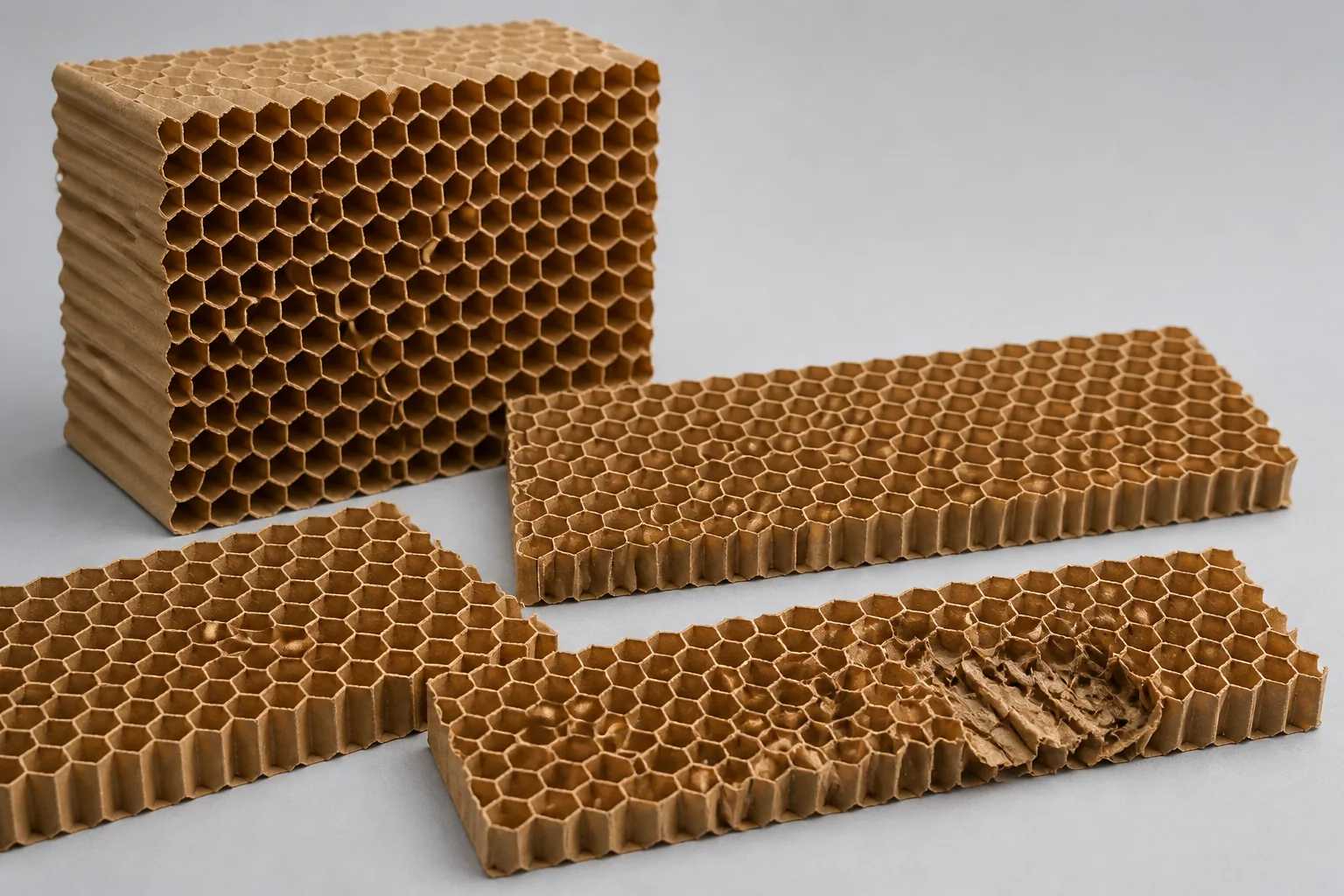
Honeycomb core presents thin paper walls, open cells and bonded nodes to the cut at the same time. The review must consider whether the material is an unexpanded block or an expanded core, how it is supported, and which face condition the panel operation accepts.
Updated
Where This Cutting Application Appears
Unexpanded honeycomb block slicing
Compact core blocks are sliced to width before expansion, requiring consistent thickness without pulling bonded node lines apart.
Expanded core sizing for sandwich panels
Opened honeycomb is cut to panel dimensions while the cells need enough support to avoid local collapse and skew.
Protective-packaging insert preparation
Core pads and shaped inserts are sized for cushioning assemblies where loose fibers and uneven faces hinder bonding or fit.
Slicing process boundary
Slicing produces repeated sections or layers controlled mainly by slice thickness; it is distinct from portioning by target serving size, strip cutting or multidirectional dicing.
Slicing setup checkpoint
Confirm slice thickness, product temperature, orientation, support or restraint and the clearing motion needed to prevent one slice from disturbing the next.
Slicing acceptance checkpoint
Check thickness distribution, face appearance, tearing, compression, product loss and whether slices separate cleanly for packing or further processing.
Define the Required Cut Result
- Control collapsed cells along the cut face
- Maintain the required geometry for unexpanded honeycomb block slicing
- Protect material integrity during slicing
- Deliver a cut condition accepted by the next production step
Problems to Diagnose Before Changing the Knife
Collapsed cells along the cut face
Review expanded versus unexpanded state, cell size, paper weight, support coverage, compression and cutting direction.
Adhesive-node pullout
Inspect adhesive cure, node spacing, slice direction, local tearing and whether failure follows the bonded line or paper wall.
Tapered or angled core slices
Check block datum, expansion uniformity, feed alignment, support flatness and thickness readings across the full face.
Loose fibers that reduce panel bond quality
Compare paper furnish, moisture, face dust, extraction and the cleanliness required before adhesive application.
Knife Forms That May Be Considered
| Possible knife form | When it may be considered | What must be confirmed |
|---|---|---|
| Straight slicing form | Consider for supported honeycomb blocks moving through a controlled slice. | Confirm this form only from the honeycomb paper cores sample, equipment interface, operating motion and approved drawing. |
| Reciprocating serrated form | Consider for low-density expanded core only when the existing motion and support are compatible. | Confirm this form only from the honeycomb paper cores sample, equipment interface, operating motion and approved drawing. |
Information to Send for Technical Review
You do not need to know the exact blade name. Send the available workpiece, machine, current-knife and cut-result information so the application can be reviewed against a drawing or sample.
- Expanded or unexpanded condition at the slicing station
- Cell size, cell orientation and expansion ratio used in production
- Paper grade, basis weight and moisture condition
- Adhesive system, node pitch and cure state
- Block or panel dimensions and required slice thickness
- Support fixture, compression method and feed direction
- Face flatness, angle, loose-fiber and bonding acceptance criteria
- Representative core samples, defect maps and current cutting-part interface
Questions About This Cutting Application
Why must expanded and unexpanded honeycomb be reviewed separately?
Expansion changes stiffness, support area and the direction in which cell walls can buckle. A setup used on a compact block may not reproduce the same face on opened core.
What indicates adhesive-node pull rather than a simple paper tear?
Node pull tends to follow bonded lines or detach paired walls, while a paper tear may cross unsupported cells. Mark the cell orientation and node pattern on defect photos.
How can a slicing trial be assessed before panel bonding?
Measure slice thickness and face angle, map crushed cells, collect loose fiber, and bond a representative sample if downstream adhesion is a critical acceptance point.
Which sample best represents honeycomb production?
Send material in the same expansion, moisture and cure condition present at cutting. Small pieces compressed for shipping may not demonstrate actual cell stability.
Can the cutting form be selected from cell size alone?
No. Cell orientation, paper weight, adhesive nodes, support method, feed motion and the existing interface also matter. Confirm these details and an approved drawing before production.
Related product and service information
- Paper Core End Trimming for Accurate Finished Length - paper cores · end trimming
- Paper Tube Length Cutting With Clean Square Ends - spiral-wound paper tubes · length cutting
- Kraft Paper Roll Slitting: Edge Quality and Dust - kraft paper rolls · roll slitting
Request a Custom Cutting-Knife Review
Send the workpiece details, machine or holder information, current knife photos or sample, required quantity and examples of the present cut problem. Final dimensions, material, edge geometry and tolerances are confirmed from the approved requirements.