
Blade Application Guides / Application Guide / structural panel production
Trimming Oriented Strand Board Edges
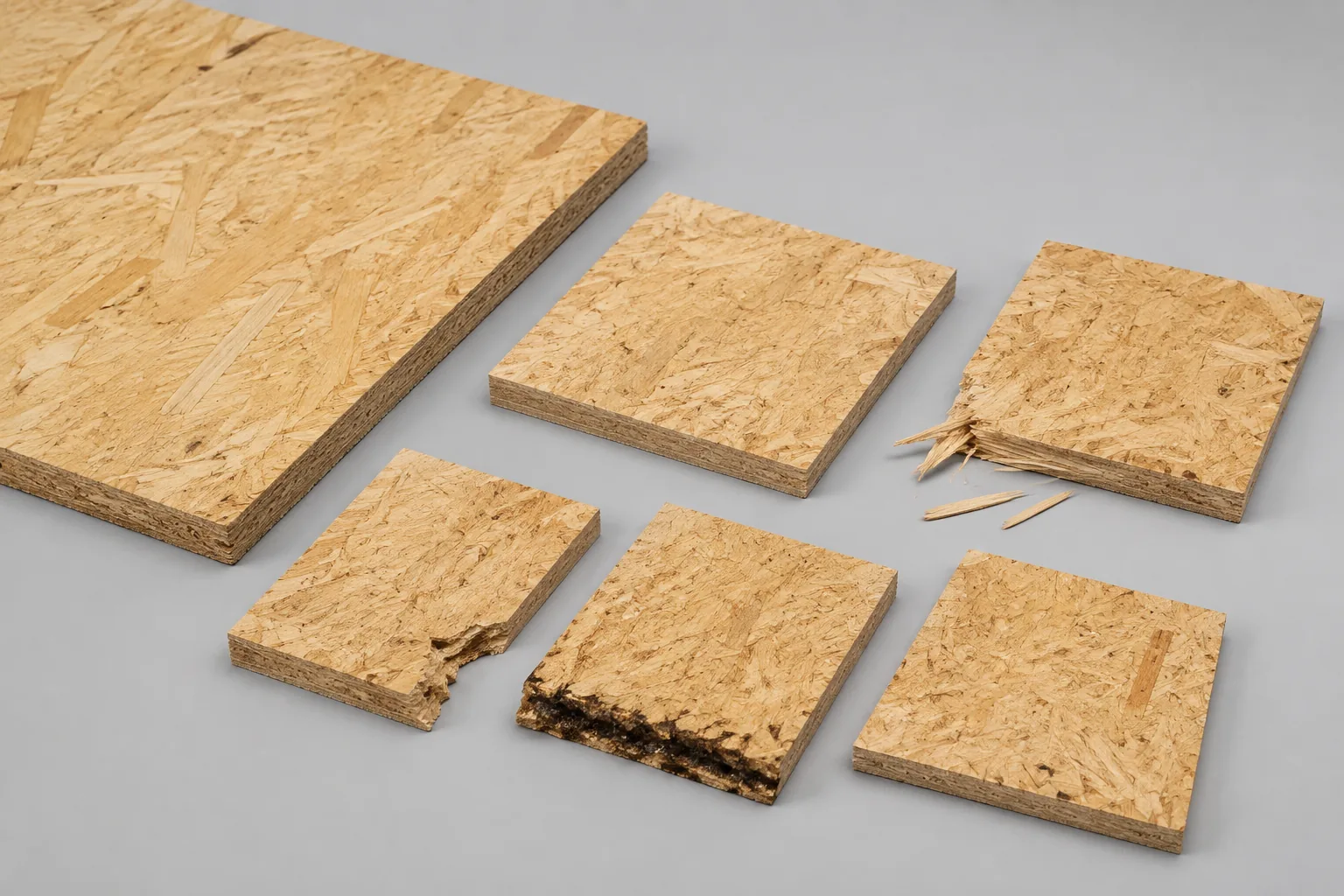
OSB is built from oriented wood strands pressed in resin-rich layers, leaving an uneven edge structure that changes with strand direction and press density. Trimming must sever projecting strands rather than lever them from the panel, especially where the perimeter will remain exposed in sheathing or web components.
Updated
Where This Cutting Application Appears
Press-line perimeter trimming
Removes rough press margins and brings full OSB panels to saleable rectangular dimensions.
Sheathing panel conversion
Cuts roof or wall sheathing sizes while maintaining square reference edges for installation layouts.
I-joist web blank preparation
Produces OSB strips for engineered components after width, orientation and downstream machining are confirmed.
Edge Trimming And Sizing process boundary
edge trimming and sizing for oriented strand board is a linked sequence: the output condition and datum from each operation become the controlled input for the next. It should not be evaluated as one generic cut or accepted only by the final dimension.
Edge Trimming And Sizing setup checkpoint
For oriented strand board, define the operation order, intermediate dimensions, registration transfer, material support, web or part handling and waste route for every stage of edge trimming and sizing.
Edge Trimming And Sizing acceptance checkpoint
Verify both intermediate and final results from edge trimming and sizing, including dimensions, registration, edge or feature quality, material damage, waste separation and stable transfer between stages.
Define the Required Cut Result
- Severed strands without deep edge pullout
- Square panels with consistent dimensions
- Intact corners through stacking and transport
- Low resin buildup and controlled dust
Problems to Diagnose Before Changing the Knife
Long strand pulls from the edge
- Identify strand orientation at the defect
- Inspect edge sharpness and entry direction
- Check face and exit support
Corner breaks during the last cut
- Review perimeter cutting sequence
- Support the corner through tool exit
- Inspect low-density or poorly bonded areas
Resin accumulates on the cutter
- Record board temperature and moisture
- Check side rubbing and tool finish
- Verify extraction around the kerf
Panel becomes trapezoidal
- Check guide and trim-head parallelism
- Verify datum transfer between edges
- Measure panel movement under feed rollers
Knife Forms That May Be Considered
| Possible knife form | When it may be considered | What must be confirmed |
|---|---|---|
| toothed circular trim cutter | A guided circular cutter suits press-line edge removal when tooth form severs long strands and clears resin-bearing debris. | Confirm final geometry and mounting from the OSB panel trim spindle, an unworn sample or an approved drawing before manufacture. |
| scoring and main cutter arrangement | A scoring pass may protect a specified face on converted panels where the line supports accurate two-tool alignment. | Confirm final geometry and mounting from the OSB sizing saw with scoring unit, an unworn sample or an approved drawing before manufacture. |
| gang edge-trim cutters | Opposed or multiple heads may square production panels in one pass when spacing, alignment and extraction are controlled. | Confirm final geometry and mounting from the OSB press-line gang trim system, an unworn sample or an approved drawing before manufacture. |
Information to Send for Technical Review
You do not need to know the exact blade name. Send the available workpiece, machine, current-knife and cut-result information so the application can be reviewed against a drawing or sample.
- Trim-line or panel-saw model
- OSB grade and strand-layer orientation
- Panel thickness, density and moisture range
- Pressed margin and finished panel dimensions
- Required face and corner acceptance
- Feed, spindle and extraction conditions
- Marked pullout, resin and squareness samples
- Tool dimensions, head positions and quantity
Questions About This Cutting Application
Why do individual OSB strands peel from the edge?
A dull or poorly supported cut can lift an oriented strand along its length instead of severing it across the kerf.
Does cutting parallel to surface strands give the same result as cross-cutting them?
No. Strand orientation changes how fibers bridge and pull out, so mark cut direction on comparison samples.
What makes OSB corners fragile after sizing?
Low local density, an unsupported final cut or pre-existing margin damage can leave a corner with few bonded strands.
Can resin buildup be solved only by cleaning more often?
Cleaning treats the deposit, but temperature, rubbing, extraction and tool finish should be reviewed to reduce its cause.
How should panel squareness be checked?
Use defined reference edges on a supported panel and state the diagonal or angular method and allowed variation.
Related product and service information
- Cutting Particleboard Panels to Size - particleboard panels · sizing and cross-cutting
- Clipping Natural Wood Veneer Sheets - natural wood veneer sheets · clipping and edge joint preparation
- Trimming Plywood Panel Edges - plywood panels · panel edge trimming
Request a Custom Cutting-Knife Review
Send the workpiece details, machine or holder information, current knife photos or sample, required quantity and examples of the present cut problem. Final dimensions, material, edge geometry and tolerances are confirmed from the approved requirements.