
Blade Application Guides / Application Guide / furniture and panel production
Cutting Particleboard Panels to Size
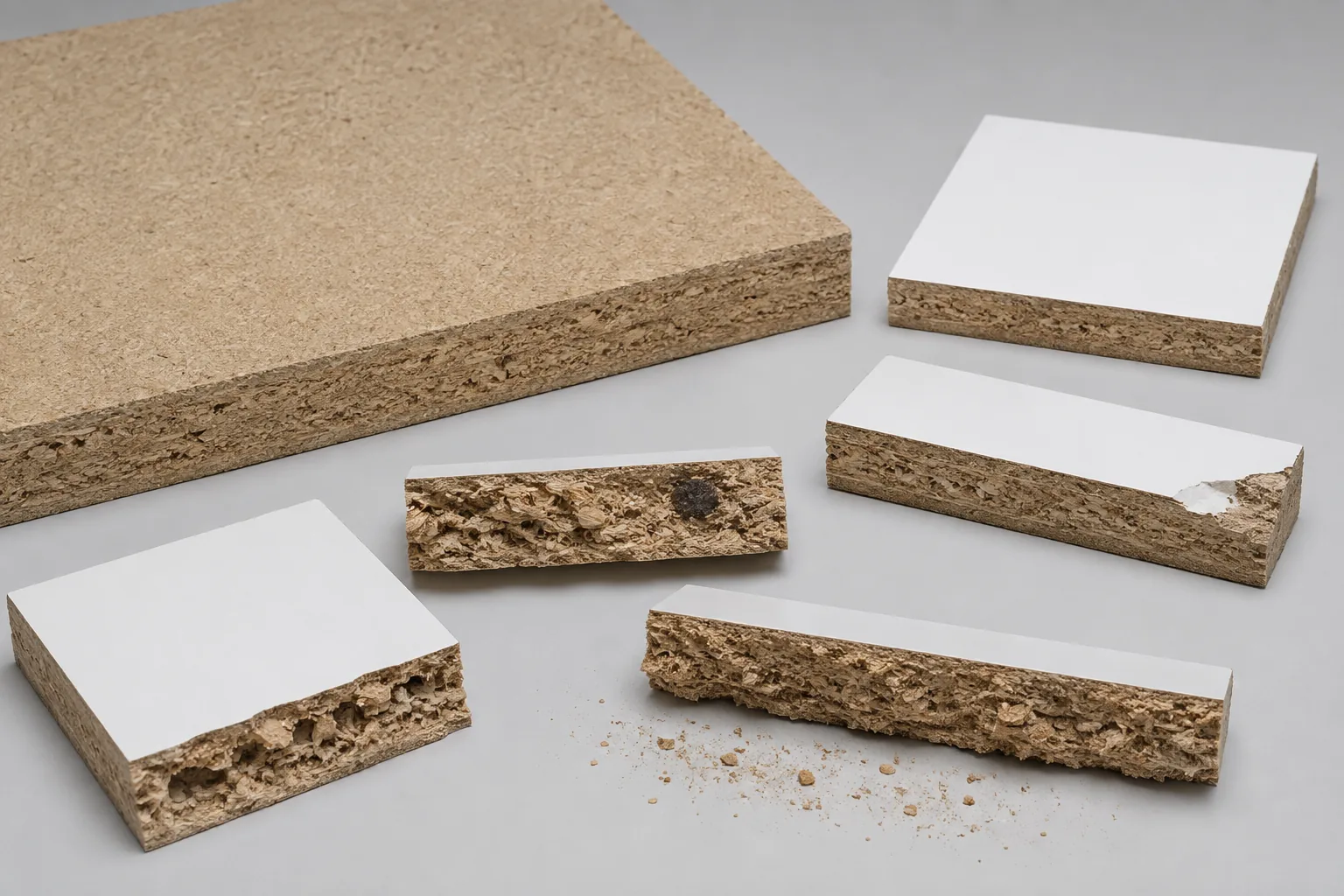
Particleboard combines dense surface layers with a coarser chip core that can contain local voids or hard inclusions. A clean size cut must protect any decorative face while keeping large core particles from tearing out ahead of the edge needed for drilling or edge banding.
Updated
Where This Cutting Application Appears
Casework component sizing
Cuts cabinet sides, shelves and partitions before boring and edge banding.
Melamine-faced board conversion
Sizes decorative panels while top-face and bottom-face chips are tracked independently.
Worktop and thick-board blanking
Cuts heavier particleboard stock where core voids, flatness and full-depth extraction affect edge consistency.
Sizing And Cross-Cutting process boundary
sizing and cross-cutting for particleboard panels is a linked sequence: the output condition and datum from each operation become the controlled input for the next. It should not be evaluated as one generic cut or accepted only by the final dimension.
Sizing And Cross-Cutting setup checkpoint
For particleboard panels, define the operation order, intermediate dimensions, registration transfer, material support, web or part handling and waste route for every stage of sizing and cross-cutting.
Sizing And Cross-Cutting acceptance checkpoint
Verify both intermediate and final results from sizing and cross-cutting, including dimensions, registration, edge or feature quality, material damage, waste separation and stable transfer between stages.
Define the Required Cut Result
- Low decorative-face chipping
- Sound core edge for later banding
- Square, repeatable panel dimensions
- Controlled dust and inclusion-related damage
Problems to Diagnose Before Changing the Knife
Large core particles pull out
- Inspect core particle size and local voids
- Check feed direction and exit support
- Review edge sharpness through full board thickness
Melamine face chips
- Verify scoring alignment and depth
- Inspect tool runout
- Check face orientation and panel support
Sudden tooth or edge damage
- Audit metal, stone and recycled-content inclusions
- Locate damage around the cutter
- Inspect extraction for hard debris
Rough edge rejects banding
- Define allowable void and breakout size
- Separate board defects from cutting damage
- Check heat and resin deposits
Knife Forms That May Be Considered
| Possible knife form | When it may be considered | What must be confirmed |
|---|---|---|
| toothed circular panel cutter | A full-depth circular cutter suits board sizing when tooth spacing clears coarse particles and the panel remains supported. | Confirm final geometry and mounting from the particleboard panel saw, an unworn sample or an approved drawing before manufacture. |
| scoring and main cutter pair | Paired tools may reduce face-layer breakout on laminated board if scoring width and alignment match the main kerf. | Confirm final geometry and mounting from the laminated-board sizing line, an unworn sample or an approved drawing before manufacture. |
| wear-resistant tipped sizing cutter | A wear-resistant cutting material may suit abrasive board recipes where the machine limits impact from hidden inclusions. | Confirm final geometry and mounting from the rigid particleboard cutting spindle, an unworn sample or an approved drawing before manufacture. |
Information to Send for Technical Review
You do not need to know the exact blade name. Send the available workpiece, machine, current-knife and cut-result information so the application can be reviewed against a drawing or sample.
- Panel saw or beam-saw model
- Particleboard grade, density and recycled content
- Board thickness and surface-layer construction
- Raw or laminated face material
- Panel dimensions, tolerances and stack height
- Feed, spindle and scoring settings
- Marked face-chip, void and wear samples
- Tool specifications, quantity and change interval
Questions About This Cutting Application
Why does particleboard lose large chips from the core?
Coarse particles, voids, weak local bonding or a worn cutting edge can allow fracture to run ahead of the cut.
Can scoring remove every chip from melamine board?
Scoring helps the entry or exit face only when width, depth and alignment are correct; board defects and main-tool wear still matter.
What causes random tool damage during an otherwise stable run?
Hard inclusions in recycled furnish are one possibility; retain the damaged board area and map the impacted cutting position.
How should an edge-banding requirement be described?
Specify acceptable breakout, void repair policy, squareness and the edge-banding process rather than asking only for a smooth edge.
Does thicker particleboard need a larger tooth pitch?
Thickness affects chip volume, but density, feed, spindle speed and extraction must be considered with tooth spacing.
Related product and service information
- Trimming Plywood Panel Edges - plywood panels · panel edge trimming
- Clipping Natural Wood Veneer Sheets - natural wood veneer sheets · clipping and edge joint preparation
- Sizing MDF and HDF Panels - MDF and HDF panels · panel sizing
Request a Custom Cutting-Knife Review
Send the workpiece details, machine or holder information, current knife photos or sample, required quantity and examples of the present cut problem. Final dimensions, material, edge geometry and tolerances are confirmed from the approved requirements.