
Blade Application Guides / Application Guide / Hydrogen equipment manufacturing
Nickel Foam Electrode Edge-Trimming Blades
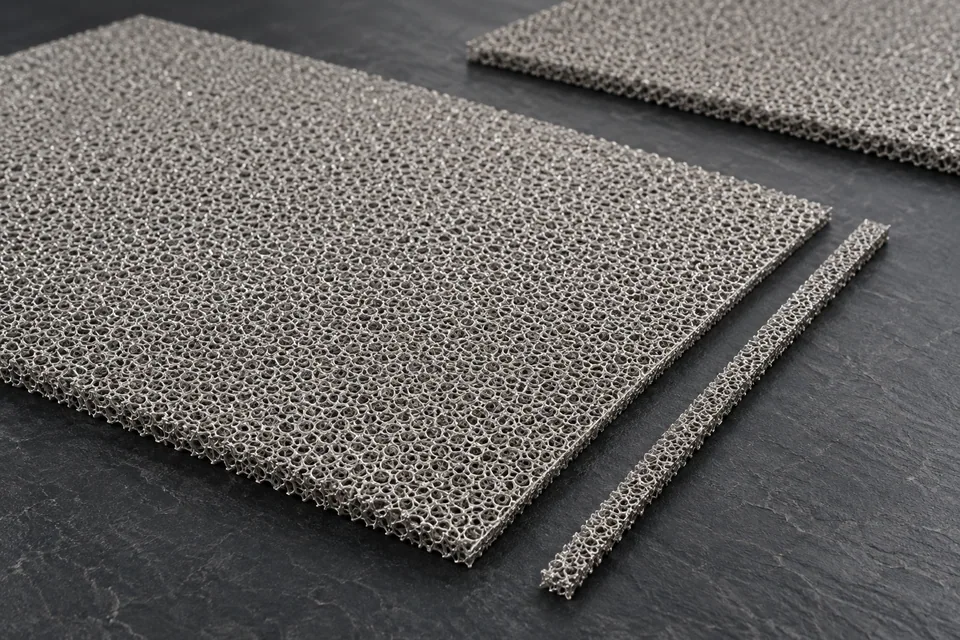
Edge trimming removes a narrow outside allowance from a nickel foam electrode sheet. Unlike dividing the sheet into several useful lanes, the objective is to keep a broad electrode with one accepted outside edge. A loose waste strip made of open ligaments may snag or break; excessive takeoff force may tear cells from the retained sheet. Define incoming variation, permitted trim width and any coated or dense contact face before the trial. A trim edge does not prove electrode performance.
Updated
Where This Cutting Application Appears
Locate the retained electrode area
Mark the sacrificial side and the minimum useful width on the buyer’s drawing. Measure incoming stock variation so the chosen trim allowance does not enter an active region or remove a required dense contact backing.
Watch the porous waste strip
Track the narrow foam strip from blade to collection. If ligaments bridge across an incomplete cut, pulling the waste can rip the useful edge; record takeoff tension and compare startup with steady operation.
Inspect the broad retained sheet
Measure finished width and straightness. Examine the retained edge for crushed pores, sharp projections and loose nickel, and inspect any activated coating or dense backing for scuffing or partial separation.
Check after waste removal
Compare the edge at the knife and after the waste strip has been pulled away. Retain both waste and useful samples so a torn cell can be traced to cutting, takeoff or later stacking rather than inferred from final debris alone.
Define the Required Cut Result
- Hold the broad electrode within finished width.
- Avoid tearing the retained open-cell network.
- Collect waste without metal fragments on the accepted face.
- Preserve specified backing and coating at the margin.
Problems to Diagnose Before Changing the Knife
Waste ribbon breaks repeatedly
- Check trim width relative to the foam cell structure.
- Inspect blade completeness and support.
- Reduce uncontrolled takeoff pull in the trial.
Retained edge has stretched ligaments
- Look for bridges on the discarded strip.
- Compare knife-exit and post-takeoff edges.
- Inspect blade penetration and alignment.
The useful face carries loose nickel
- Map particles to cut or guide contact.
- Inspect any coating for shedding.
- Review separation and collection surfaces.
Knife Forms That May Be Considered
| Possible knife form | When it may be considered | What must be confirmed |
|---|---|---|
| Supported outside-edge blade | Where a compatible sheet line removes one foam margin. | Confirm useful-edge pore state and complete ligament separation. |
| Rotary edge-trim pair | Only if the machine can guide foam and route waste without damaging the broad sheet. | Confirm mounting, side clearance and takeoff on actual stock. |
Information to Send for Technical Review
You do not need to know the exact blade name. Send the available workpiece, machine, current-knife and cut-result information so the application can be reviewed against a drawing or sample.
- Foam type and coating or backing state
- Incoming and final useful widths
- Sacrificial side and active-area drawing
- Permitted compressed-pore edge zone
- Loose-metal and protrusion limits
- Knife and support geometry
- Waste collection route
- Samples before and after trim takeoff
Questions About This Cutting Application
What is the accepted output of trimming?
The broad retained electrode at the specified width and edge condition; the narrow strip is waste.
Why inspect the discarded foam?
Incomplete cuts can leave ligament bridges that tear cells from the useful electrode during takeoff.
Can a trim blade restore damaged foam?
No. The starting sheet and coating condition must be checked before attributing damage to trimming.
What should be inspected after takeoff?
Check width, open-cell edge condition, protruding metal and coating or backing integrity.
Does a trim cut confirm cell efficiency?
No. Electrochemical performance belongs to the buyer’s electrode and stack qualification.
Public references and scope
These public sources provide material, cutting-method or safety context for this guide. Supplier pages describe their own materials or equipment; they do not establish a MEIRENTE blade specification or performance claim. Confirm the actual grade, machine setup and required cut with a drawing or sample.
Related product and service information
- Nickel Foam Electrode Sheet Slitting Blades - nickel foam electrode · sheet slitting
- Titanium Porous Transport Layer Edge Trimming Blades - titanium porous transport layer · edge trimming
- Electrolyzer Catalyst Decal Film Edge Trimming Blades - electrolyzer catalyst decal film · edge trimming
Request a Custom Cutting-Knife Review
Send the workpiece details, machine or holder information, current knife photos or sample, required quantity and examples of the present cut problem. Final dimensions, material, edge geometry and tolerances are confirmed from the approved requirements.