
Blade Application Guides / Application Guide / Hydrogen equipment manufacturing
Nickel Foam Electrode Sheet Slitting Blades
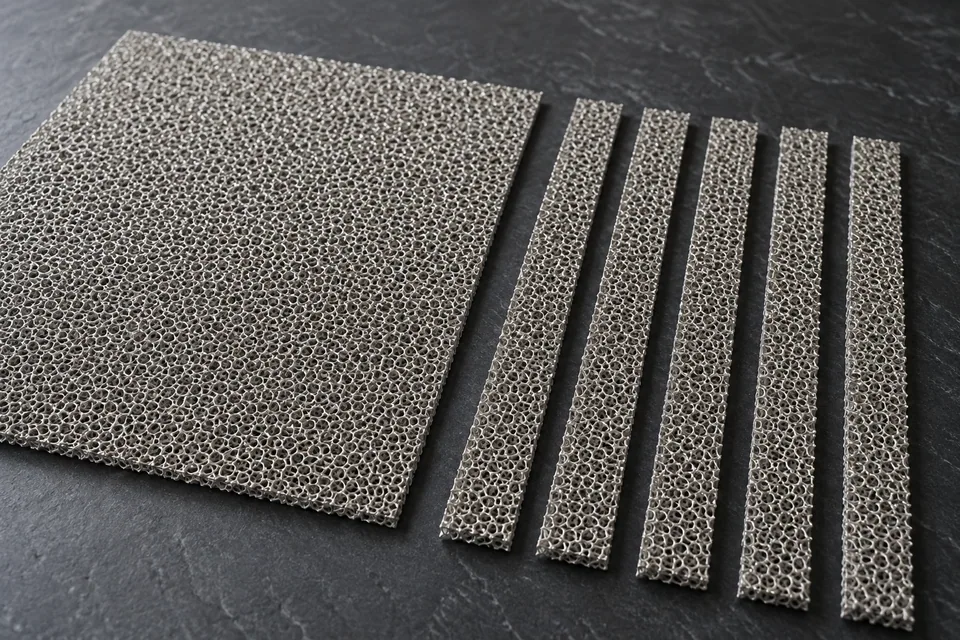
Nickel foam is an open-cell metallic network, not solid nickel foil. Electrode suppliers describe foam sheets and, in some designs, a dense contact backing or activated surface. Straight sheet slitting therefore has to control width while preserving the buyer’s permitted edge zone: blade pressure may flatten cells, leave protruding ligaments or dislodge particles. Confirm whether the actual stock is bare, coated or backed and inspect both new edges after handling. An acceptable cut cannot certify electrochemical performance.
Updated
Where This Cutting Application Appears
Lay out usable foam lanes
Place strip widths and outside margins on the buyer’s sheet drawing. Mark any dense backing or coated face so a lane is not judged against the wrong side; sample outer and middle lanes separately because support may differ across the sheet.
Check local support and cut pressure
Use a representative foam sample to compare backing under the blade. Too much localized compression can close cells near the cut, while too little support can leave unsevered ligaments; document the holder geometry and first accepted setting.
Measure the affected edge zone
Inspect straightness and width, then use the buyer’s method to evaluate crushed pores, hanging ligaments and loose metal pieces. If an activated layer or dense contact side exists, check it for peeling or marking at each slit.
Handle porous strips cleanly
Separate the strips without rubbing their edges together. Reinspect after stacking or transfer for detached particles and curl, and retain a control sample so pre-existing foam irregularity is not attributed to the cutter.
Define the Required Cut Result
- Meet strip-width and straightness requirements.
- Limit crushed cells and protruding metal at new edges.
- Preserve any specified coating or contact backing.
- Prevent loose metal particles from reaching accepted strips.
Problems to Diagnose Before Changing the Knife
Cells are flattened beside the cut
- Review backing and blade pressure.
- Measure the affected zone from the edge.
- Compare with an uncut foam control.
Metal ligaments remain attached across the slit
- Check blade condition and penetration.
- Inspect support under the foam.
- Compare foam thickness and cell structure by lot.
Particles appear after collection
- Trace first point of release along guides.
- Review strip rubbing and stacking.
- Check any activated surface for shedding.
Knife Forms That May Be Considered
| Possible knife form | When it may be considered | What must be confirmed |
|---|---|---|
| Supported straight shear blade | For a compatible line that divides foam sheet into parallel strips. | Confirm full ligament separation, edge crush and loose-particle level on actual stock. |
| Rotary sheet-slitting pair | Only when an existing machine can support the specified foam and any backing. | Confirm dimensions, overlap, side clearance and accepted edge sample. |
Information to Send for Technical Review
You do not need to know the exact blade name. Send the available workpiece, machine, current-knife and cut-result information so the application can be reviewed against a drawing or sample.
- Foam maker and exact grade
- Bare, coated or backed construction
- Cell structure and thickness range
- Sheet and finished-lane drawing
- Allowed crushed-edge zone and loose-particle criteria
- Blade and backing drawings
- Collection method
- Buyer electrode inspection method
Questions About This Cutting Application
Is nickel foam cut like solid nickel foil?
No. Its open cells and ligaments can be crushed or detached, so inspect an affected edge zone as well as width.
Why identify a dense backing?
Some electrode constructions use a contact side; its orientation and integrity change the cutting and inspection plan.
Can a clean slit prove electrode activity?
No. Activity and stack performance require the buyer’s separate electrode and cell tests.
What should be measured at the edge?
Width, straightness, protruding ligaments, crushed cells and any coating or backing damage.
What sample should the tooling trial use?
Use the actual electrode stock and include the same coating, activation or backing state planned for production.
Public references and scope
These public sources provide material, cutting-method or safety context for this guide. Supplier pages describe their own materials or equipment; they do not establish a MEIRENTE blade specification or performance claim. Confirm the actual grade, machine setup and required cut with a drawing or sample.
Related product and service information
- PEM Electrolyzer Membrane Contour-cutting Blades - PEM electrolyzer membrane · contour cutting
- Electrolyzer Catalyst Decal Film Sheet Slitting Blades - electrolyzer catalyst decal film · sheet slitting
- AEM Electrolyzer Membrane Sheet Slitting Blades - AEM electrolyzer membrane · sheet slitting
Request a Custom Cutting-Knife Review
Send the workpiece details, machine or holder information, current knife photos or sample, required quantity and examples of the present cut problem. Final dimensions, material, edge geometry and tolerances are confirmed from the approved requirements.