
Blade Application Guides / Application Guide / Protective textile converting
Neoprene-Laminated Textile Edge-Trimming Blades
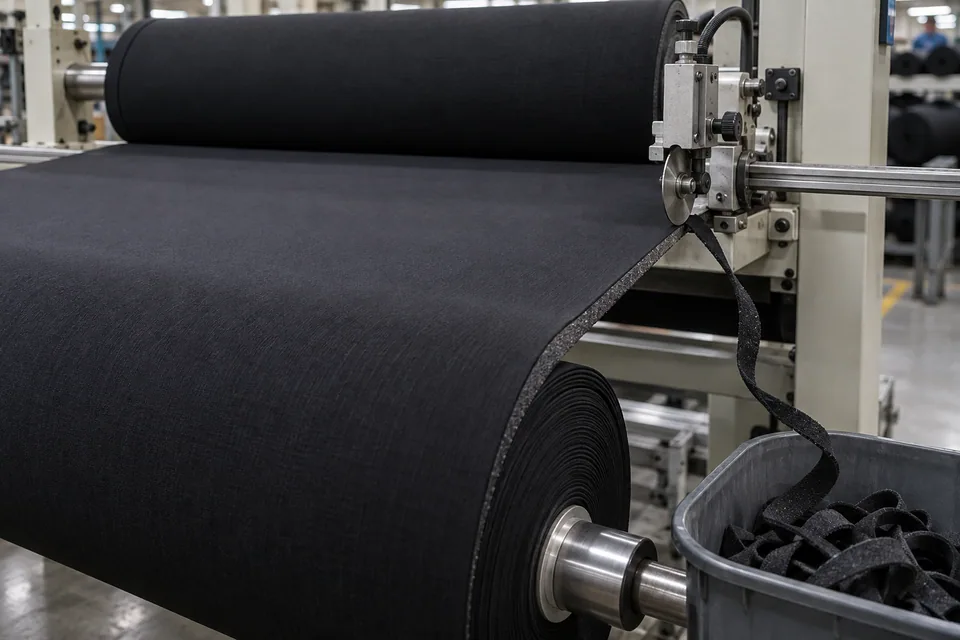
Manufacturers describe neoprene rubber laminated to jersey, polyester or other textile facings in sheet and roll supply. White Cross lists coated textile rolls and slit strips, showing that longitudinal edge conversion is realistic for suitable continuous grades. Edge trimming in this guide removes only a narrow irregular border from a supplied web or sheet before panel nesting. It is different from splitting foam thickness and from making multiple daughter rolls across a mother web. The buyer must specify the trim allowance and final usable width.
Updated
Where This Cutting Application Appears
Identify the edge defect and protected width
Inspect the source selvage for irregular textile overhang, exposed rubber or lamination offset. Establish the retained datum and approved width before setting any trim line. If a material has a functional selvage or printed registration, do not discard it merely for appearance. Set the minimum edge waste needed to remove the defect while leaving room for the buyer’s downstream pattern.
Support the laminate through the trim
Keep fabric face and elastomer aligned while the narrow waste is cut. An elastic jersey may stretch more than a woven reinforcement; excessive hold-down can shift the edge once released. If the feed is a roll, compare tension before and after the trim; if it is a sheet, hold it flat without forcing the foam to compress.
Inspect retained edge and offcut
Check whether the retained fabric is flush with the rubber or delaminates at the new border. Examine narrow waste for uncut yarn bridges and rubber crumb generation. Measure usable width at several points after relaxation, not only while the substrate is under tension. A neat visual line is insufficient if the bonded interface begins to peel when flexed.
Protect later cutting yield
Record new web or sheet width and mark face orientation for the next cutter. Separate damaged sections rather than repeatedly shaving the edge to chase irregularities. The protective item maker remains responsible for final shape, seam strength and end-use performance.
Agree a stop point for edge defects
Record incoming selvage photos at several roll locations, then map the narrow proposed trim. If the defect wanders farther into the laminate than the released allowance, stop and seek material disposition instead of following it with an increasingly wide cut. Compare the retained edge after a simple flex trial approved by the buyer. A boundary that stays flush while flat but peels during handling can compromise the next pattern-cutting stage. Record that decision against the parent material lot to preserve yield and rework history.
Define the Required Cut Result
- Remove an approved narrow selvage or damaged margin.
- Retain bonded fabric-rubber interface.
- Set reliable usable width after elastic recovery.
- Avoid wasting good laminate outside the trim allowance.
Problems to Diagnose Before Changing the Knife
Trim waste tears into short pieces
- Check margin width and blade support.
- Review waste take-away direction.
- Inspect high-stretch jersey facing.
Retained edge curls or peels
- Compare clamped and relaxed state.
- Check bond quality before cutting.
- Reduce local compression if approved.
Trim line follows a wandering defect too far inward
- Compare incoming edge map with allowance.
- Check guide reference.
- Stop when useful width is threatened.
Knife Forms That May Be Considered
| Possible knife form | When it may be considered | What must be confirmed |
|---|---|---|
| Guided edge-trim shear | For a continuous supported roll edge. | Check layer alignment and narrow-waste capture. |
| Straight edge blade | For sheet-fed trimming on flat support. | Verify usable width and no foam crushing. |
Information to Send for Technical Review
You do not need to know the exact blade name. Send the available workpiece, machine, current-knife and cut-result information so the application can be reviewed against a drawing or sample.
- Actual sheet or roll delivery form
- Laminate grade, face textile and thickness
- Approved edge allowance and final usable width
- Lamination bond and edge-flush criteria
- Relaxation and measurement procedure
Questions About This Cutting Application
Does edge trimming create multiple strips?
No. It removes a narrow border while retaining the main sheet or web.
Can a functional selvage be removed automatically?
Only when the buyer’s drawing authorizes that loss.
Why inspect after the material relaxes?
Neoprene and stretch textiles can recover from cutting tension.
Does a trimmed edge prove seam durability?
No. Later joining must be tested on the specified product.
Can trimming repair a weak laminate bond?
No. Pre-existing delamination needs buyer material disposition.
Public references and scope
These public sources provide material, cutting-method or safety context for this guide. Supplier pages describe their own materials or equipment; they do not establish a MEIRENTE blade specification or performance claim. Confirm the actual grade, machine setup and required cut with a drawing or sample.
Related product and service information
- Neoprene-Laminated Textile Roll Slitting Blades - neoprene-laminated textile · roll slitting
- Para-Aramid Prepreg Fabric Cross-Cutting Blades - para-aramid prepreg fabric · transverse cutting
- Ballistic UHMWPE Fabric Cross-Cutting Blades - ballistic UHMWPE fabric · transverse cutting
Request a Custom Cutting-Knife Review
Send the workpiece details, machine or holder information, current knife photos or sample, required quantity and examples of the present cut problem. Final dimensions, material, edge geometry and tolerances are confirmed from the approved requirements.