
Blade Application Guides / Application Guide / Protective textile converting
Para-Aramid Prepreg Fabric Cross-Cutting Blades
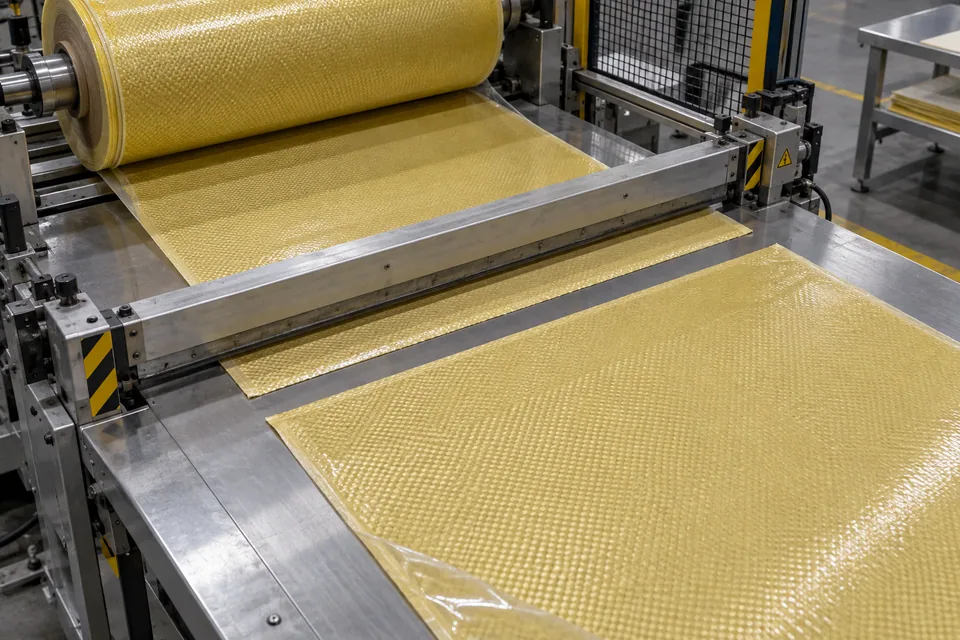
Arclin identifies Kevlar as a para-aramid fiber, while Axiom describes Kevlar-type fibers in woven aramid prepregs. TCR Composites lists woven aramid prepreg broadgoods, and Eastman lists cutting equipment for aramid composites in prepreg form, including straight end cutting. Together these primary sources support a candidate across-width cutoff of supplier-confirmed para-aramid prepreg fabric; TCR’s generic aramid listing alone does not establish the exact fiber chemistry. This guide treats transverse cutting as a straight cut across the feed direction to create length-controlled sheets for later ply nesting. It does not claim that one cut defines a finished protective-part outline or that every prepreg grade is approved for the same end use.
Updated
Where This Cutting Application Appears
Define the sheet length from the ply plan
Take the cut length from the nesting schedule, including any buyer-approved handling allowance. Mark the incoming weave orientation and the side carrying release film or paper. A transverse cut changes roll material into manageable sheets; final angled or curved plies require a separate contour operation. Label each sheet so downstream personnel do not rotate the warp and fill directions by mistake.
Stage the tacky construction
Confirm whether the supplied prepreg has one liner, two liners or exposed resin. Support the fabric across its width and keep the end-cutter path clear of folds. Trial the cut at the supplier-approved conditioning state and within the buyer’s material-control procedure; tack, stiffness and liner release can change with handling. Do not add an unsupported out-time or temperature value.
Examine the transverse edge
Inspect both sheet edge and remaining roll edge for aramid fuzz, incomplete yarn severance, resin smear and liner drag. A knife that passes through resin but leaves bridging fibers will distort the sheet when lifted. Compare several positions across the width, including selvages and the center where support pressure may differ.
Transfer without stretching the weave
Lift or convey the sheet using its liner and approved support surface. Measure the cut length only after the sheet lies flat, and compare squareness to the buyer’s datum. Record visible weave skew and edge condition before stacking. The fabric maker or laminate owner must approve any downstream cure and mechanical-performance requirements.
Make the cutoff trial measurable
Run successive sheets from the same roll location and compare both ends, not only the first acceptable sample. Record cut length after flattening, yarn tails by edge zone, liner separation and any resin transfer to the tool. Include a sheet that will be used for a downstream ply trial to see whether its cutoff edge affects nesting. If fiber bridges require tearing during lift, the operation has not produced a clean cross cut.
Define the Required Cut Result
- Create length-controlled aramid prepreg sheets from broadgoods.
- Sever tough yarns without pulling the weave.
- Keep release liner and resin surface intact.
- Preserve orientation and material-control records.
Problems to Diagnose Before Changing the Knife
Yarn bridges across the cut
- Check edge sharpness and cutting support.
- Inspect fiber versus liner separation across width.
- Review tool traverse and hold-down.
Sheet edge becomes skewed
- Check feed alignment and differential web tension.
- Measure from a consistent datum.
- Review handling after release.
Knife Forms That May Be Considered
| Possible knife form | When it may be considered | What must be confirmed |
|---|---|---|
| Guided transverse end cutter | For a straight across-width cutoff on supported broadgoods. | Verify complete fiber and liner separation at both selvages. |
| Straight-rule cut station | For low-volume sampled sheets under controlled handling. | Confirm squareness, resin pickup and cut-length repeatability. |
Information to Send for Technical Review
You do not need to know the exact blade name. Send the available workpiece, machine, current-knife and cut-result information so the application can be reviewed against a drawing or sample.
- Exact aramid/resin prepreg grade and weave
- Roll width, liner construction and supplied orientation
- Cut length and buyer handling allowance
- Material storage and exposure procedure
- Fuzz, smear and squareness acceptance criteria
Questions About This Cutting Application
Does the cutoff make a finished composite part?
No. It produces prepreg sheets for later ply cutting, stacking and buyer qualification.
Why test at the supplied handling state?
Tack and support conditions affect whether fibers pull or resin smears.
Can the release liner be ignored?
No. Its construction can change tool depth and edge pickup.
What records travel with the sheets?
The buyer may need grade, batch, orientation and material-control traceability.
Public references and scope
These public sources provide material, cutting-method or safety context for this guide. Supplier pages describe their own materials or equipment; they do not establish a MEIRENTE blade specification or performance claim. Confirm the actual grade, machine setup and required cut with a drawing or sample.
Related product and service information
- PTFE-Coated Fiberglass Cloth Cross-Cutting Blades - PTFE-coated fiberglass cloth · transverse cutting
- Ballistic UHMWPE Fabric Cross-Cutting Blades - ballistic UHMWPE fabric · transverse cutting
- Silicone-Coated Glass Fabric Cross-Cutting Blades - silicone-coated glass fabric · transverse cutting
Request a Custom Cutting-Knife Review
Send the workpiece details, machine or holder information, current knife photos or sample, required quantity and examples of the present cut problem. Final dimensions, material, edge geometry and tolerances are confirmed from the approved requirements.