
Blade Application Guides / Application Guide / Protective textile converting
Ballistic UHMWPE Fabric Cross-Cutting Blades
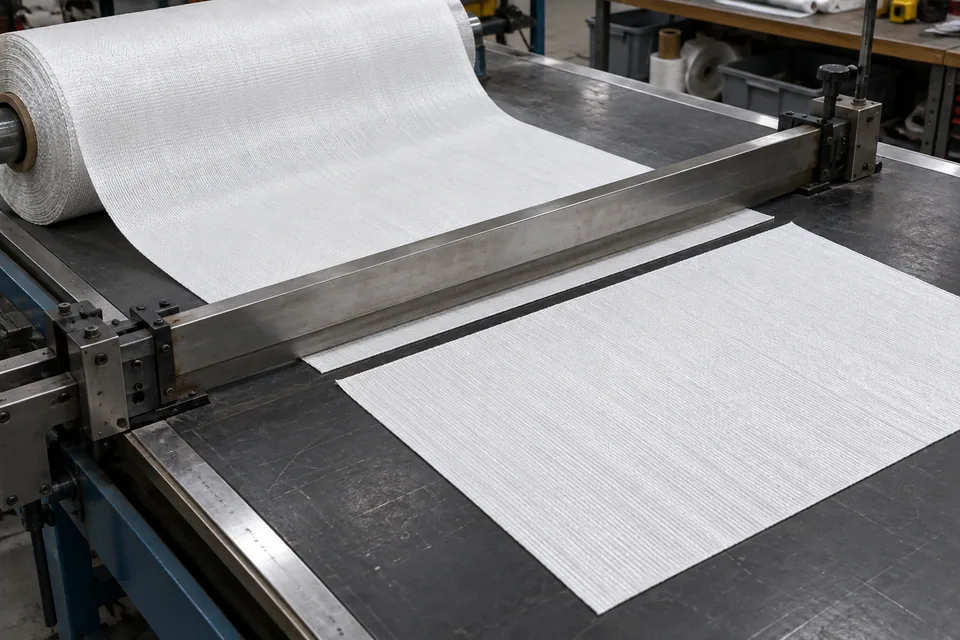
Dyneema identifies UHMWPE unidirectional composite material supplied as roll-form ingredients for soft and hard armor, and also describes UHMWPE woven or composite fabric variants. The term ballistic UHMWPE fabric therefore covers more than one architecture; this guide requires the buyer to specify UD sheet, woven fabric or another qualified roll material. Transverse cutting makes length-controlled blanks across feed direction before armor plies are nested and stacked. It neither sets the final vest shape nor demonstrates ballistic resistance.
Updated
Where This Cutting Application Appears
Select the actual reinforcement architecture
Read the material designation before designing a cutoff. A unidirectional composite can have bonded layers and a specified fiber axis; a woven cloth has warp and fill. Mark the direction that the armor layup drawing uses as its datum. Determine whether a release liner or carrier travels with the blank and whether sheet orientation must be marked on both faces.
Set a straight roll-to-sheet station
Support the full width so very strong fibers are severed instead of dragged into a loose tuft. Check the blade on a coupon from the exact material construction and avoid heat methods unless the supplier approves them. Align the transverse line square to the feed datum. Include only the handling allowance authorized by the armor-part cutter; excessive or arbitrary stock can make material accounting difficult.
Inspect for pulled fibers and layer shift
Review both the blank edge and remaining roll edge. Look for UHMWPE yarn tails, delamination of UD layers, film splitting and local distortion near the selvage. Measure length after the blank lies flat and compare the marked fiber axis with the requested orientation. If a liner remains, make sure it did not mask a partially severed lower layer.
Transfer to controlled armor layup
Label each blank with grade, batch and orientation, and prevent unapproved mixing of UD and woven constructions. The armor maker will cut final shapes, establish ply schedules and test the assembled protection system. A clean crosscut is a converting prerequisite only; it cannot establish an armor protection level.
Build an orientation-control trial
Cut several blanks while deliberately using the marking and stacking procedure planned for production. Ask a second operator to identify the fiber direction and correct face without consulting the master roll. If that cannot be done reliably, improve labeling before increasing output. Compare edge defects on cuts parallel and perpendicular to any reinforcement direction that the process may encounter. Keep coupons for the armor manufacturer’s material review without representing them as certified protective parts.
Define the Required Cut Result
- Create oriented UHMWPE reinforcement blanks from qualified roll stock.
- Sever high-strength yarns without pulling layers.
- Maintain fiber-axis and material-batch identity.
- Leave ballistic testing to the assembled design.
Problems to Diagnose Before Changing the Knife
Fibers bridge after blade passage
- Review edge sharpness and support.
- Inspect both faces and any liner.
- Check whether the material is UD or woven.
Blank loses layer registration
- Check feed and lift tension.
- Measure after flattening.
- Review carrier retention during cutoff.
Fiber orientation is lost in the blank stack
- Check both-face labeling.
- Review stacking and interleaf order.
- Verify the ply book before release.
Knife Forms That May Be Considered
| Possible knife form | When it may be considered | What must be confirmed |
|---|---|---|
| Guided transverse cutter | For supported roll-form UD or woven broadgoods. | Verify complete fiber severance and square blank. |
| Straight-rule knife station | For controlled low-volume blank lengths. | Check operator handling does not skew reinforcement. |
Information to Send for Technical Review
You do not need to know the exact blade name. Send the available workpiece, machine, current-knife and cut-result information so the application can be reviewed against a drawing or sample.
- Exact UHMWPE product and UD/woven architecture
- Roll width, fiber-axis marking and liner
- Blank length and downstream ply plan
- Fiber-tail and layer-shift criteria
- Armor manufacturer traceability requirements
Questions About This Cutting Application
Is every UHMWPE fabric a woven cloth?
No. Ballistic ingredients often include UD composite sheets as well as woven constructions.
Does the cutoff set the final armor outline?
No. It creates manageable blanks for later nesting and ply cutting.
Why mark the fiber axis?
Ply orientation is defined by the armor layup design.
Can a clean edge prove a protection rating?
No. Only the finished assembly’s approved tests can do that.
Are UD and woven UHMWPE equivalent?
No. The armor owner must name the qualified reinforcement architecture.
Public references and scope
These public sources provide material, cutting-method or safety context for this guide. Supplier pages describe their own materials or equipment; they do not establish a MEIRENTE blade specification or performance claim. Confirm the actual grade, machine setup and required cut with a drawing or sample.
Related product and service information
- Neoprene-Laminated Textile Edge-Trimming Blades - neoprene-laminated textile · edge trimming
- Para-Aramid Prepreg Fabric Cross-Cutting Blades - para-aramid prepreg fabric · transverse cutting
- PTFE-Coated Fiberglass Cloth Cross-Cutting Blades - PTFE-coated fiberglass cloth · transverse cutting
Request a Custom Cutting-Knife Review
Send the workpiece details, machine or holder information, current knife photos or sample, required quantity and examples of the present cut problem. Final dimensions, material, edge geometry and tolerances are confirmed from the approved requirements.