
Blade Application Guides / Application Guide / Protective textile converting
Neoprene-Laminated Textile Roll Slitting Blades
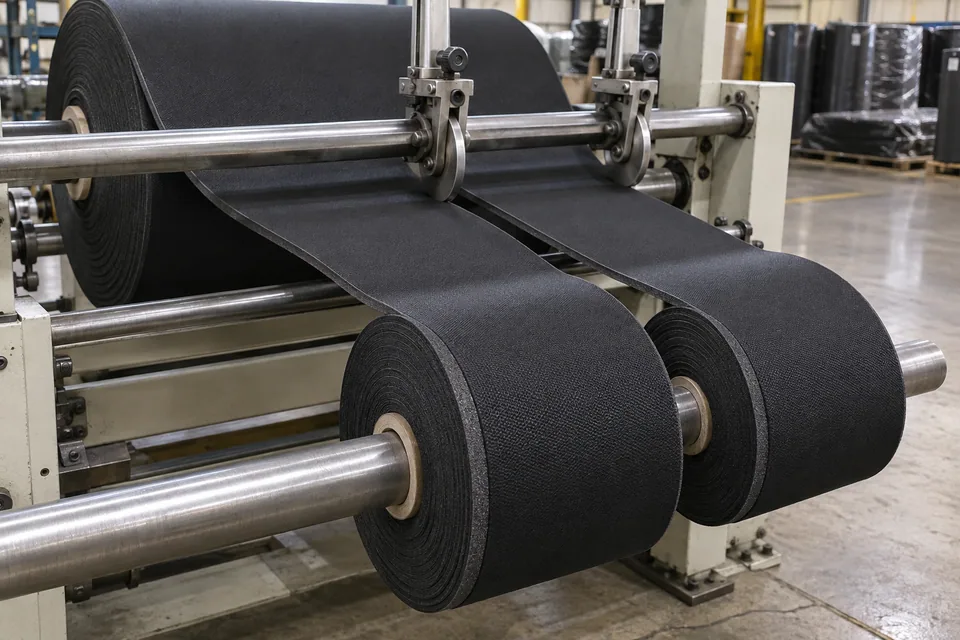
Neopreneturk and Yiheng describe neoprene sheets laminated with facing fabrics and supplied in roll forms; White Cross lists neoprene-coated textile rolls and slit strips. These primary sources support a continuous textile-rubber web when the buyer actually supplies a windable grade. Roll slitting here means unwinding that laminate, dividing it longitudinally and rewinding usable narrow strips. It does not mean splitting foam thickness or sawing through a wound log. Thick sheet-only grades should be routed to sheet cutting instead.
Updated
Where This Cutting Application Appears
Confirm a windable laminate
Obtain core diameter, roll width, thickness range and face construction from the supplied grade. A jersey-faced elastomer may stretch and recover differently from a woven or loop-facing version. Map the long-strip widths for braces, protective covers or other buyer-defined parts; avoid attaching an unsupported ballistic claim to neoprene itself. If the material is only delivered as individual sheets, abandon the roll slitting setup.
Choose support around the elastic web
Set the unwind and rewind path to avoid pulling the fabric face away from the rubber layer. Trial winding tension, nip contact and cutter support on the actual laminate. A thin flexible roll may tolerate web slitting, while a thick foam-faced grade may compress at a rotary nip and open with a tapered edge. Compare slit samples before choosing shear, crush or another approved blade form.
Inspect textile and rubber at the same edge
Check both daughter lanes for yarn fuzz, rubber crumbs, interface peel and varying strip width. Inspect the edge after the web relaxes as well as immediately at the knives; elastic recovery can hide an uneven cut under tension. Measure at several roll positions, including near the splice if the buyer permits splices.
Rewind for the next converter
Wind each strip without edge telescoping or blocking, label rubber and fabric faces, and protect the textile from compression marks. A clean slit is an intermediate material condition. The finished protective or sports item still depends on downstream pattern cutting, joining and its own performance checks.
Test winding and unwinding of the new strip
Make enough slit length to form a real daughter roll, not just a handful of loose coupons. Unwind a sample after storage in the buyer’s normal condition and inspect whether the rubber surfaces block, the textile face creases, or the laminate separates at the edge. Measure recovered width after the same relaxation period used for acceptance. If the narrow strip will be pattern cut, trial one piece so the roll route is evaluated through its next conversion step.
Define the Required Cut Result
- Make long narrow lanes from an approved windable laminate.
- Avoid stretching textile or crushing neoprene foam.
- Keep bonded layers together at slit edges.
- Deliver stable labeled daughter rolls.
Problems to Diagnose Before Changing the Knife
Textile face peels from rubber at edge
- Check slitter compression and laminate bond quality.
- Inspect cut orientation and web tension.
- Compare fresh and aged roll areas.
Strip width changes after rewind
- Measure after relaxation.
- Review elastic stretch through nips.
- Check core alignment and winding pressure.
Narrow strip blocks or creases in storage
- Inspect rewind pressure and face orientation.
- Compare immediate and stored rolls.
- Check the supplied laminate grade.
Knife Forms That May Be Considered
| Possible knife form | When it may be considered | What must be confirmed |
|---|---|---|
| Rotary shear slitting pair | For flexible roll grades that pass edge trials. | Check layer alignment, crumbs and recovered width. |
| Supported straight web blade | For a thinner grade where shear compression is excessive. | Confirm complete textile and rubber severance. |
Information to Send for Technical Review
You do not need to know the exact blade name. Send the available workpiece, machine, current-knife and cut-result information so the application can be reviewed against a drawing or sample.
- Neoprene grade and one- or two-sided textile facing
- Roll dimensions and allowable winding tension
- Strip width map and end use
- Bond, edge-fuzz and crumb criteria
- Recovery-time measurement rule
Questions About This Cutting Application
Is roll slitting the same as splitting neoprene thickness?
No. It divides the web into long strips across its width.
Can every neoprene sheet go through a slitter?
No. Only an actual windable roll grade should be trialed.
Why measure after relaxation?
Elastic recovery can change apparent strip width.
Does a slit strip become protective equipment?
No. Final patterning and performance validation remain downstream.
When should a sheet-only grade be excluded?
If it cannot be fed and rewound as a stable web, use a sheet route.
Public references and scope
These public sources provide material, cutting-method or safety context for this guide. Supplier pages describe their own materials or equipment; they do not establish a MEIRENTE blade specification or performance claim. Confirm the actual grade, machine setup and required cut with a drawing or sample.
Related product and service information
- Para-Aramid Prepreg Fabric Cross-Cutting Blades - para-aramid prepreg fabric · transverse cutting
- Neoprene-Laminated Textile Edge-Trimming Blades - neoprene-laminated textile · edge trimming
- Ballistic UHMWPE Fabric Cross-Cutting Blades - ballistic UHMWPE fabric · transverse cutting
Request a Custom Cutting-Knife Review
Send the workpiece details, machine or holder information, current knife photos or sample, required quantity and examples of the present cut problem. Final dimensions, material, edge geometry and tolerances are confirmed from the approved requirements.