
Blade Application Guides / Application Guide / Flexible packaging
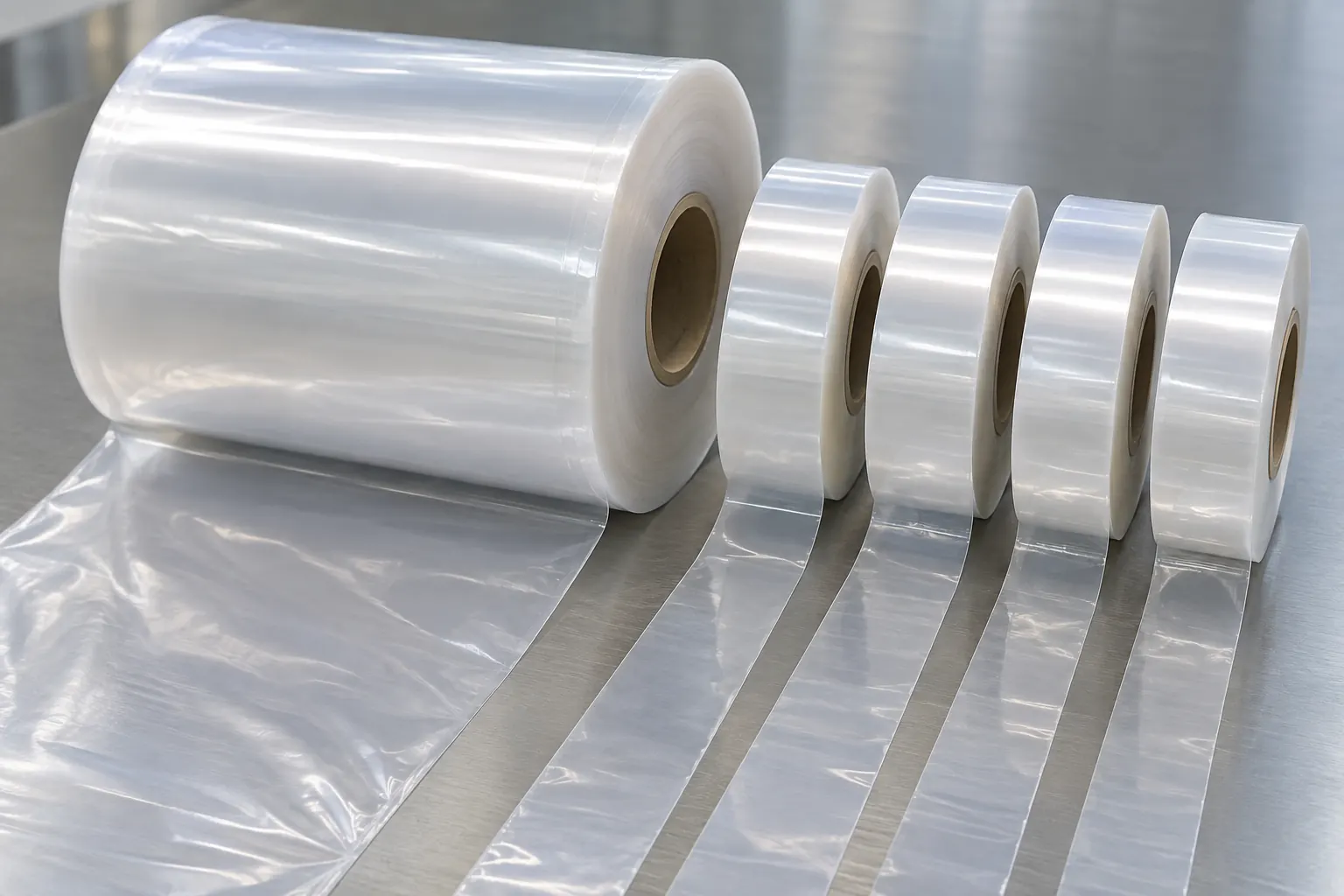
Mono-Material PE Pouch Film Roll Slitting
Mono-material PE pouch structures may combine oriented, printed, barrier-coated and sealant polyethylene layers while remaining mechanically softer and more extensible than PET-based laminates. Slitting should therefore be reviewed through the actual layer stack, gauge profile, tension history, sealant tack and the reel behavior required by the pouch line.
Updated
Where This Cutting Application Appears
Premade pouch stock
Slit printed all-PE master rolls into reels matched to pouch forming and sealing widths.
Form-fill-seal web preparation
Prepare stable narrow webs for continuous packaging where edge quality affects tracking and seals.
Barrier-coated PE conversion
Width-convert coated polyethylene structures while monitoring coating and sealant-layer integrity.
Roll Slitting process boundary
Roll slitting divides a master roll longitudinally into narrower rolls; it does not separate the web transversely into sheets or fixed lengths.
Roll Slitting setup checkpoint
Confirm unwind and rewind tension, slit widths, knife positions, core alignment, trim removal and the winding behavior of every daughter roll.
Roll Slitting acceptance checkpoint
Inspect roll width, edge condition, telescoping, interleaving, debris and whether each rewound roll remains stable at the required diameter.
Define the Required Cut Result
- Maintain slit width without stretching the soft web.
- Produce flat reel edges with minimal lip, curl or neck-in.
- Limit gels, strings and loose edge fragments.
- Deliver winding quality suitable for printing, sealing and pouch forming.
Problems to Diagnose Before Changing the Knife
Slit edge curls or forms a raised lip
- Measure layer asymmetry and gauge profile.
- Compare tension and winding direction.
- Inspect edge deformation immediately and after relaxation.
Web necks in and finished width varies
- Record tension by zone and actual speed.
- Check temperature and draw between rolls.
- Measure width under controlled relaxation.
Sealant layer strings at the edge
- Identify resin, additives and surface tack.
- Compare material temperature and edge support.
- Inspect contamination or local buildup.
Reel blocks or telescopes after slitting
- Review winding tension and lay-on conditions.
- Check slip additives, storage heat and roll hardness.
- Separate cut-edge effects from winding instability.
Knife Forms That May Be Considered
| Possible knife form | When it may be considered | What must be confirmed |
|---|---|---|
| Circular shear slitting arrangement | For controlled separation where paired rotating edges and web support are available. | Confirm shaft interface, overlap, side load, rotation, web path and approved sample. |
| Razor slitting arrangement | For compatible thin PE webs on equipment designed for supported or in-air razor slitting. | Confirm film stack, support mode, blade holder, exposure, speed and safety requirements from the line. |
Information to Send for Technical Review
You do not need to know the exact blade name. Send the available workpiece, machine, current-knife and cut-result information so the application can be reviewed against a drawing or sample.
- Complete PE layer stack, orientation, coatings and nominal gauge
- Gauge profile and widthwise thickness variation
- Master-roll dimensions, core, winding direction and roll hardness
- Required slit widths, tolerance and edge acceptance samples
- Line speed and tension ranges for unwind, slit and rewind zones
- Web temperature, static control, additives and blocking tendency
- Existing slitting mode, holder interface and used component sample
- Downstream printing, sealing or pouch-machine requirements and order volume
Questions About This Cutting Application
Why does all-PE film stretch during slitting?
Low modulus, web temperature and excessive tension or draw can elongate the structure. Width should be checked after a defined relaxation period.
Can a PET-laminate setup be copied?
Not safely by assumption. An all-PE structure can respond differently in tension, heat, friction and winding.
What causes a raised slit edge?
Possible contributors include gauge profile, asymmetric layers, local compression, tension and edge deformation.
Should the sealant layer be identified?
Yes. Resin type, tack, additives and orientation can affect stringing, buildup and blocking.
What samples are most useful?
Provide the uncut roll, accepted and rejected slit reels, relaxed-width measurements and samples after the pouch process.
Related product and service information
- Mono-Material PE Pouch Film Edge Trimming - mono-material PE pouch film · width edge trimming
- EVOH Barrier Film Laminate Roll Slitting Blades: Layer and Barrier Integrity - EVOH barrier film laminate · roll slitting
- Nylon Retort Pouch Film Roll Slitting Blades: Tough-Layer Edge Control - nylon retort pouch film · roll slitting
Request a Custom Cutting-Knife Review
Send the workpiece details, machine or holder information, current knife photos or sample, required quantity and examples of the present cut problem. Final dimensions, material, edge geometry and tolerances are confirmed from the approved requirements.