
Blade Application Guides / Application Guide / Multilayer ceramic capacitor material manufacturing
MLCC PET Release Film Slitting Blades
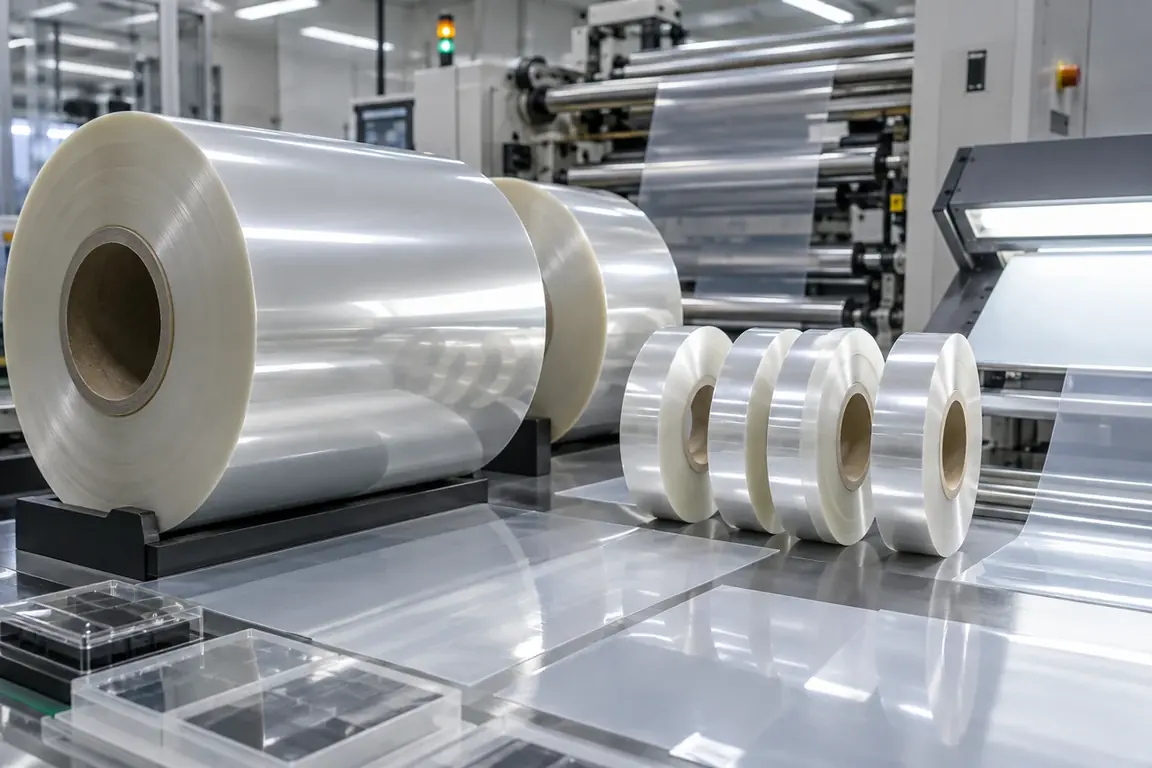
MLCC PET release film slitting blades convert high-smoothness carrier film into widths used for ceramic slurry coating and multilayer capacitor production. This topic concerns the release film, not the ceramic green tape cut later in the process. Because surface defects, particles and winding marks can transfer into sensitive downstream layers, the review should define the release side, cleanliness method, web path, width plan, edge acceptance and finished-roll handling.
Updated
Where This Cutting Application Appears
Release-film master-roll conversion
Wide PET release film is slit into process widths for later ceramic-layer coating operations.
Coating-line roll preparation
Finished rolls are wound with the required release-surface orientation for the customer's downstream line.
Outside-edge trimming
Damaged or irregular master-roll edges are removed before usable lanes are separated and rewound.
Precision Web Slitting And Clean Rewinding process boundary
Precision web slitting and clean rewinding for High-smoothness PET release film for MLCC production is a linked sequence: the output condition and datum from each operation become the controlled input for the next. It should not be evaluated as one generic cut or accepted only by the final dimension.
Precision Web Slitting And Clean Rewinding setup checkpoint
For High-smoothness PET release film for MLCC production, define the operation order, intermediate dimensions, registration transfer, material support, web or part handling and waste route for every stage of Precision web slitting and clean rewinding.
Precision Web Slitting And Clean Rewinding acceptance checkpoint
Verify both intermediate and final results from Precision web slitting and clean rewinding, including dimensions, registration, edge or feature quality, material damage, waste separation and stable transfer between stages.
Define the Required Cut Result
- Clean continuous film edges with controlled particles and no attached strands.
- Protected release surfaces without avoidable scratches, pressure marks or transferred debris.
- Stable lane width and web tracking across the approved roll-conversion plan.
- Uniform finished rolls with aligned faces and preserved surface orientation.
Problems to Diagnose Before Changing the Knife
Edge particles transfer onto the release surface
- Determine whether particles originate at the slit edge, guide contact or rewind area.
- Inspect the release surface and roll face using the customer's approved method.
- Compare cleaning intervals with material condition and observed edge quality.
Release surface is scratched or pressure-marked
- Identify the functional side and every contact point along the web path.
- Record where marks first appear from unwind through finished-roll handling.
- Compare accepted and rejected lanes from the same master roll.
Thin film wrinkles or wanders during slitting
- Confirm whether wrinkles enter the cutting station or begin after lane separation.
- Review unwind alignment, roller contact and support around the cut.
- Compare lane behavior during stable running, start-up and stopping.
Finished rolls telescope or show uneven faces
- Compare individual rewind positions and finished lane widths.
- Inspect roll faces and selected unwound sections after normal handling.
- Review lane separation, rewind alignment and packaging support together.
Knife Forms That May Be Considered
| Possible knife form | When it may be considered | What must be confirmed |
|---|---|---|
| Machine-matched rotary slitting arrangement | For continuous precision conversion of PET release-film master rolls. | Film grade, holder interface, web support, lane plan, rewind layout and accepted edge result. |
| Supported thin-film slitting arrangement | When the release film requires controlled support and limited functional-side contact through separation. | Film orientation, support position, contact restrictions, web path and finished-roll inspection. |
| Clean edge-trim arrangement | When outside roll edges are removed before process-width lanes are rewound. | Trim width, waste collection, usable-web reference, release side and downstream roll handling. |
Information to Send for Technical Review
You do not need to know the exact blade name. Send the available workpiece, machine, current-knife and cut-result information so the application can be reviewed against a drawing or sample.
- MLCC release-film product description and representative master-roll material.
- Release-side identification, film orientation and supplier handling information.
- Master-roll format, finished widths, lane count and edge-trim plan.
- Machine slitting position, holder interface, web path and rewind arrangement.
- Photographs of accepted and rejected edges, surfaces and finished roll faces.
- Examples of particles, scratches, wrinkles, width variation or telescoping.
- Customer cleanliness, inspection, storage and packaging requirements.
- Trial quantity, production pattern and current tooling details if available.
Questions About This Cutting Application
How is MLCC PET release film different from ceramic green tape?
The PET film is a process carrier and release surface used during ceramic-layer preparation; it is not the ceramic layer itself.
Why must the release side be identified before a trial?
Surface orientation determines permitted contact, winding direction and how scratches or particles should be inspected.
Can edge quality be judged from the finished roll face alone?
Not always. Inspect close edge views and selected unwound sections for particles, strands and surface transfer.
What should be compared across slit lanes?
Compare width, edge particles, surface condition, tracking and rewind quality at marked lane positions.
Should unknown release-coating details be estimated?
No. Record them as unconfirmed and rely on product identification, samples and customer inspection requirements.
Related product and service information
- Semiconductor Die-Attach Film Slitting Blades - Semiconductor die-attach adhesive film laminate · Liner-supported roll slitting and edge trimming
- Semiconductor Wafer Backgrinding Tape Cutting Blades - Semiconductor wafer backgrinding protection tape · Wafer-contour cutting after tape lamination
- Semiconductor ABF Build-Up Film Slitting Blades - Semiconductor package substrate build-up dielectric film · Precision roll slitting and sheeting
Request a Custom Cutting-Knife Review
Send the workpiece details, machine or holder information, current knife photos or sample, required quantity and examples of the present cut problem. Final dimensions, material, edge geometry and tolerances are confirmed from the approved requirements.