
Blade Application Guides / Application Guide / Lithium metal battery manufacturing
Lithium Metal Anode Foil Punching Blades
Lithium metal anode foil punching blades prepare cut-to-length pieces, discs or controlled profiles from supplied lithium metal or lithium-alloy foil. Because the material can be soft, easily marked and subject to strict environmental handling rules, a blade review must use the actual foil condition, carrier arrangement, finished geometry, approved edge sample and customer-defined handling procedure rather than assumptions based on the battery type alone.
Updated
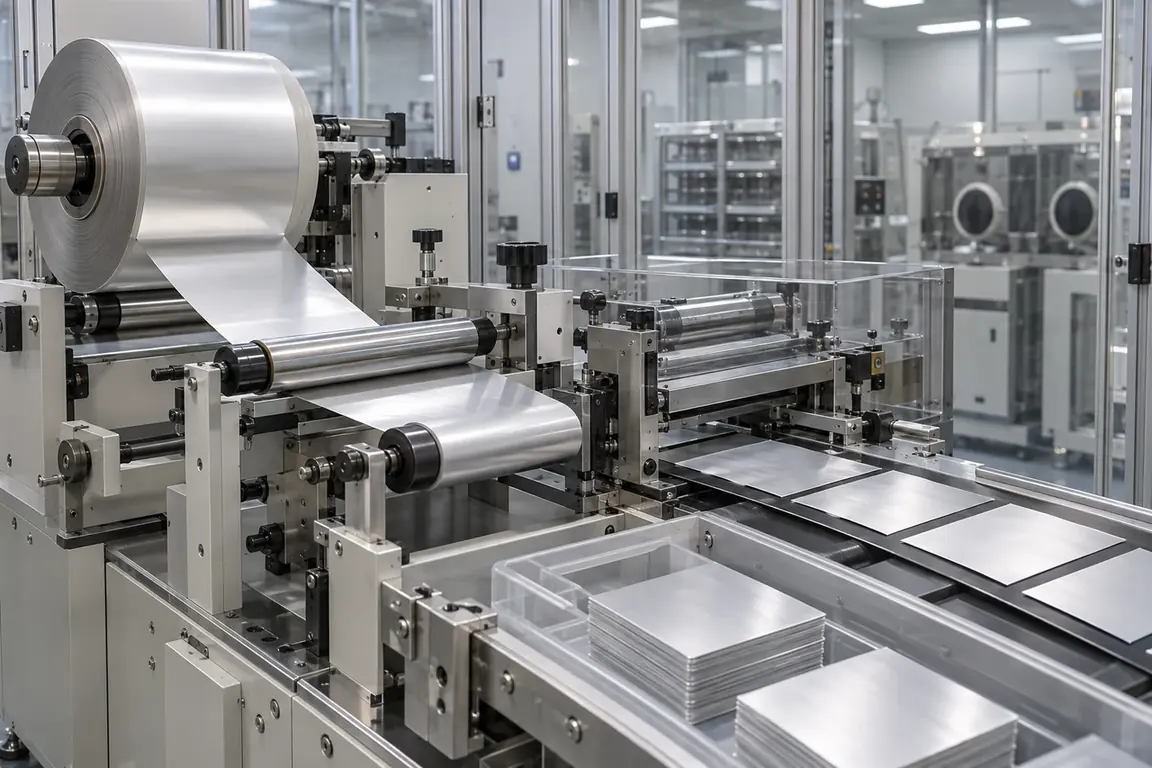
Where This Cutting Application Appears
Cut-to-length anode preparation
Roll or strip material is separated into controlled lengths for later handling, inspection or cell-component preparation.
Disc and profile blanking
Lithium foil is converted into round or non-rectangular anode blanks according to an approved component drawing.
Liner-supported foil conversion
Foil supplied with a carrier or interleaf is cut while the required post-cut relationship between layers is maintained.
Precision Blanking, Punching And Cut-To-Length process boundary
Precision blanking, punching and cut-to-length for Lithium metal foil for battery anodes is a linked sequence: the output condition and datum from each operation become the controlled input for the next. It should not be evaluated as one generic cut or accepted only by the final dimension.
Precision Blanking, Punching And Cut-To-Length setup checkpoint
For Lithium metal foil for battery anodes, define the operation order, intermediate dimensions, registration transfer, material support, web or part handling and waste route for every stage of Precision blanking, punching and cut-to-length.
Precision Blanking, Punching And Cut-To-Length acceptance checkpoint
Verify both intermediate and final results from Precision blanking, punching and cut-to-length, including dimensions, registration, edge or feature quality, material damage, waste separation and stable transfer between stages.
Define the Required Cut Result
- Complete foil separation without avoidable folding, smearing or edge rollover.
- Repeatable blank geometry matched to the controlled drawing or approved sample.
- Protected functional surfaces with handling and particle exposure kept within the customer's accepted method.
- Reliable part and waste release without dragging the finished lithium foil blank.
Problems to Diagnose Before Changing the Knife
Foil edge folds or smears during separation
- Confirm the supplied foil form, surface condition and any supporting layer.
- Inspect the defect direction relative to feed direction and tool movement.
- Review support immediately around the cut and the sequence used to release the blank.
Finished blank sticks to waste or tooling
- Record where adhesion begins and whether it occurs on the lithium surface, carrier or interleaf.
- Compare accepted and rejected parts using the same removal procedure.
- Review part ejection, waste clearance and collection without assuming an unconfirmed surface treatment.
Surface marks or foreign material appear after cutting
- Map every contact surface used during feeding, cutting, removal and packaging.
- Distinguish marks created at the cutting station from those introduced during later handling.
- Use the customer's inspection method to document the location and character of the condition.
Profile remains locally connected
- Identify the exact corner, transition or feed position where separation is incomplete.
- Check whether the condition repeats at the same location on successive blanks.
- Review material support, waste movement and machine action with representative production foil.
Knife Forms That May Be Considered
| Possible knife form | When it may be considered | What must be confirmed |
|---|---|---|
| Supported cut-to-length blade arrangement | For preparing rectangular foil pieces from a roll or strip before a separate profiling operation. | Foil format, support method, feed reference, finished length, contact restrictions and accepted edge sample. |
| Flat profile blanking arrangement | For sheet-fed or indexed material requiring a controlled disc or custom anode outline. | Controlled drawing, foil and carrier stack, profile layout, blank release, waste removal and inspection method. |
| Rotary profile cutting arrangement | For repeated profiles in continuously or intermittently fed foil when compatible with the customer's machine. | Repeat layout, web path, machine interface, support, transfer sequence and approved finished part. |
Information to Send for Technical Review
You do not need to know the exact blade name. Send the available workpiece, machine, current-knife and cut-result information so the application can be reviewed against a drawing or sample.
- Lithium foil or lithium-alloy product description and representative samples.
- Supplied roll, strip or sheet format and identification of both surfaces.
- Carrier, interleaf or protective-layer arrangement and intended post-cut state.
- Controlled finished-part drawing, datum and current revision.
- Machine station, feed direction, support and available tooling-interface information.
- Accepted and rejected edge samples photographed under the normal inspection method.
- Customer-defined environmental, contact, collection and packaging requirements.
- Trial quantity, production pattern and current cutting information if available.
Questions About This Cutting Application
Can lithium metal anode foil punching blades be selected from foil thickness alone?
No. The supplied foil condition, alloy or product identification, support, carrier stack, profile and accepted handling method must also be reviewed.
Should a carrier or interleaf be included in cutting trials?
Use the intended production stack and state clearly which layers must be cut, retained or removed after cutting.
What samples are useful for a first review?
Provide representative uncut material plus accepted and rejected blanks with orientation and both surfaces clearly identified.
Why must blank release be reviewed with the cutting result?
A fully separated blank can still be folded, marked or dragged during ejection and waste removal, making the finished part unusable.
Should unknown lithium foil properties be estimated?
No. Mark unknown information as unconfirmed and use customer documentation, actual samples and documented trials.
Related product and service information
- Lithium-Ion Battery Pouch Film Slitting Blades - Lithium-ion battery aluminum-plastic pouch laminate film · Roll slitting and edge trimming
- Fuel Cell Proton Exchange Membrane Slitting Blades - Fuel cell proton exchange membrane · Roll slitting
- Fuel Cell Gas Diffusion Layer Cutting Blades - Fuel cell gas diffusion layer · Sheet cutting and edge trimming
Request a Custom Cutting-Knife Review
Send the workpiece details, machine or holder information, current knife photos or sample, required quantity and examples of the present cut problem. Final dimensions, material, edge geometry and tolerances are confirmed from the approved requirements.