
Blade Application Guides / Application Guide / Paper converting
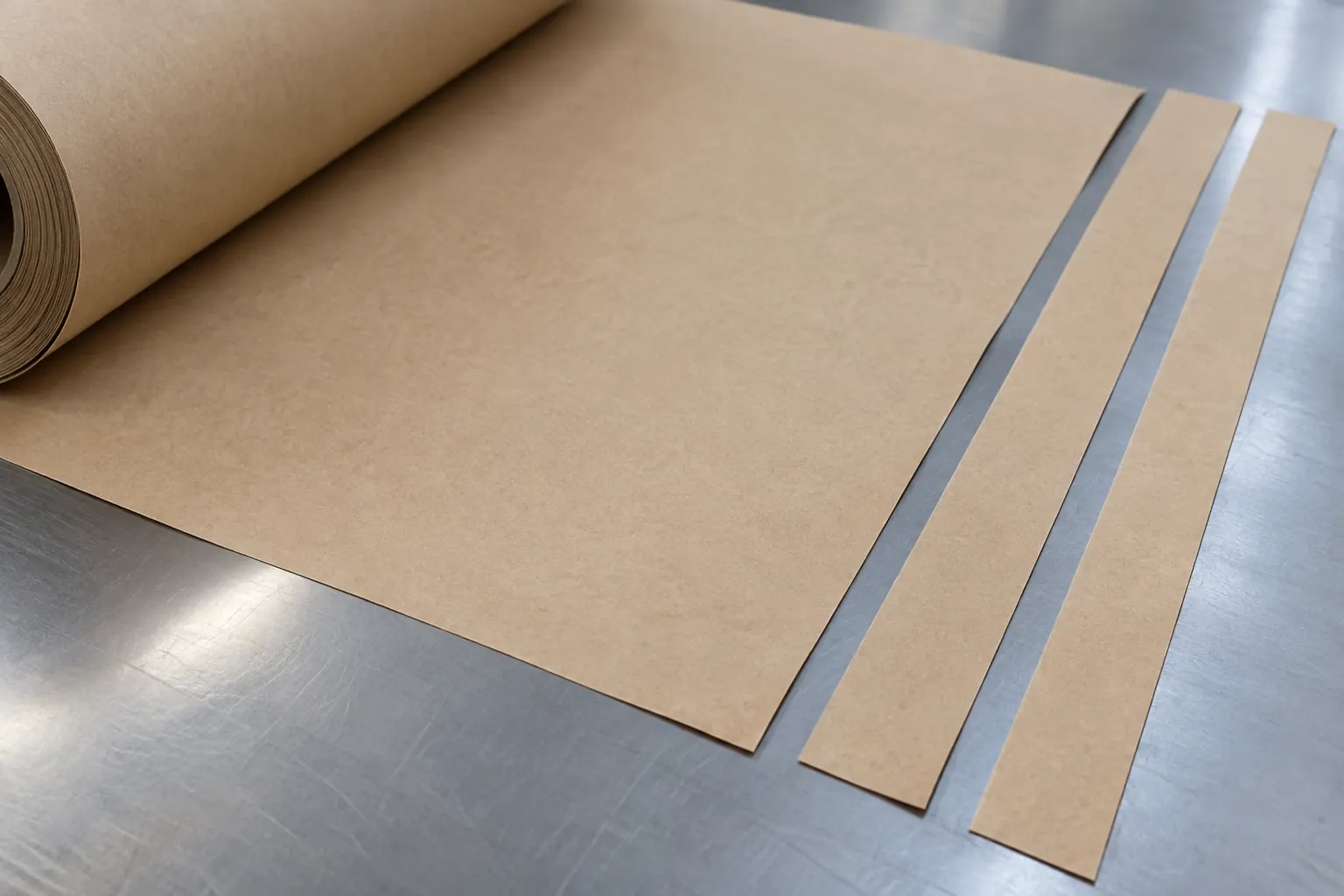
Kraft Interleaving Paper Edge Trimming: Smooth Protective Margins
A trimmed interleaving-paper edge may contact polished metal, glass or coated surfaces, so protruding fibers and trapped hard particles matter beyond simple appearance. Width correction and damaged-edge removal must be balanced against trim-strip strength, dust extraction and the paper's ability to track without wrinkles.
Updated
Where This Cutting Application Appears
Metal interleaf width matching
Kraft web is trimmed to cover metal coil or strip without projecting into guides or leaving the product exposed.
Damaged-roll edge recovery
Crushed, wet or contaminated outer margins are removed during rewinding to recover usable protective paper.
Protective-paper finishing
Deckle edges and uneven mill widths are corrected before rolls are supplied for glass, laminate or rubber separation.
Width Edge Trimming process boundary
Width edge trimming removes controlled side margins to establish parallel finished edges and final web width; it is not a transverse length cut.
Width Edge Trimming setup checkpoint
Define both finished edge positions, centerline control, side guidance, trim width and reliable removal of the two continuous edge strips.
Width Edge Trimming acceptance checkpoint
Measure finished width across the run and inspect parallelism, camber, burr or fray, surface damage and trim-break frequency.
Define the Required Cut Result
- Create smooth margins safe for contact with finished surfaces
- Maintain specified coverage width and parallel edges
- Remove damaged zones as continuous trim strips
- Control loose fibers and hard-particle contamination
Problems to Diagnose Before Changing the Knife
Trimmed edge remains hairy or uneven
Review furnish, moisture, edge damage depth, support, cutting contact, speed and whether the incoming edge is compressed.
Trim strip breaks at crushed roll sections
Map incoming damage, strip width, paper tensile strength, extraction tension and pickup geometry across the roll.
Finished edge scratches protected metal
Analyze loose fibers, embedded particles, edge folds, width alignment, winding hardness and contact pressure in use.
Web steers after one-sided trimming
Check asymmetric tension, trim width, incoming roll shape, edge-guide reference, web spreading and unwind alignment.
Knife Forms That May Be Considered
| Possible knife form | When it may be considered | What must be confirmed |
|---|---|---|
| Circular shear edge trimming | Consider for supported rotary trimming of kraft interleaf margins. | Confirm rotary dimensions, overlap, side load, rotation, holder and accepted edge through actual line data. |
| Supported stationary edge trimming | Consider only where equipment support, holder control and guarding suit a stationary cutting edge. | Confirm exposure, edge form, web path and safety requirements from the installed configuration. |
Information to Send for Technical Review
You do not need to know the exact blade name. Send the available workpiece, machine, current-knife and cut-result information so the application can be reviewed against a drawing or sample.
- Kraft furnish, basis weight, moisture and tensile direction
- Incoming edge damage, contamination and roll profile
- Original width, finished width and trim allowance per side
- Protected product, contact risk and edge-softness criterion
- Line speed, tension, web guiding and unwind configuration
- Trim extraction path, airflow and waste-handling method
- Current holders, support geometry and verified dimensions
- Failed trim strips, edge debris and marked-product evidence
Questions About This Cutting Application
Can trimming recover a crushed interleaving roll edge?
It may recover usable width if damage does not extend too far inward, but the remaining roll shape, tension and cleanliness must be checked.
Why can one-sided trimming make a web steer?
Asymmetric edge condition, tension, roll shape or removed width can change web balance. Guidance and spreading should be reviewed during the trial.
How is a surface-safe paper edge defined?
Agree limits for protruding fibers, hard particles, folds and width alignment, then test the paper against a representative protected surface.
Should contaminated edge waste be extracted separately?
That depends on the contamination and recycling plan. Identify the material and prevent loose debris from re-entering the usable web.
Can the required trim form be assumed from kraft paper?
No. Verify the installed motion, holder, support, paper grade, trim width, speed and accepted margin before specification.
Related product and service information
- Silicone Release Paper Roll Slitting: Clean Edges and Stable Reels - silicone release paper · roll slitting
- Glassine Liner Paper Edge Trimming: Straight Edges and Unbroken Trim - glassine liner paper · width edge trimming
- Clay-Coated Label Paper Edge Trimming: Clean Margins and Stable Width - clay-coated label paper · width edge trimming
Request a Custom Cutting-Knife Review
Send the workpiece details, machine or holder information, current knife photos or sample, required quantity and examples of the present cut problem. Final dimensions, material, edge geometry and tolerances are confirmed from the approved requirements.