
Blade Application Guides / Application Guide / Frozen french fry and potato processing
French Fry Potato Strip-Cutting Knives for Uniform Size
French fry potato strip-cutting knives divide peeled potatoes into repeated straight or formed strips for blanching, frying or freezing. Geometry depends on the complete cutting head, potato size and condition, feed orientation and downstream standard. Review should use the machine interface, approved sample, product drawing and defect distribution rather than treating the job as general vegetable chopping.
Updated
Where This Cutting Application Appears
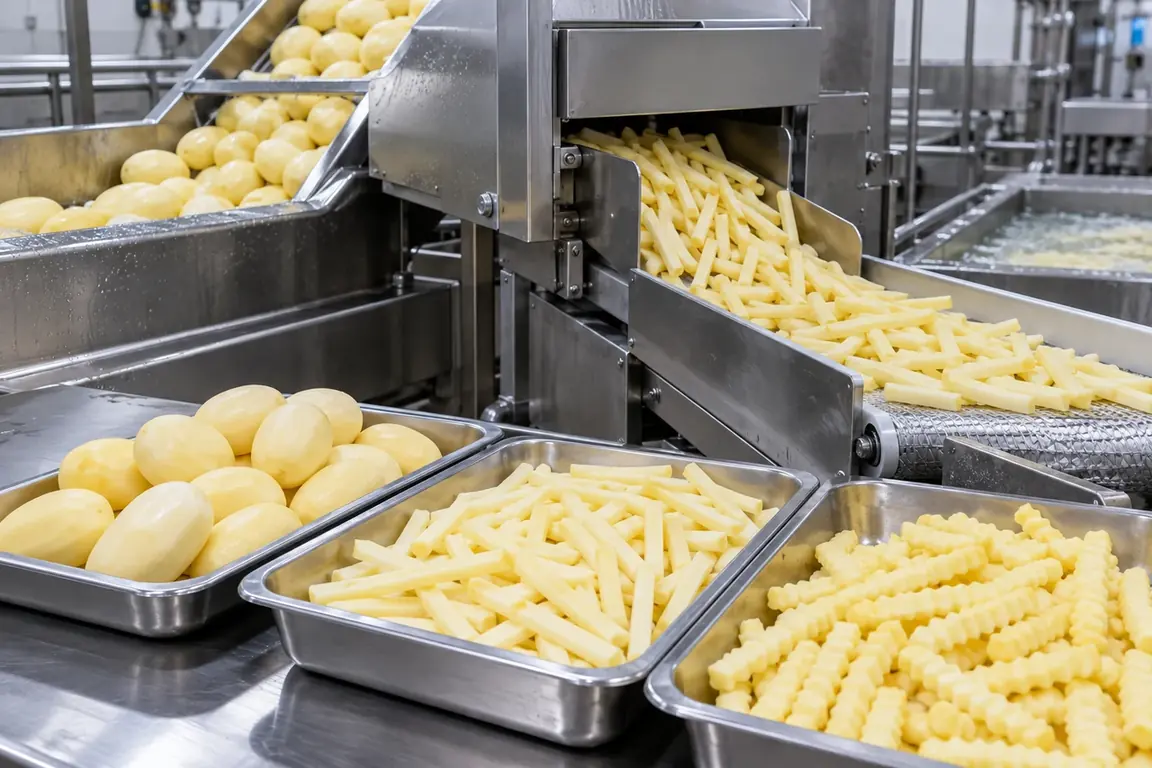
Straight-cut french fry production
Prepared potatoes are divided into controlled straight strips.
Crinkle and formed strip products
Profiled components create the approved surface form while preserving strip integrity.
Specialty potato strip preparation
Products are cut to controlled cross-sections and lengths before thermal processing.
High-Capacity Strip Cutting And Cross-Cutting process boundary
High-capacity strip cutting and cross-cutting for Peeled whole potatoes for french fry production is a linked sequence: the output condition and datum from each operation become the controlled input for the next. It should not be evaluated as one generic cut or accepted only by the final dimension.
High-Capacity Strip Cutting And Cross-Cutting setup checkpoint
For Peeled whole potatoes for french fry production, define the operation order, intermediate dimensions, registration transfer, material support, web or part handling and waste route for every stage of High-capacity strip cutting and cross-cutting.
High-Capacity Strip Cutting And Cross-Cutting acceptance checkpoint
Verify both intermediate and final results from High-capacity strip cutting and cross-cutting, including dimensions, registration, edge or feature quality, material damage, waste separation and stable transfer between stages.
Define the Required Cut Result
- Consistent cross-section and length distribution to the approved standard.
- Clean surfaces with limited feathering, cracking and short pieces.
- Stable flow through the cutting head without repeated blockage.
- Food-contact condition, cleanability and fit matched to the line.
Problems to Diagnose Before Changing the Knife
Strip dimensions vary across the cutting head
- Map dimensions to cutting-head position.
- Confirm potato size, orientation and feed condition.
- Inspect spacing, support and assembly from the approved drawing.
Potato surfaces feather or split
- Record variety, solids condition, temperature and holding time.
- Compare defect direction with each cutting stage.
- Inspect edges, support and product acceleration.
Too many short pieces or broken strips
- Separate cutting breakage from conveying damage.
- Review input size and length classification.
- Use the same sampling procedure for accepted and rejected runs.
Starch buildup restricts the cutting head
- Identify buildup location and cleaning interval.
- Review preparation, water management and sanitation.
- Inspect narrow passages and component alignment.
Knife Forms That May Be Considered
| Possible knife form | When it may be considered | What must be confirmed |
|---|---|---|
| Straight strip-cutting knife grid arrangement | For equipment dividing potatoes into repeated straight sections. | OEM head drawing, strip geometry, sequence, supports, mounting and sample. |
| Profiled crinkle strip-cutting arrangement | For products requiring a formed rather than straight surface. | Profile drawing, phase relationship, head interface, direction and inspection. |
| Coordinated slicing and cross-cut knife set | When cross-section and length are made in synchronized stages. | Machine sequence, first-stage product, timing, interfaces and length distribution. |
Information to Send for Technical Review
You do not need to know the exact blade name. Send the available workpiece, machine, current-knife and cut-result information so the application can be reviewed against a drawing or sample.
- Potato variety, preparation, size range and process temperature.
- Finished strip drawing or approved product samples.
- Cut-size and length-distribution inspection method.
- Machine model and complete cutting-head drawing.
- Existing knives, spacers, supports and mounting.
- Feed orientation, throughput context and preparation sequence.
- Accepted and rejected product showing defects.
- Food-contact, sanitation, traceability and trial requirements.
Questions About This Cutting Application
Why is potato variety relevant?
Structure and solids condition can change breakage and surface quality.
Can one knife determine the complete fry size?
Often no; geometry may depend on a coordinated head and multiple stages.
How should uneven size be investigated?
Map measurements to head position and review input, spacing, support and assembly.
What samples help with short pieces?
Provide product immediately after cutting and after conveying to locate breakage.
Can desired fry width specify the replacement knife?
No; OEM interface, head geometry, product standard and food requirements are needed.
Related product and service information
- Cheese Block and Log Slicing - cheese blocks and logs · slicing and portioning
- Frozen Meat Block Portioning - frozen meat blocks · block portioning
- Leafy Vegetable and Herb Cross-Cutting - leafy vegetables and herbs · cross-cutting and chopping
Request a Custom Cutting-Knife Review
Send the workpiece details, machine or holder information, current knife photos or sample, required quantity and examples of the present cut problem. Final dimensions, material, edge geometry and tolerances are confirmed from the approved requirements.