
Blade Application Guides / Application Guide / electronics manufacturing
Flexible Circuit Substrate Film Cutting
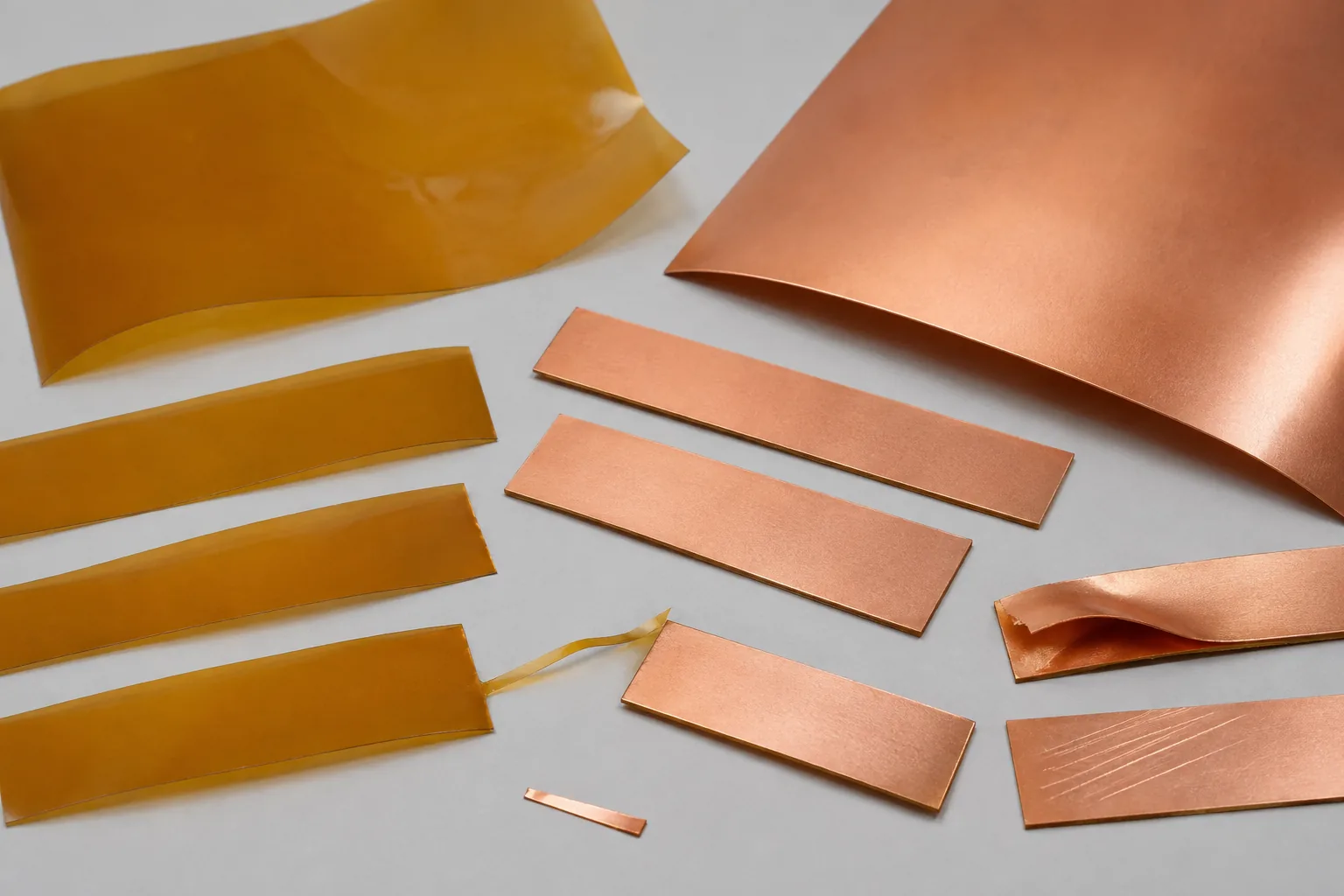
Flexible circuit substrate may be bare polyimide or polyester film, adhesive-coated laminate, or copper-clad material with a protected functional surface. Its low thickness makes it sensitive to web tension and burr transfer, while the layer stack determines whether an edge stretches, delaminates or leaves metallic slivers.
Updated
Where This Cutting Application Appears
Slitting bare dielectric film
Convert polyimide or polyester master rolls into controlled widths before coating or circuit fabrication.
Sheeting copper-clad flex laminate
Cross-cut laminated rolls into panels while protecting copper faces and bonded edges.
Trimming adhesive-coated substrate
Remove uneven coated margins without transferring adhesive or lifting release liners.
Web Slitting And Sheeting process boundary
web slitting and sheeting for flexible circuit substrate film is a linked sequence: the output condition and datum from each operation become the controlled input for the next. It should not be evaluated as one generic cut or accepted only by the final dimension.
Web Slitting And Sheeting setup checkpoint
For flexible circuit substrate film, define the operation order, intermediate dimensions, registration transfer, material support, web or part handling and waste route for every stage of web slitting and sheeting.
Web Slitting And Sheeting acceptance checkpoint
Verify both intermediate and final results from web slitting and sheeting, including dimensions, registration, edge or feature quality, material damage, waste separation and stable transfer between stages.
Define the Required Cut Result
- Straight polymer edges without stretched tails
- Controlled copper burr and no loose metallic slivers
- Bonded layers aligned without edge delamination
- Functional surfaces free from avoidable scratches or debris
Problems to Diagnose Before Changing the Knife
Polymer forms a thin tail beyond the cut
Check film tension, support, edge drag, penetration or shear clearance and downstream pull.
Copper burr appears on one face
Map burr direction to upper and lower knives, then review overlap, clearance, bevel and side load.
Layers open at the slit edge
Inspect bond condition, web bending, differential tension, knife-face contact and adhesive cure.
Scratches repeat in one lane
Trace debris, guides, spacers, knife faces and contact rolls at the same cross-web position.
Knife Forms That May Be Considered
| Possible knife form | When it may be considered | What must be confirmed |
|---|---|---|
| circular shear knife | A matched shear pair may suit copper-clad or tougher laminates when clearance and side load are precisely controlled. | Confirm upper/lower diameters, bores, thicknesses, bevels, overlap, clearance, rotation and web orientation. |
| straight cutoff knife | A straight knife can suit indexed sheeting when the laminate is held flat against a uniform support. | Confirm cutting width, stroke, bevel, holder, backing surface and locations of copper or adhesive layers. |
Information to Send for Technical Review
You do not need to know the exact blade name. Send the available workpiece, machine, current-knife and cut-result information so the application can be reviewed against a drawing or sample.
- Base polymer and film manufacturing direction
- Copper thickness and one- or two-sided cladding
- Adhesive, coverlay, liner or protective-film sequence
- Total thickness and variation by layer
- Master width, slit plan or sheet dimensions
- Web speed, tension zones, support and surface-contact layout
- Knife pair or cutoff holder drawings and setup records
- Samples showing film tails, copper burr, delamination or scratches
Questions About This Cutting Application
Can bare polyimide and copper-clad laminate use one setup?
Do not assume so. Copper introduces burr and particle risks, while adhesives and film layers change drag and support.
Why does a polymer tail remain after the copper is separated?
The film may stretch into clearance or lose support. Inspect both layer edges and preserve cutting orientation.
Does the protected face need to be identified?
Yes. Surface contact, bevel direction and debris can affect one face differently; mark every submitted sample.
How should copper burr be reported?
Use the customer's defined method, sampling points and edge orientation rather than a visual statement alone.
Can a finished flex panel define the knife?
It helps show the result, but holder interfaces and intended layer boundaries remain hidden. Supply equipment data and an approved drawing.
Related product and service information
- Graphite Thermal Film Cutting - graphite thermal interface film · film slitting and profiling
- Ceramic Green Tape Cutting - ceramic green tape · tape slitting and blanking
- Surgical Drape Laminate Cutting - surgical drape laminates · laminate slitting and sheeting
Request a Custom Cutting-Knife Review
Send the workpiece details, machine or holder information, current knife photos or sample, required quantity and examples of the present cut problem. Final dimensions, material, edge geometry and tolerances are confirmed from the approved requirements.