
Blade Application Guides / Application Guide / electronic ceramics
Ceramic Green Tape Cutting
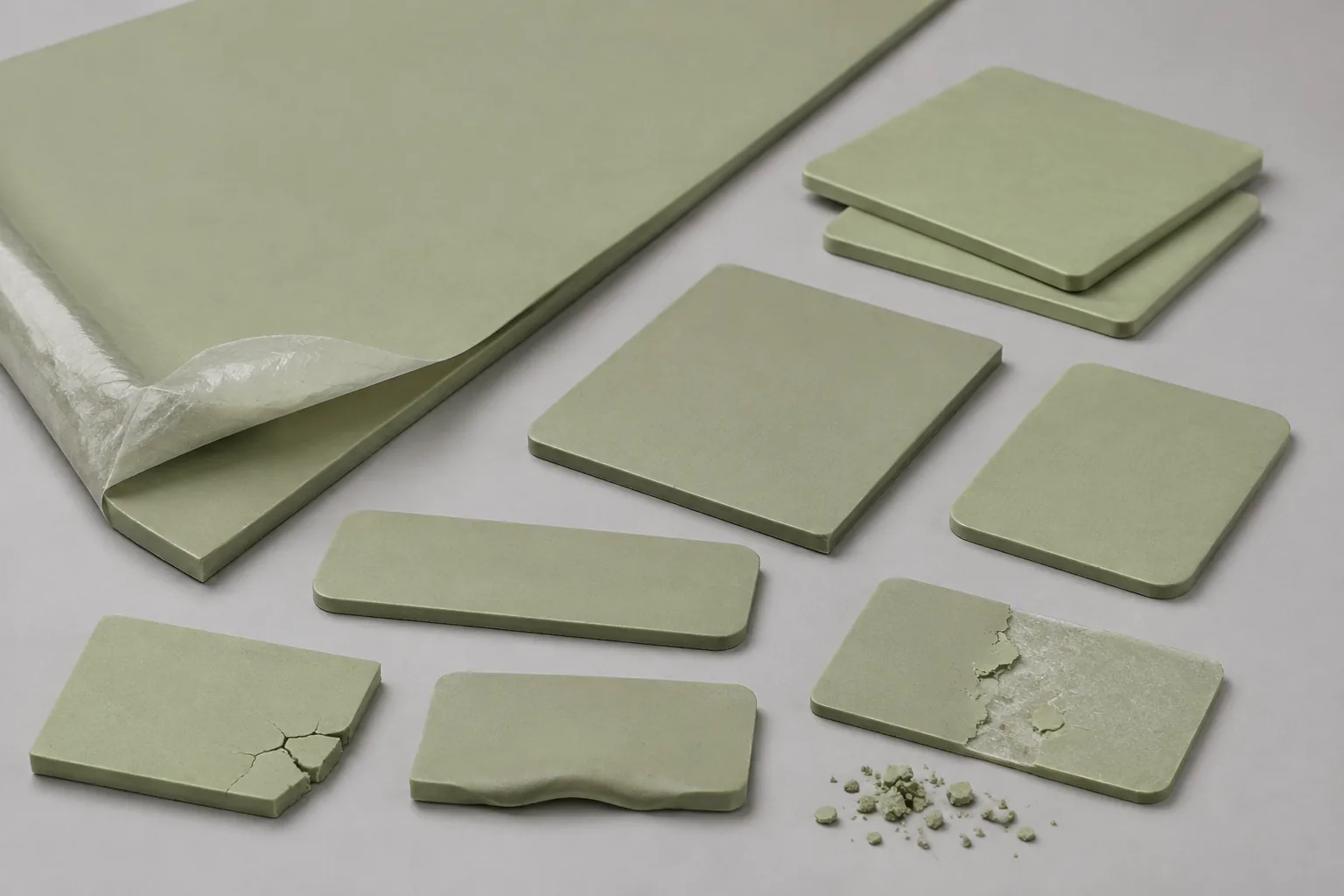
Ceramic green tape is an unfired particle-filled sheet held together by an organic binder, often carried on a release film. It can deform while soft, crack while dry, or shed particles at the edge, so cutting decisions must use the tape's conditioned state and layer arrangement.
Updated
Where This Cutting Application Appears
Slitting green-tape master rolls
Produce narrow webs before printing, stacking or component forming while preserving edge straightness.
Blanking ceramic sheets
Cut rectangular or profiled pieces from tape supported by a carrier film.
Kiss cutting tape on a release carrier
Separate the ceramic layer to shape while leaving the carrier continuous for handling.
Tape Slitting And Blanking process boundary
tape slitting and blanking for ceramic green tape is a linked sequence: the output condition and datum from each operation become the controlled input for the next. It should not be evaluated as one generic cut or accepted only by the final dimension.
Tape Slitting And Blanking setup checkpoint
For ceramic green tape, define the operation order, intermediate dimensions, registration transfer, material support, web or part handling and waste route for every stage of tape slitting and blanking.
Tape Slitting And Blanking acceptance checkpoint
Verify both intermediate and final results from tape slitting and blanking, including dimensions, registration, edge or feature quality, material damage, waste separation and stable transfer between stages.
Define the Required Cut Result
- Clean particle-filled edges without cracks
- Stable dimensions with limited stretching or compression
- Controlled kiss depth where the carrier must remain intact
- Accurate corners and profiles without loose ceramic debris
Problems to Diagnose Before Changing the Knife
Fine cracks extend from the cut
Check tape dryness, binder condition, support, edge wedge, cutting direction and specified corner radius.
The edge deforms or closes behind the knife
Review tape softness, dwell, edge thickness, release motion and when dimensions are measured.
Carrier film is cut unintentionally
Inspect penetration, backing flatness, carrier thickness, tool runout and local tape build.
Ceramic particles shed along the perimeter
Compare edge wear, cutting mode, tape conditioning, support and part stripping.
Knife Forms That May Be Considered
| Possible knife form | When it may be considered | What must be confirmed |
|---|---|---|
| razor slitter | A supported razor cut may suit thin roll stock when drag and particle generation remain controlled. | Confirm carrier orientation, holder, penetration, web tension, tape condition and accepted edge samples. |
| profiled blanking knife | A closed profile can suit repeated green-sheet blanks with controlled support and release. | Confirm CAD outline, radii, knife section, penetration, backing and part-removal method. |
Information to Send for Technical Review
You do not need to know the exact blade name. Send the available workpiece, machine, current-knife and cut-result information so the application can be reviewed against a drawing or sample.
- Ceramic composition category and solids loading
- Binder system and conditioned moisture or solvent state
- Tape and carrier-film thicknesses
- Roll or sheet format and material direction
- Blank outline, corner radii and dimensional tolerance
- Full cut or kiss cut for each layer
- Machine, holder, backing and stripping arrangement
- Samples showing cracks, deformation, carrier cuts or particle loss
Questions About This Cutting Application
Why does green tape sometimes crack and sometimes deform?
Binder and conditioning determine whether the sheet behaves brittle or soft. Record time, temperature and storage state at cutting.
Can a finished fired part define the green-tape knife size?
No. Firing shrinkage and process compensation belong to the customer's design; provide the approved green-sheet dimensions.
How is a kiss cut distinguished from a full cut?
The drawing must identify which layer remains intact and the acceptable carrier mark, supported by samples.
What causes particles around a blank edge?
A worn edge, insufficient support, brittle tape or rough stripping can all contribute. Inspect the part before and after removal.
Are all LTCC or ceramic tapes cut the same way?
No. Composition, binder, thickness and carrier differ. Review the actual supplied tape and equipment.
Related product and service information
- Flexible Circuit Substrate Film Cutting - flexible circuit substrate film · web slitting and sheeting
- Graphite Thermal Film Cutting - graphite thermal interface film · film slitting and profiling
- Surgical Drape Laminate Cutting - surgical drape laminates · laminate slitting and sheeting
Request a Custom Cutting-Knife Review
Send the workpiece details, machine or holder information, current knife photos or sample, required quantity and examples of the present cut problem. Final dimensions, material, edge geometry and tolerances are confirmed from the approved requirements.