
Blade Application Guides / Application Guide / medical disposables
Surgical Drape Laminate Cutting
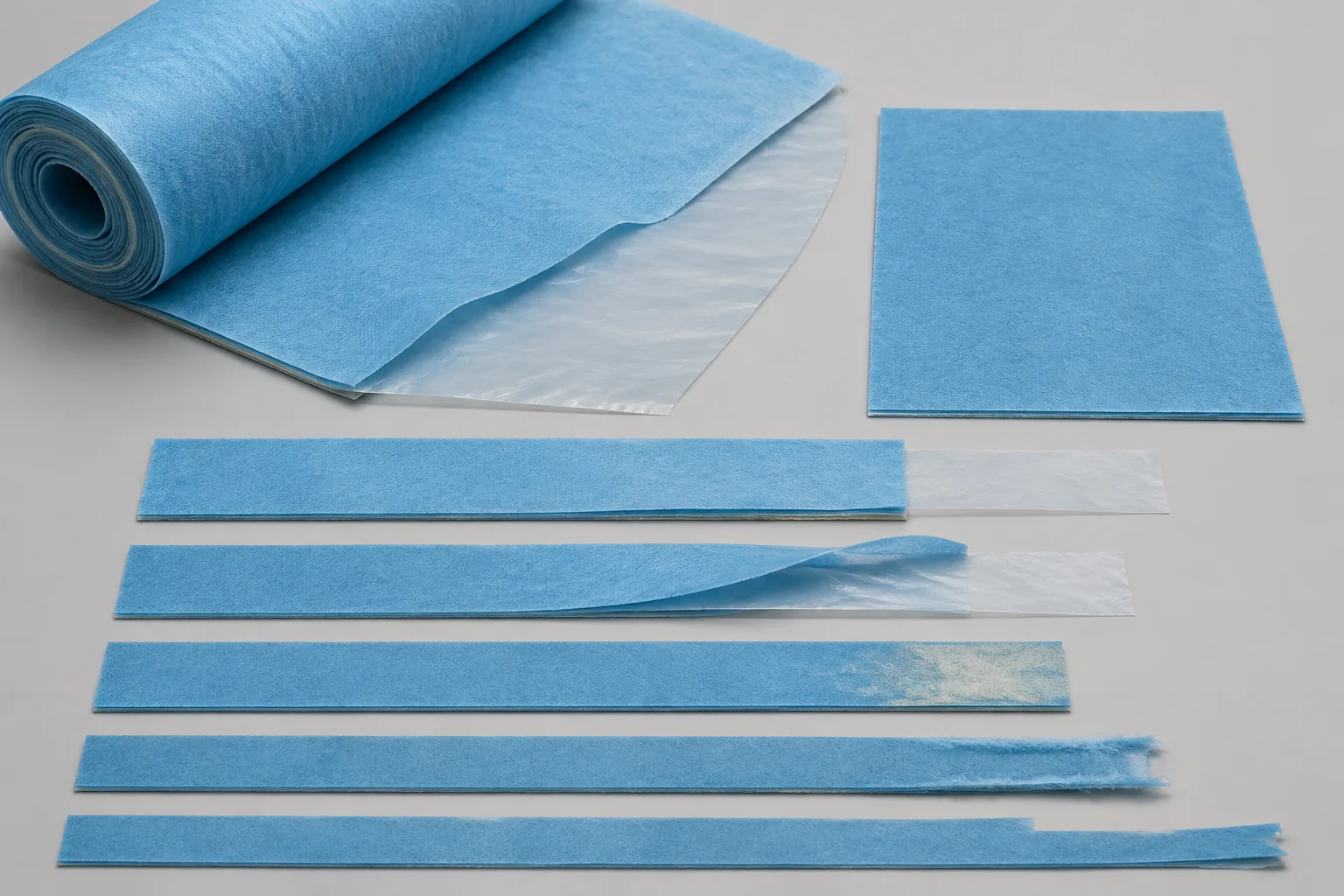
A surgical drape laminate can combine low-friction film, soft nonwoven, absorbent zones, reinforcement and adhesive features. These layers may stretch, delaminate or transfer adhesive differently, making web support and layer orientation as important as the nominal total thickness.
Updated
Where This Cutting Application Appears
Slitting laminated drape stock
Divide master rolls before printing or converting while keeping film and nonwoven edges aligned.
Sheeting drape material to length
Cross-cut wide web into panels for folding, fenestration or later assembly operations.
Trimming adhesive or reinforced margins
Remove uneven edges around constructions that contain tape zones, reinforcement or absorbent patches.
Laminate Slitting And Sheeting process boundary
laminate slitting and sheeting for surgical drape laminates is a linked sequence: the output condition and datum from each operation become the controlled input for the next. It should not be evaluated as one generic cut or accepted only by the final dimension.
Laminate Slitting And Sheeting setup checkpoint
For surgical drape laminates, define the operation order, intermediate dimensions, registration transfer, material support, web or part handling and waste route for every stage of laminate slitting and sheeting.
Laminate Slitting And Sheeting acceptance checkpoint
Verify both intermediate and final results from laminate slitting and sheeting, including dimensions, registration, edge or feature quality, material damage, waste separation and stable transfer between stages.
Define the Required Cut Result
- Aligned layer edges without delamination
- Controlled dimensions despite differential stretch
- Low lint and no long film tails at the edge
- Limited adhesive transfer into the cutting zone
Problems to Diagnose Before Changing the Knife
Film stretches past the nonwoven edge
Review layer tension, laminate bond, edge mode, knife drag and support immediately after cutting.
Layers peel apart at the slit
Inspect bond condition, cutting direction, side load, overlap and whether the laminate is flexed sharply after the cut.
Adhesive contaminates the working edge
Identify adhesive location and cure state, then review temperature, exposed coating, blade finish and cleaning interval.
Sheet length changes during a run
Compare web tension, feed encoder or timing, roll diameter effects, product slip and cutoff phase.
Knife Forms That May Be Considered
| Possible knife form | When it may be considered | What must be confirmed |
|---|---|---|
| circular slitter | A rotary slitter may suit longitudinal conversion when all layers are tensioned and supported as one web. | Confirm razor, score or shear mode; then document diameter, bore, bevel, lower interface, rotation and web path. |
| straight cutoff knife | A straight cross-cut can suit indexed sheeting when the laminate is held flat against a consistent backing surface. | Confirm cutting width, stroke, bevel, mounting, counter-surface and locations of adhesive or reinforcement. |
Information to Send for Technical Review
You do not need to know the exact blade name. Send the available workpiece, machine, current-knife and cut-result information so the application can be reviewed against a drawing or sample.
- Full layer sequence and material family of each layer
- Thickness and basis weight by layer, not total only
- Bonding method and any adhesive zones crossing the cut
- Web width, panel length and allowed layer offset
- Machine direction, tension range and guiding layout
- Slitting mode or cutoff stroke and backing details
- Current blade dimensions, finish and cleaning practice
- Samples showing film tails, lint, delamination or adhesive transfer
Questions About This Cutting Application
Why can a thin drape laminate be harder to cut than a thicker sheet?
Different layers may stretch or fracture at different times. Total thickness does not describe bond strength, film behavior or fiber support.
Should the film side face the knife or the support?
That depends on cutting mode, bevel and the defect priority. Mark layer orientation and compare both faces during trials.
Can adhesive zones be cut with the same setup as plain laminate?
They may require different cleaning, finish or release considerations. Declare every adhesive path that crosses the knife.
What indicates delamination caused by cutting?
Look for separation beginning exactly at the slit and compare it with incoming bond quality and downstream bending.
Who validates the finished surgical drape?
The device or product manufacturer remains responsible for validation. The knife supplier reviews only the stated cutting application and interface.
Related product and service information
- Lateral Flow Nitrocellulose Membrane Slitting Blades - Lateral-flow nitrocellulose membrane · Precision roll slitting
- Diaper Topsheet and Backsheet Slitting - diaper topsheet and backsheet webs · multilayer web slitting
- Medical Adhesive Tape Roll Slitting - medical adhesive tape rolls · roll slitting
Request a Custom Cutting-Knife Review
Send the workpiece details, machine or holder information, current knife photos or sample, required quantity and examples of the present cut problem. Final dimensions, material, edge geometry and tolerances are confirmed from the approved requirements.