
Blade Application Guides / Application Guide / electronics thermal management
Graphite Thermal Film Cutting
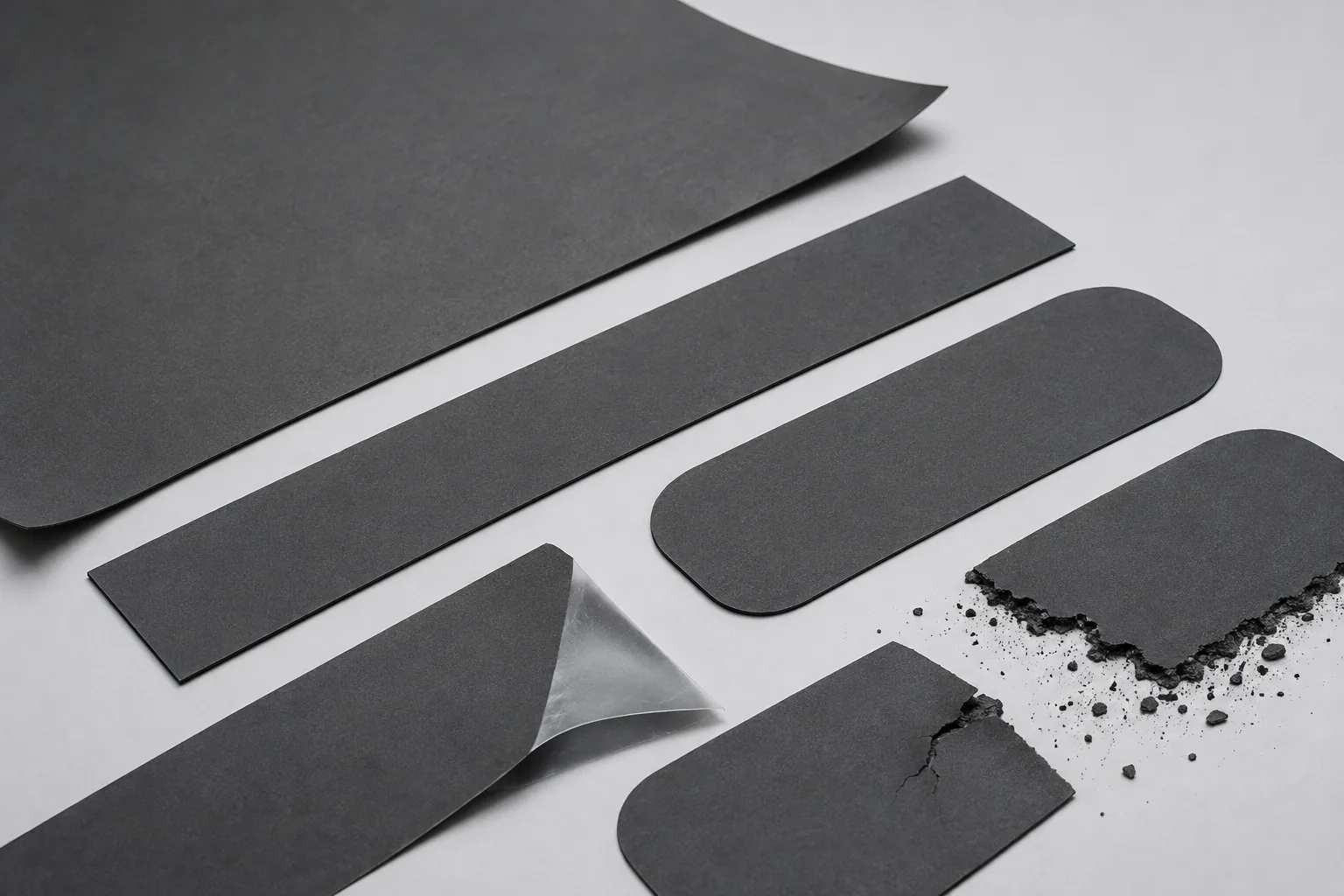
Graphite thermal film conducts heat through a thin, highly oriented and often laminated structure that can flake or split along its layers. Slitting and profile cutting must preserve the functional sheet while managing brittle edges, carrier films, adhesive and protective liners declared in the construction.
Updated
Where This Cutting Application Appears
Slitting graphite thermal-spreader rolls
Convert master material into narrow strips before lamination or component assembly.
Profiling laminated graphite sheets
Cut device-specific outlines through graphite, adhesive and carrier layers according to an approved drawing.
Trimming protected graphite panels
Remove uneven margins while preserving a protective film or liner where the process requires it.
Film Slitting And Profiling process boundary
film slitting and profiling for graphite thermal interface film is a linked sequence: the output condition and datum from each operation become the controlled input for the next. It should not be evaluated as one generic cut or accepted only by the final dimension.
Film Slitting And Profiling setup checkpoint
For graphite thermal interface film, define the operation order, intermediate dimensions, registration transfer, material support, web or part handling and waste route for every stage of film slitting and profiling.
Film Slitting And Profiling acceptance checkpoint
Verify both intermediate and final results from film slitting and profiling, including dimensions, registration, edge or feature quality, material damage, waste separation and stable transfer between stages.
Define the Required Cut Result
- Continuous graphite edges with limited flakes and dust
- Accurate profile without cracks extending into the part
- Aligned carrier, adhesive and graphite layers
- Clean release without lifting the protective liner
Problems to Diagnose Before Changing the Knife
Graphite flakes away from the edge
Review layer orientation, support, edge wedge, penetration direction and handling immediately after cutting.
Cracks propagate into narrow features
Inspect inside radii, ligament width, material thickness, clamping and the direction of the graphite structure.
Carrier film extends beyond the graphite
Check differential stretch, layer bond, knife drag, penetration and backing contact.
Dark particles transfer to the finished face
Trace debris from cutting, stripping and stacking; review extraction, cleaning and contact surfaces.
Knife Forms That May Be Considered
| Possible knife form | When it may be considered | What must be confirmed |
|---|---|---|
| razor slitter | A supported razor cut may suit thin roll material where drag and unsupported fracture are controlled. | Confirm film stack, support, penetration, web tension, protective face and accepted edge samples. |
| profiled die-cutting knife | A closed profile can suit repeated thermal-spreader shapes when radii, backing and stripping are defined. | Confirm CAD outline, layer stack, kiss- or full-cut boundaries, knife section, penetration and part-release method. |
Information to Send for Technical Review
You do not need to know the exact blade name. Send the available workpiece, machine, current-knife and cut-result information so the application can be reviewed against a drawing or sample.
- Graphite type, manufacturing route and nominal thickness
- Carrier, adhesive, coating and protective-liner sequence
- Roll or sheet format and material orientation
- Part outline, inside radii and narrow-feature dimensions
- Kiss-cut or full-cut requirement for every layer
- Web tension or sheet hold-down and backing material
- Current tool geometry and waste-stripping method
- Samples showing flakes, cracks, layer offset, liner lift or particle transfer
Questions About This Cutting Application
Why does graphite film crack beyond the visible cut?
A brittle layer can continue along its internal orientation when support or radius is insufficient. Inspect both faces and the layer direction.
Can graphite film be cut like ordinary plastic film?
Do not assume so. Its layered brittle behavior, particles and lamination require separate review.
What determines whether the liner should remain intact?
The downstream handling plan and drawing define kiss-cut boundaries. State clearly which layers must separate.
Why does the carrier form a tail at the edge?
A flexible carrier may stretch away from the graphite if penetration, support or layer adhesion is uneven.
What profile details are most important?
Provide datums, internal radii, narrow ligaments, layer boundaries, tolerances and the stripping direction used after cutting.
Related product and service information
- Catalyst-Coated Membrane Edge Trimming Blades - catalyst-coated membrane · edge trimming
- Flexible Circuit Substrate Film Cutting - flexible circuit substrate film · web slitting and sheeting
- Ceramic Green Tape Cutting - ceramic green tape · tape slitting and blanking
Request a Custom Cutting-Knife Review
Send the workpiece details, machine or holder information, current knife photos or sample, required quantity and examples of the present cut problem. Final dimensions, material, edge geometry and tolerances are confirmed from the approved requirements.