
Blade Application Guides / Application Guide / electronics assembly
Electronics Foam Gasket Cutting
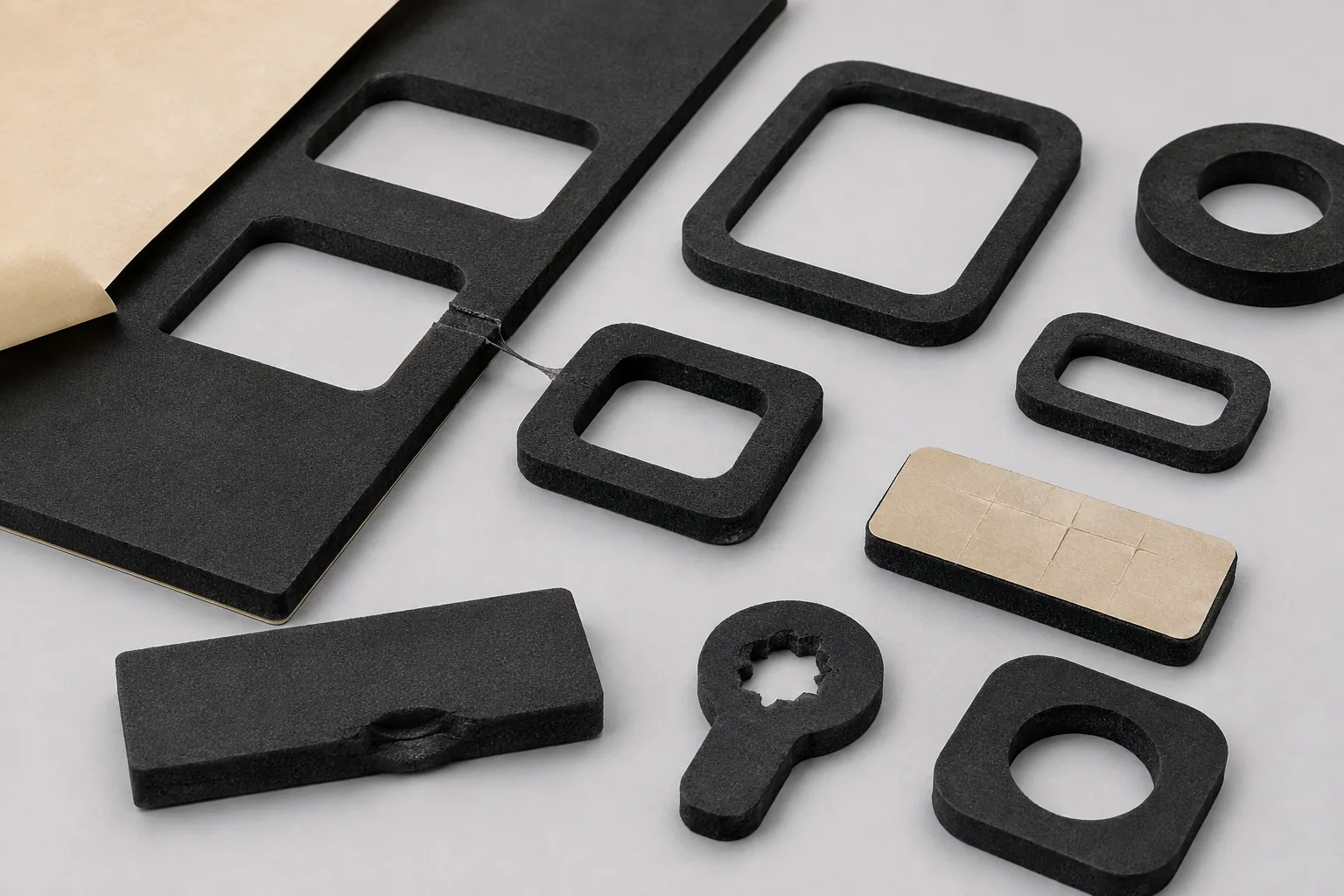
Electronics gasket stock may combine open- or closed-cell foam with adhesive, film, fabric or release liner. Soft layers compress and recover, while adhesive can string or lift the liner, making cut depth, profile radii and stripping behavior part of the same tooling decision.
Updated
Where This Cutting Application Appears
Kiss cutting adhesive foam gaskets
Cut foam and adhesive to profile while retaining the release liner for assembly handling.
Full cutting non-adhesive foam seals
Separate individual cushioning or sealing parts through the complete material thickness.
Profiling multilayer EMI or acoustic gaskets
Form openings and outer contours in foam combined with fabric, film or other declared functional layers.
Kiss Cutting And Profiling process boundary
kiss cutting and profiling for electronics foam gasket stock is a linked sequence: the output condition and datum from each operation become the controlled input for the next. It should not be evaluated as one generic cut or accepted only by the final dimension.
Kiss Cutting And Profiling setup checkpoint
For electronics foam gasket stock, define the operation order, intermediate dimensions, registration transfer, material support, web or part handling and waste route for every stage of kiss cutting and profiling.
Kiss Cutting And Profiling acceptance checkpoint
Verify both intermediate and final results from kiss cutting and profiling, including dimensions, registration, edge or feature quality, material damage, waste separation and stable transfer between stages.
Define the Required Cut Result
- Accurate profile after foam recovery
- Intact release liner at kiss-cut boundaries
- Clean adhesive edges without strings or lift
- Small holes and radii released without tearing
Problems to Diagnose Before Changing the Knife
Foam remains compressed around the edge
Review knife wedge, dwell, density, hold-down and measurement time after cutting.
The release liner is scored or cut through
Check penetration setting, backing hardness, liner thickness, web flatness and local layer variation.
Adhesive strings connect part and matrix
Inspect adhesive flow, temperature, edge finish, stripping angle and delay before waste removal.
Small internal features tear during stripping
Review radius, ligament width, foam strength, cut completeness and matrix-removal direction.
Knife Forms That May Be Considered
| Possible knife form | When it may be considered | What must be confirmed |
|---|---|---|
| profiled die-cutting knife | A closed profile can suit repeated gasket outlines when penetration and stripping are controlled. | Confirm CAD geometry, internal features, knife section, cut depth, backing and waste-removal direction. |
| oscillating straight knife | An oscillating tool may suit low-volume or large profiles on equipment designed for digital contour cutting. | Confirm tool holder, stroke, path, foam restraint, layer stack and acceptable edge taper from trials. |
Information to Send for Technical Review
You do not need to know the exact blade name. Send the available workpiece, machine, current-knife and cut-result information so the application can be reviewed against a drawing or sample.
- Foam polymer, open- or closed-cell structure and density
- Foam thickness and recovery measurement method
- Adhesive, carrier, fabric, film and liner sequence
- Kiss-cut and full-cut boundaries on the drawing
- Profile radii, holes, narrow ligaments and tolerances
- Press or cutting-table support and registration
- Waste matrix and part-release method
- Samples showing compression, liner marks, adhesive strings or torn features
Questions About This Cutting Application
When should a foam gasket be measured?
Use the customer's agreed recovery period and conditioning; immediate dimensions may reflect temporary compression.
Why does the liner cut through only in one area?
Backing wear, thickness variation, runout or local overlap can change penetration. Map the defect to the profile.
Can a tighter inside radius be added without changing tooling risk?
Not necessarily. Small radii and narrow ligaments can tear during cutting or stripping; review material and release direction.
Does a coating solve adhesive stringing?
It may affect release, but adhesive state, temperature, edge condition and stripping timing also matter.
What should a gasket CAD file identify?
Show datums, layer boundaries, kiss depth, holes, radii, tolerances and the intended part-versus-matrix side.
Related product and service information
- Mica Insulation Sheet Cutting - mica insulation sheets · sheet sizing and profiling
- Confectionery Slab and Bar Cutting - confectionery slabs and bars · guillotine cutting and scoring
- Sanitary Pad Absorbent Core Cutting - sanitary pad absorbent cores · core contour cutting
Request a Custom Cutting-Knife Review
Send the workpiece details, machine or holder information, current knife photos or sample, required quantity and examples of the present cut problem. Final dimensions, material, edge geometry and tolerances are confirmed from the approved requirements.