
Blade Application Guides / Application Guide / Hydrogen equipment manufacturing
Electrolyzer Catalyst Decal Film Sheet Slitting Blades
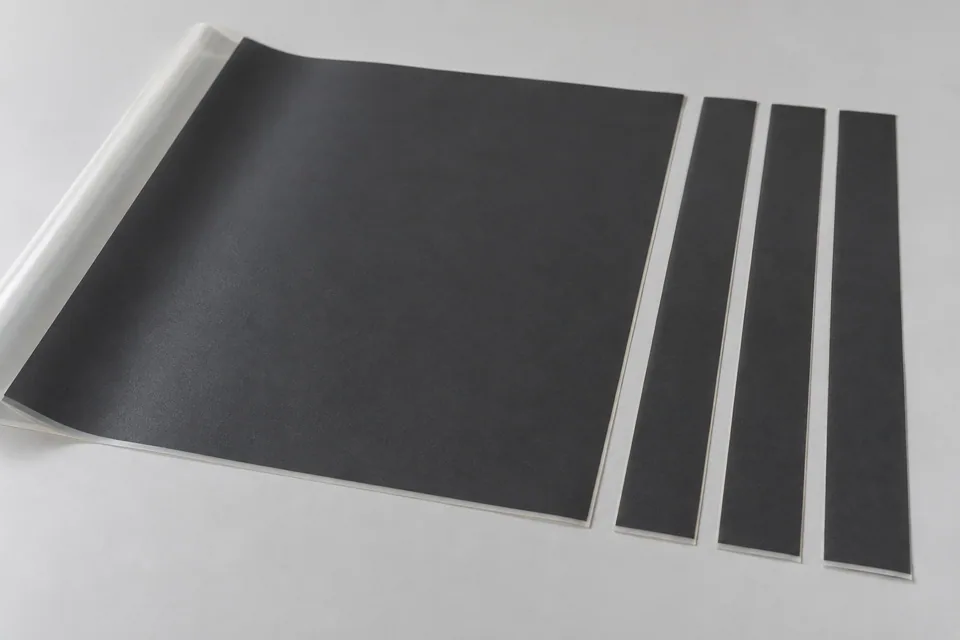
A catalyst decal carries a dried catalyst layer on a temporary substrate before transfer to an electrolyzer membrane in one manufacturing route. Sheet slitting divides a finite decal sheet lengthwise into narrower rectangular strips or lanes; it does not release a shaped patch or simply shave an outside margin. Because the catalyst layer and release substrate can fail differently, first identify which side is coated, whether the cut crosses catalyst, and which dimensional reference is used for later transfer. Inspect the slit edge and both faces without assuming the cutting knife determines transfer yield.
Updated
Where This Cutting Application Appears
Layout of finite sheets
Mark the incoming sheet length, width, coated patches and intended longitudinal lanes. The output is narrower sheet strips of the original length, not rewound coils unless the buyer describes a separate roll process.
Coated and uncoated boundary
Define a safe distance from the slit line to the catalyst layer or agree a coated-area cut. Inspect for coating cracks, flakes and debris at the boundary; a clean substrate edge alone is insufficient.
Support and registration
Hold the sheet flat without rubbing or pressing the active face. Compare lane widths and patch positions against the transfer fixture, and note whether one lane drifts because of feed skew.
Separation and collection
Separate cut strips without face-to-face abrasion or mislabeling of coated orientation. Retain offcuts for the buyer’s material-accounting procedure and sample both entry and exit edges.
Define the Required Cut Result
- Make each longitudinal sheet lane to the buyer’s width plan.
- Preserve coating and substrate condition next to every slit.
- Keep patch-to-edge registration suitable for the transfer step.
- Collect and identify strips and offcuts without surface contact damage.
Problems to Diagnose Before Changing the Knife
Coating flakes next to one slit
- Check whether the knife crosses a coated patch.
- Inspect edge support and blade condition.
- Compare incoming coating integrity from the same sheet.
Lane width changes from entry to exit
- Check sheet alignment and feed skew.
- Measure cutter positions and sheet restraint.
- Compare dimensions against the transfer datum, not only the raw sheet edge.
Strips stick or mark during collection
- Confirm coated-face orientation.
- Review separator and stacking contact.
- Inspect any static or carrier-release behavior with the buyer’s process owner.
Knife Forms That May Be Considered
| Possible knife form | When it may be considered | What must be confirmed |
|---|---|---|
| Guided straight slitting edge | For linear lengthwise cuts through finite sheets on a compatible table or feed line. | Confirm substrate and coating edge quality, backing and lane registration. |
| Paired shear slitting edges | Where the actual machine supports a scissor action for multiple longitudinal lanes. | Confirm holder geometry, pressure/overlap and cut sample with the real decal construction. |
Information to Send for Technical Review
You do not need to know the exact blade name. Send the available workpiece, machine, current-knife and cut-result information so the application can be reviewed against a drawing or sample.
- Decal substrate and catalyst-layer construction
- Sheet dimensions and coated patch map
- Coated-face orientation and protected no-contact areas
- Lane widths, datum and transfer registration limits
- Accepted coating/edge samples
- Sheet feed, support and backing drawings
- Blade station layout and current settings
- Offcut handling and trial sampling plan
Questions About This Cutting Application
Is sheet slitting the same as contour cutting?
No. Sheet slitting makes lengthwise rectangular lanes; contour cutting follows a specified shaped perimeter around a decal patch.
Can the blade touch the catalyst layer?
That is a buyer-specific process decision. The patch map and accepted edge sample must show whether cutting through coating is permitted.
Does a clean slit prove the decal will transfer well?
No. Transfer depends on the catalyst layer, substrate and transfer process; the cut trial only establishes its own dimensional and edge condition.
What should be measured besides strip width?
Measure coated-patch position relative to the slit and inspect cracking, flakes and face marks along the whole sheet.
Public references and scope
These public sources provide material, cutting-method or safety context for this guide. Supplier pages describe their own materials or equipment; they do not establish a MEIRENTE blade specification or performance claim. Confirm the actual grade, machine setup and required cut with a drawing or sample.
Related product and service information
- Nickel Foam Electrode Contour-Cutting Blades - nickel foam electrode · contour cutting
- AEM Electrolyzer Membrane Sheet Slitting Blades - AEM electrolyzer membrane · sheet slitting
- Electrolyzer Catalyst Decal Film Contour Cutting Blades - electrolyzer catalyst decal film · contour cutting
Request a Custom Cutting-Knife Review
Send the workpiece details, machine or holder information, current knife photos or sample, required quantity and examples of the present cut problem. Final dimensions, material, edge geometry and tolerances are confirmed from the approved requirements.