
Blade Application Guides / Application Guide / Biopharmaceutical manufacturing
Chromatography Membrane-Adsorber Media Edge-Trimming Blades
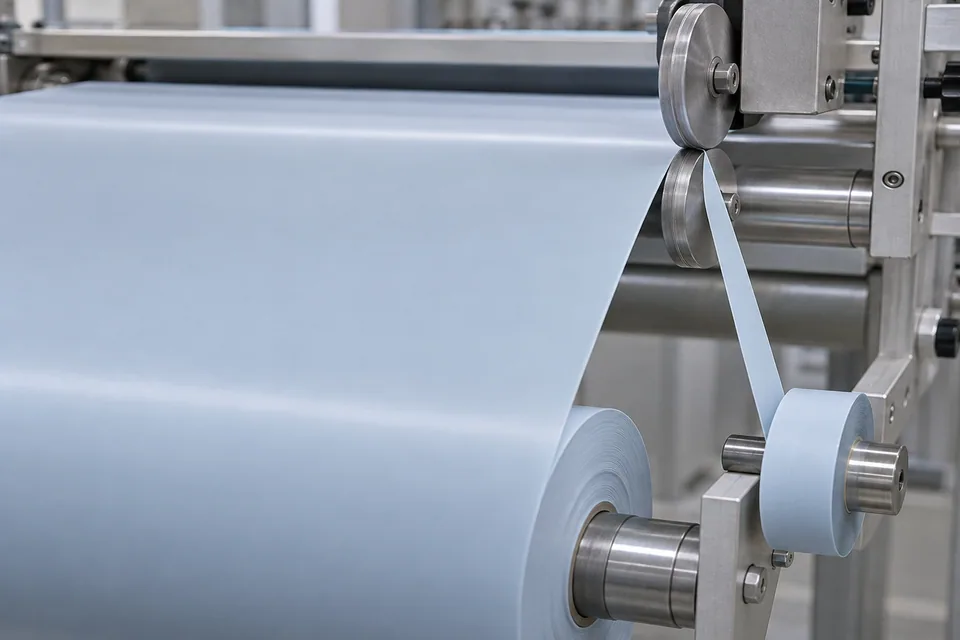
Membrane chromatography uses functional media to bind selected process impurities or products. Pall lists Mustang ion-exchange membrane as sheet stock and offers custom roll, sheet and disc sizes; Merck describes a chromatography membrane in flat-sheet and pleated device configurations. This guide concerns the unassembled media supplied for conversion, never a finished adsorber capsule. Edge trimming removes a damaged or excess longitudinal selvedge before a buyer-defined component is cut or assembled. Confirm the supplied grade, storage condition and active-face handling with its maker. A neat trim line alone says nothing about ligand activity, binding capacity or final flow performance.
Updated
Where This Cutting Application Appears
Locate the useful coated or functional zone
Use the membrane supplier’s map and the buyer’s nesting drawing to mark what portion of the sheet is functional. An outside trim may remove only an approved margin. If the roll has a protective interleaf or distinct faces, mark the winding orientation before the cut so retained stock is not flipped in later assembly.
Support the edge during continuous feed
Trial a short length with the actual membrane and any carrier that will travel through the line. Watch for an unsupported edge fluttering toward the knife or a support layer extending past the functional layer. Capture the trim ribbon promptly so it cannot brush the usable media.
Compare cut and uncut margins
Inspect both faces at the retained edge for smearing, lifted coating, loose fibers or a crushed pore field. Record the distance from the new edge to the designated active area. If material conditioning changes width, compare specimens measured in the same supplier-approved state.
Check the next conversion step
Pass trial strips to the buyer’s stacking or pleating evaluation. A straight edge should feed and register without shedding particles into a seal zone; the buyer must test adsorption and hydraulic properties after the actual downstream process.
Define the Required Cut Result
- Remove only the buyer-authorized longitudinal selvedge.
- Protect the functional zone from blade contact and loose trim.
- Keep the retained sheet flat and correctly oriented.
- Document edge observations separately from chromatography performance.
Problems to Diagnose Before Changing the Knife
Active coating appears abraded near the retained edge
- Compare the supplier’s uncut control.
- Inspect blade contact and support geometry.
- Recheck winding face orientation.
Selvedge pulls into the web path
- Observe waste takeoff and edge tension.
- Inspect static or curl in the trim ribbon.
- Trial a shorter unsupported span.
Width changes after cutting
- Measure material in the same conditioning state.
- Record tension at the gauge point.
- Separate stock variability from knife wander.
Knife Forms That May Be Considered
| Possible knife form | When it may be considered | What must be confirmed |
|---|---|---|
| Guided rotary edge-trim pair | For confirmed roll-form stock that remains stable during continuous feed. | Validate that knife engagement stays outside the functional zone. |
| Supported straight-edge cut | For short sheets or grades that cannot be web fed. | Compare edge debris and retained width with a supplier-approved control. |
Information to Send for Technical Review
You do not need to know the exact blade name. Send the available workpiece, machine, current-knife and cut-result information so the application can be reviewed against a drawing or sample.
- Exact ion-exchange membrane grade and supplier instructions
- Roll or sheet format and active-area map
- Face, liner and winding orientation
- Permitted outer trim allowance
- Target retained width and conditioning state
- Accepted edge imagery and debris limit
- Next stacking or pleating step
- Buyer adsorption and flow acceptance plan
Questions About This Cutting Application
Is the workpiece an assembled adsorber?
No. It is unassembled ion-exchange membrane stock; a capsule or module is outside the trimming operation.
Why map the active area first?
The trim must not remove functional media needed for the buyer’s final membrane bed.
Can a clean edge prove binding capacity?
No. The buyer evaluates chromatography performance after conversion and assembly.
Does every membrane grade tolerate a rotary edge trim?
That depends on delivered form, support and supplier handling requirements; use a material trial.
What should accompany an RFQ?
Send a labeled specimen, useful-zone drawing, required edge state and next assembly drawing.
Public references and scope
These public sources provide material, cutting-method or safety context for this guide. Supplier pages describe their own materials or equipment; they do not establish a MEIRENTE blade specification or performance claim. Confirm the actual grade, machine setup and required cut with a drawing or sample.
Related product and service information
- Chromatography Membrane-Adsorber Media Roll Slitting Blades - chromatography membrane-adsorber media · roll slitting
- Single-Use Bioreactor Bag Film Edge Trimming Blades - single-use bioreactor bag film · edge trimming
- Virus-Filtration Membrane Edge Trimming Blades - virus-filtration membrane · edge trimming
Request a Custom Cutting-Knife Review
Send the workpiece details, machine or holder information, current knife photos or sample, required quantity and examples of the present cut problem. Final dimensions, material, edge geometry and tolerances are confirmed from the approved requirements.