
Blade Application Guides / Application Guide / Biopharmaceutical manufacturing
Chromatography Membrane-Adsorber Media Roll Slitting Blades
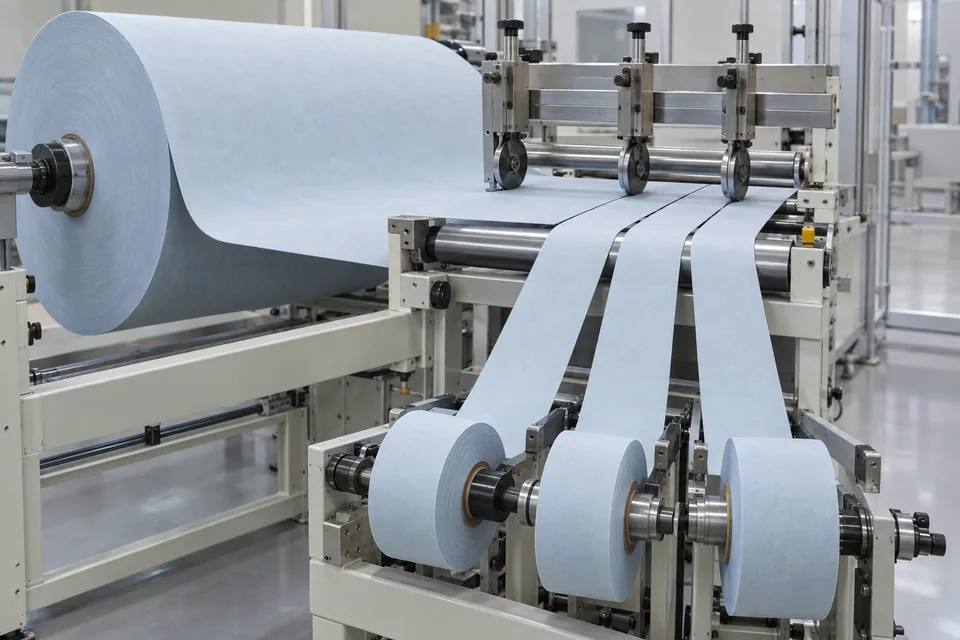
Chromatography membrane adsorbers use functional membrane material inside a defined cassette or capsule. Sartorius describes both rolled membrane and stacked membrane architectures. This page concerns only unassembled membrane-adsorber media supplied as a continuous flat web before rolling, stacking, sealing or housing assembly. A manufacturer may slit an approved parent web into component widths, but the named product references do not establish a universal cutting route for every adsorber chemistry or device. Longitudinal roll slitting must protect functional membrane surfaces, any support, and the edge that will enter a flow path. Width alone does not prove chromatographic capacity, flow behavior or device integrity; those remain the adsorber maker’s qualification work.
Updated
Where This Cutting Application Appears
Start with the device geometry
Translate the released membrane element and housing drawing into usable web widths, edge allowances and scrap. Identify whether the media will be rolled or layered later. A width appropriate for one architecture cannot be assumed for the other.
Trace web faces and lots
Record ligand chemistry or membrane grade, any face-specific treatment or support, lot and roll direction. Agree how the parent roll may contact guides and shafts; friction can affect a functional surface before the knife cuts. Do not assume every adsorber membrane has a single product-contact face.
Trial the actual slit and rewind
Set longitudinal knives, web tension, separation and winding on a representative lot. Inspect both edges for stretched pores, fiber pullout, loose powder or support peel. Compare a freshly cut edge with one after rewinding and handling.
Pass qualified components forward
Measure every lane, label face and direction, and protect the slit rolls for assembly. The adsorber maker should confirm that the finished element still meets its own flow, binding, cleanliness and integrity requirements.
Define the Required Cut Result
- Produce the media width in the released element drawing.
- Retain the specified active sorptive area and orientation.
- Control loose edge material and support damage.
- Preserve lot traceability into adsorber assembly.
Problems to Diagnose Before Changing the Knife
An edge sheds fibers or fine particles
- Inspect blade sharpness and contact pressure.
- Compare active membrane and backing layers.
- Check cut face before and after winding.
The media curls or telescopes after rewind
- Review parent roll tension and slit-lane separation.
- Record face orientation and winding hardness.
- Measure after the owner’s conditioning period.
A slit roll will not fit the rolled element
- Reconcile device element width with slit map.
- Check actual lane width and edge allowance.
- Confirm assembly direction and core requirements.
Knife Forms That May Be Considered
| Possible knife form | When it may be considered | What must be confirmed |
|---|---|---|
| Continuous longitudinal rotary slitters | When the media owner approves a roll-to-roll width conversion. | Verify web stability and edge quality on the actual functional membrane. |
| Dedicated outside trim knives | When a sacrificial selvage is removed before useful lanes are wound. | Confirm that debris routes away from the active face and required width remains. |
Information to Send for Technical Review
You do not need to know the exact blade name. Send the available workpiece, machine, current-knife and cut-result information so the application can be reviewed against a drawing or sample.
- Adsorber media grade, chemistry and support construction
- Approval for roll-to-roll conversion of unassembled media
- Released device-element width and active-area drawing
- Parent roll width, direction, face and lot
- Slitter layout, web path, winding and cleanliness conditions
- Edge particle, peel and curl acceptance examples
- Packaging and assembly transfer instructions
- Device-maker binding, flow and integrity qualification plan
Questions About This Cutting Application
Is a completed chromatography capsule being slit?
No. This is a flat unassembled membrane web before the element is built.
Does every membrane adsorber use a roll?
No. Some products use stacked sheets; confirm the actual architecture and incoming form.
Can blade appearance establish binding capacity?
No. The device maker evaluates chemistry, active area and chromatographic performance.
Why specify media face and direction?
They govern guide contact and how the component enters the later assembly.
What should the buyer provide first?
Send the media specification and released element-width drawing together.
Public references and scope
These public sources provide material, cutting-method or safety context for this guide. Supplier pages describe their own materials or equipment; they do not establish a MEIRENTE blade specification or performance claim. Confirm the actual grade, machine setup and required cut with a drawing or sample.
Related product and service information
- Chromatography Membrane-Adsorber Media Rotary Die-Cutting Blades - chromatography membrane-adsorber media · rotary die cutting
- Single-Use Bioreactor Bag Film Roll Slitting Blades - single-use bioreactor bag film · roll slitting
- Virus-Filtration Membrane Roll Slitting Blades - virus-filtration membrane · roll slitting
Request a Custom Cutting-Knife Review
Send the workpiece details, machine or holder information, current knife photos or sample, required quantity and examples of the present cut problem. Final dimensions, material, edge geometry and tolerances are confirmed from the approved requirements.