
Blade Application Guides / Application Guide / Wind-turbine blade manufacturing
Blade Leading-Edge Protection Tape Edge-Trimming Blades
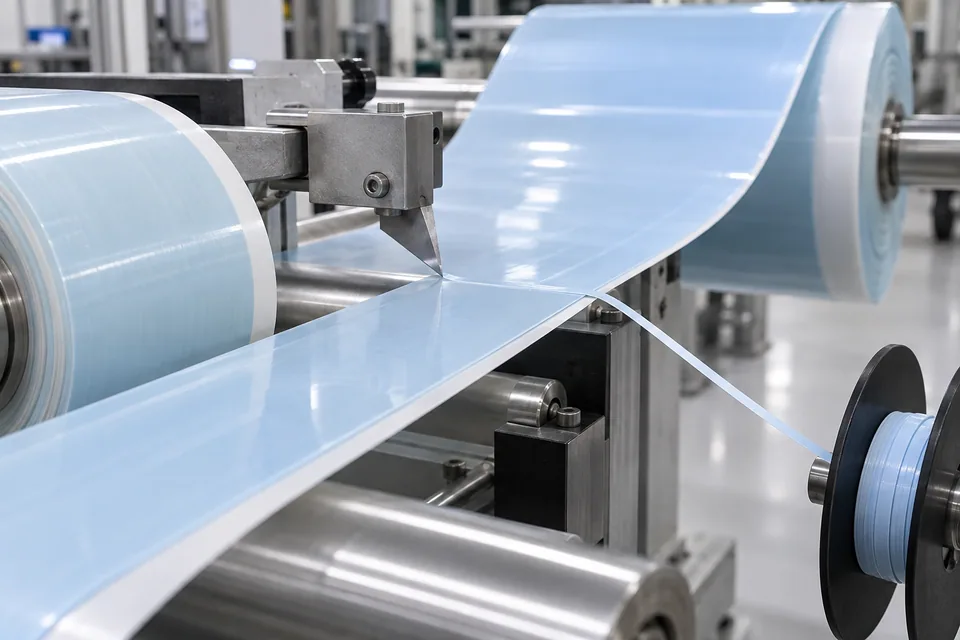
3M describes leading-edge wind-blade protection tape as polyurethane backing with acrylic pressure-sensitive adhesive, supplied in roll widths for OEM and field use. An edge-trimming station can remove an approved narrow margin from a compatible source roll if the final tape remains within the blade installation drawing. This operation creates a single principal retained web, unlike multi-lane slitting. It is not an instruction to cut away exposed edges from tape already installed on a blade; those repairs follow product and blade-owner procedures.
Updated
Where This Cutting Application Appears
Approve the edge strip
Identify a real outside-edge defect such as a backing nick, folded liner or adhesive contamination. Mark the allowable removed width and the minimum retained width from the application specification. If an edge fault reaches farther inward, reject or seek a revised conversion instruction instead of trimming away usable tape without authorization.
Hold the laminate through the trim
Guide the web with the adhesive protected by its liner. Test a longitudinal edge blade on the exact backing and liner construction, watching for adhesive transfer and waste ribbon wrapping. A narrow strip can stick back onto the retained roll, so arrange waste removal before increasing speed. Keep contact surfaces clean under the tape maker’s instructions.
Inspect the new outside edge
Measure retained width at the beginning, middle and end of the roll. Examine polyurethane for nicks or curl, adhesive for squeeze-out and liner for a complete separation line. Confirm the trimmed side does not acquire a ridge that might promote lift when wrapped around a curved leading edge.
Wind and identify the retained roll
Rewind without telescoping or interlayer blocking. Label product grade, original lot, trimmed side and final width. Protect the fresh edge during packaging and transport. If the original branded roll had product-specific markings on the discarded selvage, preserve that information in the conversion record.
Check the receiving application
Peel and place a test segment using the qualified installation method. Verify the new edge lies down without exposed adhesive or liner tears. Erosion resistance, weathering and repair suitability are determined by the chosen tape product and installed system, not by the trimming inspection alone. Keep a before-and-after photograph of the damaged side with the same scale. This makes it possible to show that the unwanted defect was removed while the retained tape still has the specified protective width. Recheck the opposite edge, because guide pressure there can introduce a second defect during the trim. Retain the sample beside the roll record for later comparison.
Define the Required Cut Result
- Remove only an authorized longitudinal margin.
- Keep required protective-tape width.
- Preserve backing, adhesive and liner edge quality.
- Maintain roll identity and installation usability.
Problems to Diagnose Before Changing the Knife
Waste strip reattaches to adhesive
- Control waste take-off.
- Check liner coverage.
- Inspect wound roll face.
New edge curls on application
- Check backing strain and knife condition.
- Measure roll width after rewind.
- Trial on a curved fixture.
Knife Forms That May Be Considered
| Possible knife form | When it may be considered | What must be confirmed |
|---|---|---|
| Guided trim knife | For an approved outside-edge cut on protected tape stock. | Check laminate edge and waste take-off. |
| Paired shear trim station | If exact grade and liner pass shear trials. | Confirm no adhesive squeeze-out or curl. |
Information to Send for Technical Review
You do not need to know the exact blade name. Send the available workpiece, machine, current-knife and cut-result information so the application can be reviewed against a drawing or sample.
- Product grade and supplier conversion approval
- Documented damaged side and trim allowance
- Required retained width
- Backing/adhesive/liner stack
- Edge lift, blocking and peel criteria
Questions About This Cutting Application
Is this the same as cutting several lanes?
No. Edge trimming removes a narrow outer strip from a principal web.
May any damaged roll be recovered by trimming?
Only if the remaining width and product requirements permit it.
Does this address tape already on a blade?
No. It converts uninstalled roll stock.
Why keep the original lot?
Installation and product performance must stay traceable to the supplied tape.
Public references and scope
These public sources provide material, cutting-method or safety context for this guide. Supplier pages describe their own materials or equipment; they do not establish a MEIRENTE blade specification or performance claim. Confirm the actual grade, machine setup and required cut with a drawing or sample.
Related product and service information
- Blade Leading-Edge Protection Tape Roll Slitting Blades - blade leading-edge protection tape · roll slitting
- Blade-Root Reinforcement Fabric Edge-Trimming Blades - blade-root reinforcement fabric · edge trimming
- Wind-Blade Structural Adhesive Film Edge-Trimming Blades - wind-blade structural adhesive film · edge trimming
Request a Custom Cutting-Knife Review
Send the workpiece details, machine or holder information, current knife photos or sample, required quantity and examples of the present cut problem. Final dimensions, material, edge geometry and tolerances are confirmed from the approved requirements.