
Blade Application Guides / Application Guide / Technical films
Anti-Static Protective Film Roll Slitting
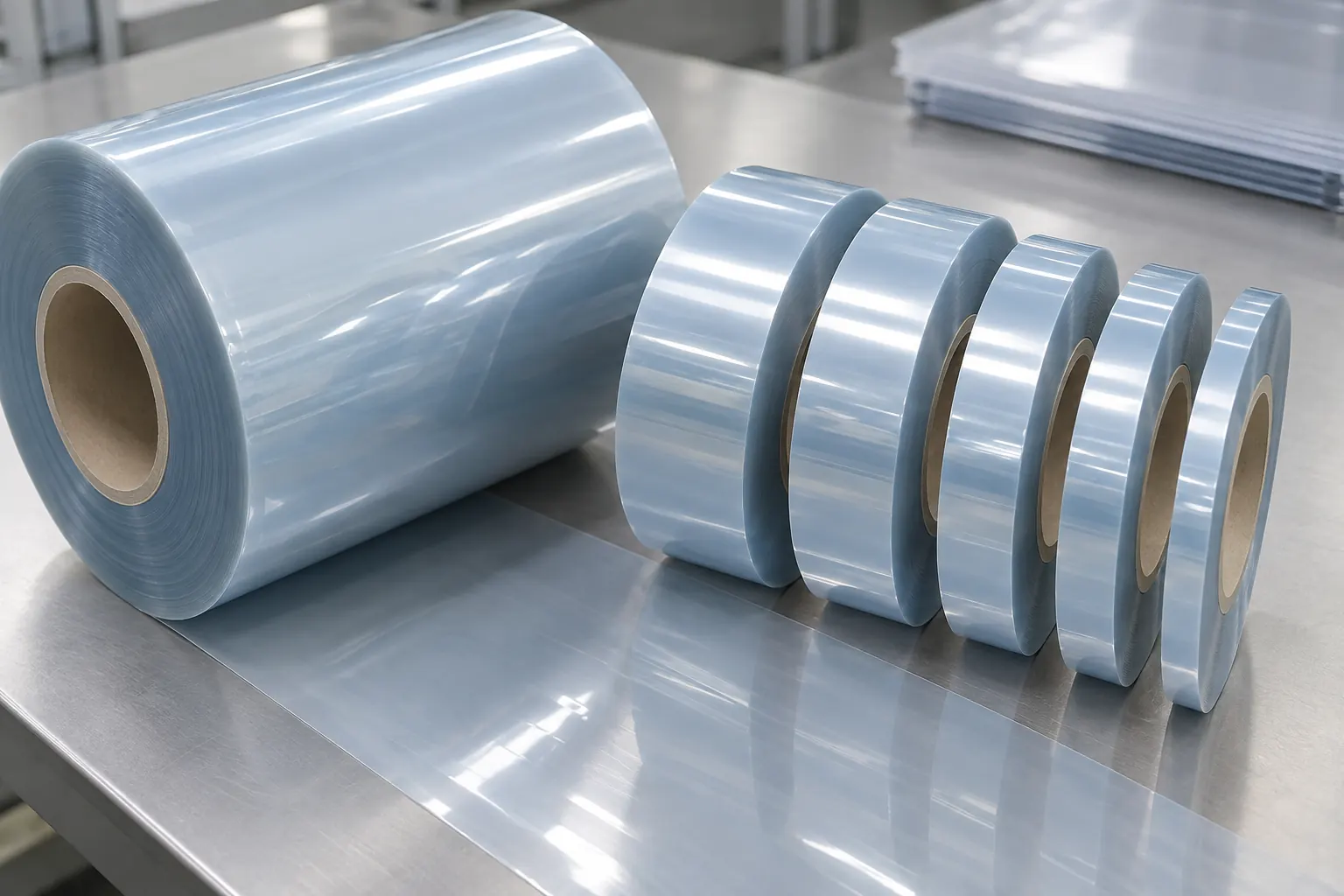
Anti-static protective film is used to shield electronics, displays, metals or sensitive surfaces while reducing charge accumulation. It may combine a PE or PET carrier, anti-static treatment, low-tack adhesive and release liner. Slitting review should protect both electrical surface performance and contamination-sensitive adhesive edges.
Updated
Where This Cutting Application Appears
Electronics surface protection
Slit clean low-charge film into widths for displays, panels and device components.
Metal and plastic sheet masking
Prepare protective reels that apply straight and peel without contaminated edges.
Cleanroom process protection
Convert antistatic film while controlling particles and electrostatic attraction.
Roll Slitting process boundary
Roll slitting divides a master roll longitudinally into narrower rolls; it does not separate the web transversely into sheets or fixed lengths.
Roll Slitting setup checkpoint
Confirm unwind and rewind tension, slit widths, knife positions, core alignment, trim removal and the winding behavior of every daughter roll.
Roll Slitting acceptance checkpoint
Inspect roll width, edge condition, telescoping, interleaving, debris and whether each rewound roll remains stable at the required diameter.
Define the Required Cut Result
- Preserve specified surface-resistance or charge-decay performance.
- Maintain clean adhesive edges without ooze or particles.
- Hold reel width, straightness and layer alignment.
- Avoid static-driven debris attraction and unstable rewinding.
Problems to Diagnose Before Changing the Knife
Slit web attracts particles
- Measure charge and grounding through the line.
- Check humidity and treatment side.
- Compare incoming and finished rolls.
Adhesive forms a sticky reel edge
- Identify adhesive and coat weight.
- Record temperature and winding pressure.
- Inspect carrier-to-liner alignment.
Anti-static performance differs near edge
- Map surface resistance across web width.
- Check treatment coverage and handling contact.
- Define measurement conditioning.
Protective roll telescopes or wrinkles
- Review tension and roll hardness.
- Check gauge profile and core alignment.
- Separate winding defects from slit-edge lip.
Knife Forms That May Be Considered
| Possible knife form | When it may be considered | What must be confirmed |
|---|---|---|
| Circular shear slitting arrangement | For supported antistatic, adhesive or lined protective-film structures. | Confirm stack, overlap, side load, holder, rotation, grounding and cleanliness requirements. |
| Razor slitting arrangement | For compatible thin unlined film on clean purpose-designed razor equipment. | Confirm support, treatment face, holder, exposure, speed, static control and extraction. |
Information to Send for Technical Review
You do not need to know the exact blade name. Send the available workpiece, machine, current-knife and cut-result information so the application can be reviewed against a drawing or sample.
- Carrier resin, gauge, anti-static treatment and target property range
- Adhesive, release liner and protected-surface compatibility
- Treatment and adhesive face orientation through the line
- Master-roll size, core, target widths and tolerance
- Speed, tension, humidity, grounding and ionization conditions
- Existing slitting form, holder and used sample
- Particle, adhesive, scratch, curl and edge-alignment limits
- Cleanliness protocol, packing, shelf life, end use and volume
Questions About This Cutting Application
Can slitting change anti-static performance?
Handling, contamination, rubbing or incomplete treatment near the edge may change measured surface behavior.
Why specify conditioning for resistance tests?
Humidity, temperature and test method can significantly affect reported anti-static values.
Can ordinary dust control replace static control?
No. Cleaning and extraction help, but grounding, ionization and material charge behavior must also be reviewed.
What causes a sticky finished edge?
Adhesive ooze, liner offset, heat, winding pressure and edge deformation are common factors.
What samples should remain sealed?
Keep representative incoming and finished specimens protected from contamination until electrical and cleanliness testing.
Related product and service information
- Anti-Static Protective Film Edge Trimming - anti-static protective film · width edge trimming
- Window Tint Film Roll Slitting - window tint film · roll slitting
- Holographic Transfer Film Roll Slitting - holographic transfer film · roll slitting
Request a Custom Cutting-Knife Review
Send the workpiece details, machine or holder information, current knife photos or sample, required quantity and examples of the present cut problem. Final dimensions, material, edge geometry and tolerances are confirmed from the approved requirements.