
Blade Application Guides / Application Guide / Technical films
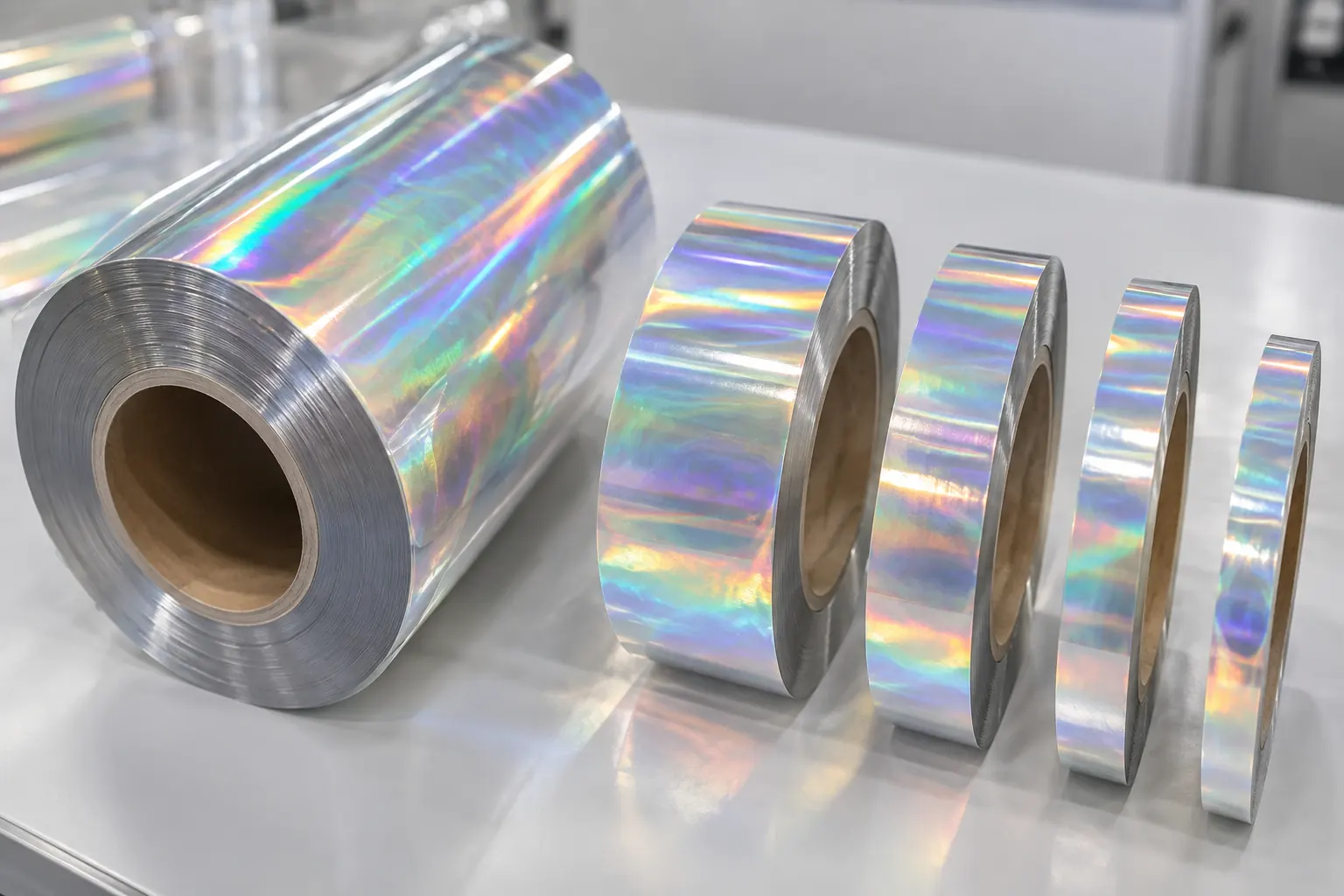
Holographic Transfer Film Roll Slitting
Holographic transfer film carries micro-embossed optical structures and may include release, metallized and protective coatings on a PET carrier. Slitting defects can be visually amplified by diffraction. Review should identify which layer transfers, the optical repeat direction and whether edge debris could contaminate stamping or transfer equipment.
Updated
Where This Cutting Application Appears
Hot-stamping foil reels
Prepare narrow transfer rolls for decorative or security stamping applications.
Registered holographic transfer webs
Convert reels while preserving optical-repeat orientation and edge registration.
Decorative laminate transfer film
Supply clean, stable rolls for downstream heat and pressure transfer.
Roll Slitting process boundary
Roll slitting divides a master roll longitudinally into narrower rolls; it does not separate the web transversely into sheets or fixed lengths.
Roll Slitting setup checkpoint
Confirm unwind and rewind tension, slit widths, knife positions, core alignment, trim removal and the winding behavior of every daughter roll.
Roll Slitting acceptance checkpoint
Inspect roll width, edge condition, telescoping, interleaving, debris and whether each rewound roll remains stable at the required diameter.
Define the Required Cut Result
- Protect micro-embossed and metallized optical layers.
- Maintain reel width and optical-repeat orientation.
- Limit flakes, dust and edge whitening.
- Build stable rolls that feed consistently during transfer.
Problems to Diagnose Before Changing the Knife
Metallic or optical coating flakes at the edge
- Identify coating and release-layer order.
- Inspect flake origin under magnification.
- Compare support, tension and winding direction.
Holographic pattern appears damaged near the slit
- Use controlled directional lighting.
- Map contact and compression zones.
- Check debris trapped in the roll edge.
Narrow reel telescopes
- Review winding tension and core alignment.
- Check carrier thickness and roll hardness.
- Separate edge quality from rewind control.
Transfer process shows edge contamination
- Collect edge particles after slitting.
- Inspect coating adhesion and roll packing.
- Compare contamination location downstream.
Knife Forms That May Be Considered
| Possible knife form | When it may be considered | What must be confirmed |
|---|---|---|
| Circular shear slitting arrangement | For supported conversion of coated PET transfer webs into narrow reels. | Confirm coating side, overlap, side load, holder, rotation, core and approved edge sample. |
| Razor slitting arrangement | For compatible thin carrier constructions on clean, purpose-designed razor stations. | Confirm coating sensitivity, support mode, holder, exposure, extraction and speed. |
Information to Send for Technical Review
You do not need to know the exact blade name. Send the available workpiece, machine, current-knife and cut-result information so the application can be reviewed against a drawing or sample.
- Carrier gauge and complete release, embossing, metal and lacquer stack
- Transfer layer and optical face orientation
- Optical repeat, web direction and any registration requirement
- Master-roll size, core, target widths and tolerance
- Line speed, web tension, static and cleanliness conditions
- Existing slitting arrangement, holder and used sample
- Limits for flakes, scratches, haze, dust and edge wave
- Rewind hardness, packing, transfer process and production volume
Questions About This Cutting Application
Why are small edge defects highly visible on holographic film?
Diffractive structures redirect light, so scratches, compression and coating loss can create strong contrast.
Does optical repeat affect slitting?
It can affect inspection, reel orientation and registered downstream use, so repeat and web direction should be documented.
Can coating flakes contaminate transfer?
Yes. Loose edge particles may enter the stamping or transfer interface and create recurring defects.
Which side should face outward on the slit reel?
Follow the downstream transfer and handling specification rather than assuming one winding orientation.
What sample lighting is useful?
Inspect under repeatable diffuse and directional light because some damage is visible only at certain angles.
Related product and service information
- Holographic Transfer Film Edge Trimming - holographic transfer film · width edge trimming
- Window Tint Film Roll Slitting - window tint film · roll slitting
- Laser-Printable Film Roll Slitting - laser-printable film · roll slitting
Request a Custom Cutting-Knife Review
Send the workpiece details, machine or holder information, current knife photos or sample, required quantity and examples of the present cut problem. Final dimensions, material, edge geometry and tolerances are confirmed from the approved requirements.