
Blade Application Guides / Application Guide / Technical films
Anti-Static Protective Film Edge Trimming
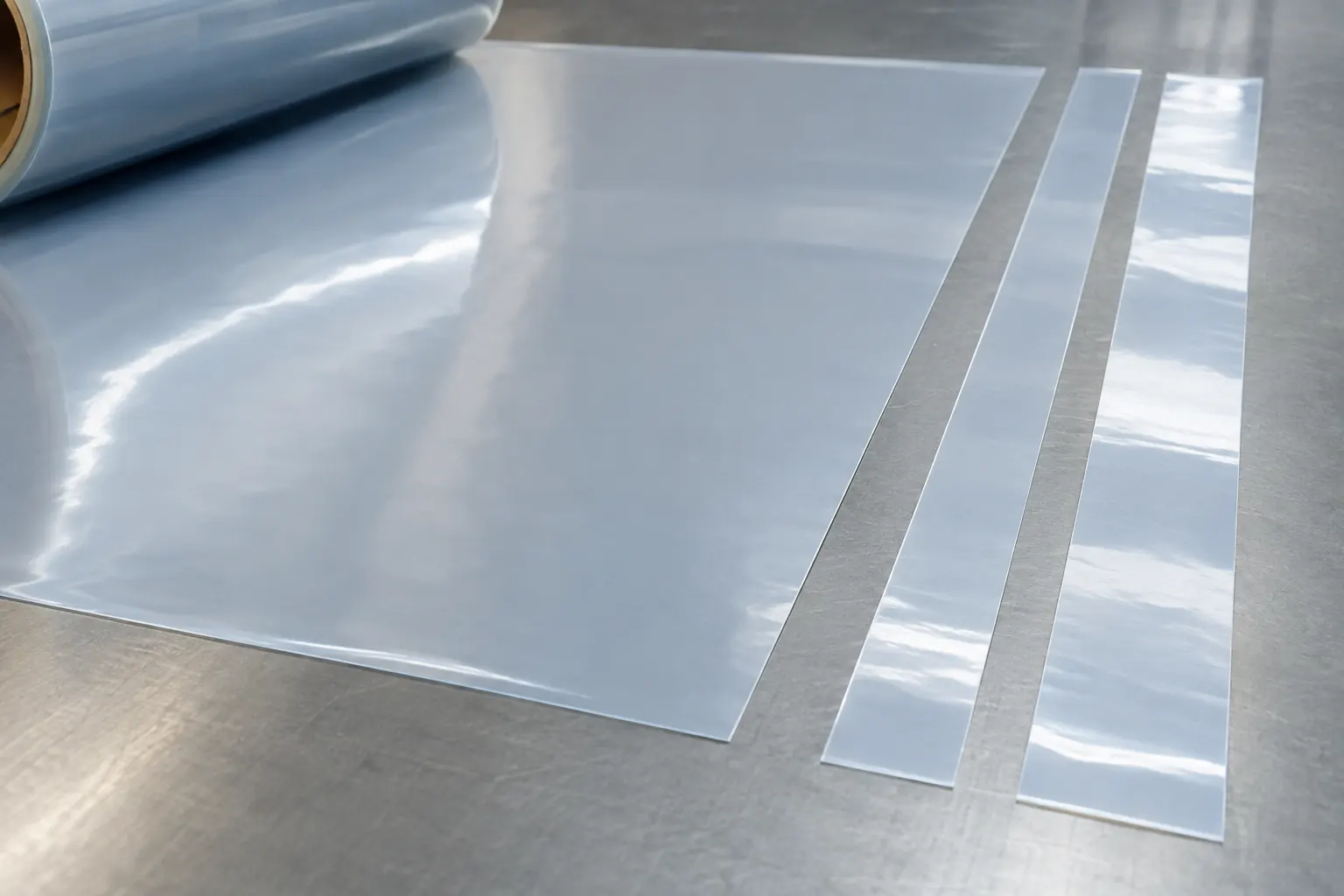
Edge trimming anti-static protective film removes untreated, adhesive-heavy or damaged web margins before clean rewinding. The treatment boundary may not match the physical edge, and static can redirect narrow trim ribbons or attract their debris. Review should connect usable electrical width, adhesive alignment and extraction conditions.
Updated
Where This Cutting Application Appears
Untreated-margin removal
Trim edges outside the specified antistatic treatment coverage.
Adhesive-edge cleanup
Remove irregular coating or exposed adhesive before final protective-film winding.
Clean finished-width conversion
Set precise web width for electronics, display or sheet-masking processes.
Width Edge Trimming process boundary
Width edge trimming removes controlled side margins to establish parallel finished edges and final web width; it is not a transverse length cut.
Width Edge Trimming setup checkpoint
Define both finished edge positions, centerline control, side guidance, trim width and reliable removal of the two continuous edge strips.
Width Edge Trimming acceptance checkpoint
Measure finished width across the run and inspect parallelism, camber, burr or fray, surface damage and trim-break frequency.
Define the Required Cut Result
- Preserve the required antistatic usable width.
- Prevent trim debris from returning to the clean product web.
- Control adhesive exposure, raised lips and edge blocking.
- Maintain continuous trim extraction without static wandering.
Problems to Diagnose Before Changing the Knife
Trim ribbon is attracted back to the web
- Measure charge and polarity.
- Review ionizer and grounding locations.
- Check ribbon path, speed and airflow.
Electrical property fails near finished edge
- Map treatment coverage before trimming.
- Standardize conditioning and test positions.
- Inspect contact contamination.
Adhesive smears along the margin
- Identify adhesive and coat profile.
- Record temperature and winding pressure.
- Check liner or carrier offset.
Edge debris exceeds cleanroom limit
- Characterize polymer, coating and ambient particles.
- Review extraction and cleaning.
- Compare counts before and after conversion.
Knife Forms That May Be Considered
| Possible knife form | When it may be considered | What must be confirmed |
|---|---|---|
| Circular shear edge-trim arrangement | For supported trimming of adhesive, lined or multilayer antistatic film. | Confirm stack, treatment side, overlap, side load, holder, grounding and extraction. |
| Supported razor edge-trim arrangement | For compatible thin unlined film on a clean antistatic razor station. | Confirm support, exposure, holder, speed, ionization and particle collection. |
Information to Send for Technical Review
You do not need to know the exact blade name. Send the available workpiece, machine, current-knife and cut-result information so the application can be reviewed against a drawing or sample.
- Carrier, gauge, treatment chemistry and specified electrical range
- Treatment boundary and adhesive or liner construction
- Incoming width, defective margin and required usable width
- Trim width and extraction route on both sides
- Speed, tension, humidity, grounding, ionization and airflow
- Existing trimming mode, support, holder and used sample
- Particle, adhesive, edge-lip and resistance acceptance limits
- Clean packing, shelf life, end-use process and production quantity
Questions About This Cutting Application
Why can trim ribbon move unpredictably?
Light ribbon responds strongly to electrostatic fields, airflow and extraction tension.
Does physical width equal antistatic usable width?
Not always. Treatment coverage must be mapped and included in the finished-width specification.
Can edge cleaning restore electrical performance?
Cleaning may remove contamination but cannot replace missing or damaged treatment.
How should particles be assessed?
Use the customer's cleanliness method and distinguish generated fragments from background contamination.
What should be recorded during extraction trials?
Record ribbon continuity, charge, breaks, contact with usable web, debris and finished-edge property results.
Related product and service information
- Holographic Transfer Film Roll Slitting - holographic transfer film · roll slitting
- Window Tint Film Edge Trimming - window tint film · width edge trimming
- Laser-Printable Film Edge Trimming - laser-printable film · width edge trimming
Request a Custom Cutting-Knife Review
Send the workpiece details, machine or holder information, current knife photos or sample, required quantity and examples of the present cut problem. Final dimensions, material, edge geometry and tolerances are confirmed from the approved requirements.