
Blade Application Guides / Application Guide / Technical films
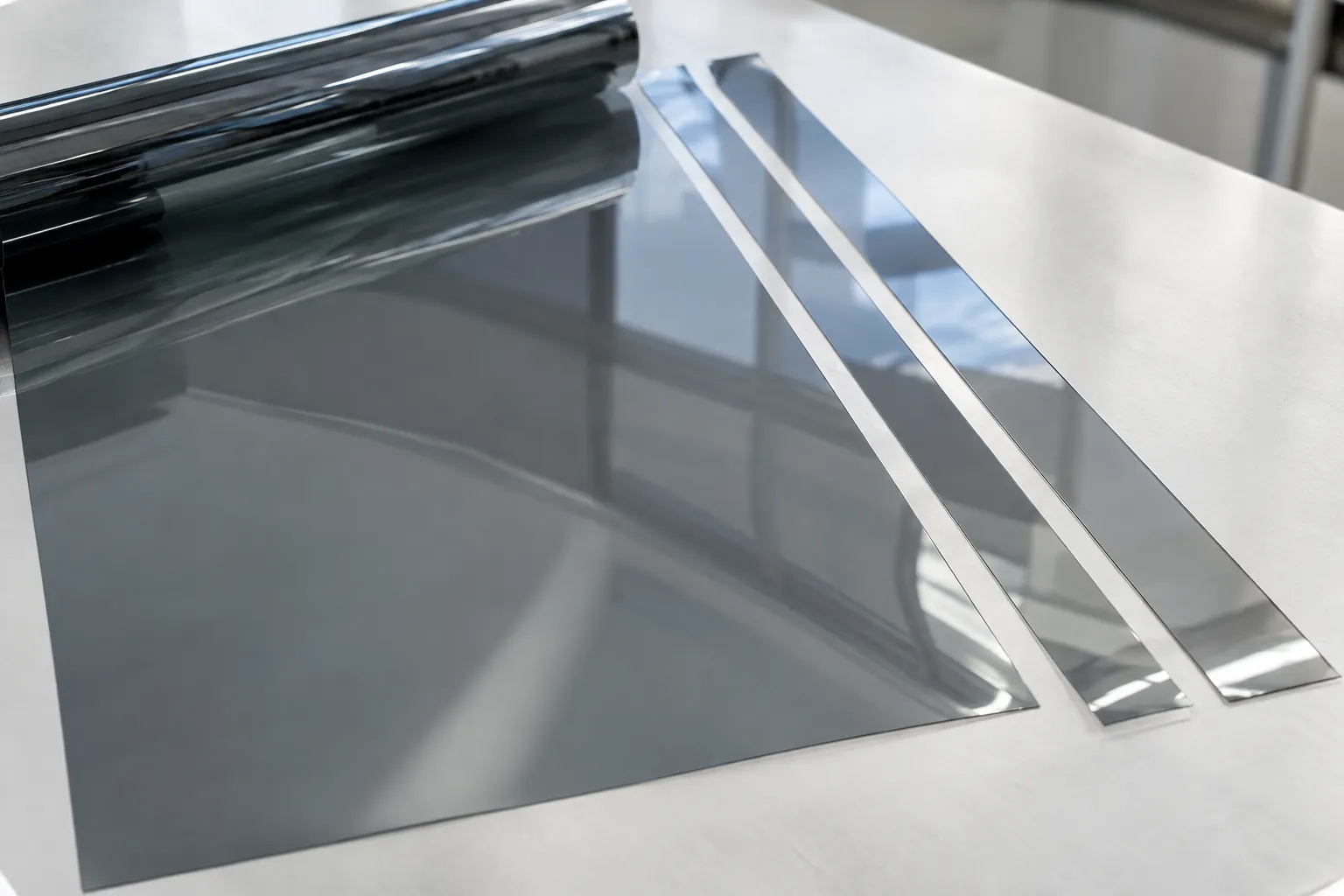
Window Tint Film Edge Trimming
Window tint edge trimming may remove coating margins, damaged roll edges or excess liner before final rewinding. The trim can include a hard-coated carrier, soft adhesive and release liner with different fracture behavior. Review must define whether all layers are trimmed together and whether any intentional liner overhang is required.
Updated
Where This Cutting Application Appears
Coating-margin removal
Remove uncoated or process-affected margins before finished-roll winding.
Damaged-edge cleanup
Trim wrinkled or contaminated outer edges while preserving usable optical web.
Final installer-width finishing
Set finished width and any specified liner relationship for distribution rolls.
Width Edge Trimming process boundary
Width edge trimming removes controlled side margins to establish parallel finished edges and final web width; it is not a transverse length cut.
Width Edge Trimming setup checkpoint
Define both finished edge positions, centerline control, side guidance, trim width and reliable removal of the two continuous edge strips.
Width Edge Trimming acceptance checkpoint
Measure finished width across the run and inspect parallelism, camber, burr or fray, surface damage and trim-break frequency.
Define the Required Cut Result
- Achieve stable finished width and intentional layer alignment.
- Avoid exposed adhesive, edge blocking and loose liner fibers.
- Maintain a continuous trim ribbon through extraction.
- Protect the visible coating from scratches and particles.
Problems to Diagnose Before Changing the Knife
Adhesive remains exposed beside the liner
- Confirm intended liner overhang.
- Measure layer registration before trimming.
- Review differential tension and adhesive flow.
Multilayer trim ribbon splits apart
- Identify which layers separate first.
- Check release level and extraction tension.
- Review ribbon width and path.
Finished edge develops haze
- Inspect coating fracture under consistent light.
- Check compression and debris.
- Compare both trimming directions.
Web edge lifts during rewind
- Review curl balance and roll hardness.
- Inspect adhesive coverage near edge.
- Check trim-induced lip or liner debris.
Knife Forms That May Be Considered
| Possible knife form | When it may be considered | What must be confirmed |
|---|---|---|
| Circular shear edge-trim arrangement | For supported trimming of the complete tint laminate. | Confirm layer stack, overlap, side load, holder, rotation, trim extraction and liner relationship. |
| Razor edge-trim arrangement | For compatible thin window films on a purpose-designed supported razor station. | Confirm film support, blade exposure, adhesive behavior, holder and cleanliness controls. |
Information to Send for Technical Review
You do not need to know the exact blade name. Send the available workpiece, machine, current-knife and cut-result information so the application can be reviewed against a drawing or sample.
- Carrier, functional coating, adhesive and release-liner construction
- Layers to be trimmed and required liner overhang or flush condition
- Incoming edge defects, web width and final-width tolerance
- Trim width and ribbon handling on each side
- Speed, tension, temperature, static and winding direction
- Existing trim form, support, holder and used sample
- Limits for haze, scratches, adhesive exposure and loose debris
- Rewind hardness, packing method, storage and production quantity
Questions About This Cutting Application
Should film and liner always finish flush?
Not necessarily. Some products require a deliberate liner relationship, which must be shown on the approved specification.
Why can the trim ribbon delaminate?
The release liner, adhesive and coated carrier have different adhesion and tensile behavior under extraction load.
Can trimming remove an optical defect?
Only if the defect is confined to the margin and the remaining web still meets width and quality requirements.
What causes an exposed sticky edge?
Layer offset, adhesive ooze, differential stretch or an incorrect trim datum can expose adhesive.
How should edge haze be inspected?
Use controlled transmitted and reflected light on labelled samples from both web sides.
Related product and service information
- Cellulose Acetate Film Roll Slitting Blades - cellulose acetate film · roll slitting
- Holographic Transfer Film Edge Trimming - holographic transfer film · width edge trimming
- Laser-Printable Film Edge Trimming - laser-printable film · width edge trimming
Request a Custom Cutting-Knife Review
Send the workpiece details, machine or holder information, current knife photos or sample, required quantity and examples of the present cut problem. Final dimensions, material, edge geometry and tolerances are confirmed from the approved requirements.