
Blade Application Guides / Application Guide / Technical films
Laser-Printable Film Edge Trimming
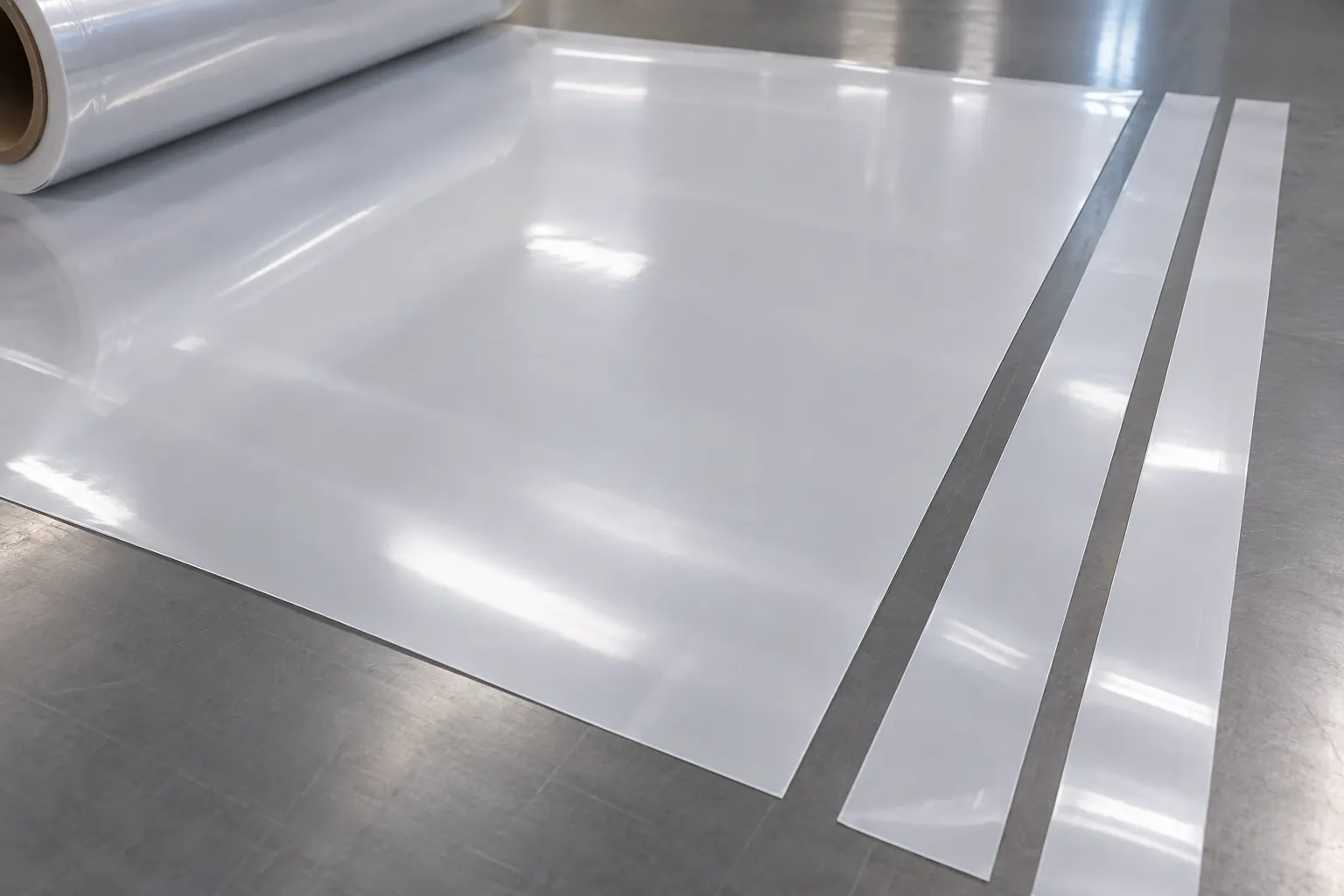
Edge trimming laser-printable film removes coating beads, uncoated margins or damaged web edges before final sheeting or printing. A filled receptor coating may fracture into fine dust, while adhesive constructions add liner alignment and sticky trim behavior. The trim datum and cleanliness limit should be defined from downstream printer needs.
Updated
Where This Cutting Application Appears
Coating-edge cleanup
Remove heavy, missing or nonuniform receptor-coating margins.
Final printer-web sizing
Set the finished width used by subsequent sheeting or roll-fed printing.
Adhesive media finishing
Trim face stock and liner while controlling exposed adhesive and particles.
Width Edge Trimming process boundary
Width edge trimming removes controlled side margins to establish parallel finished edges and final web width; it is not a transverse length cut.
Width Edge Trimming setup checkpoint
Define both finished edge positions, centerline control, side guidance, trim width and reliable removal of the two continuous edge strips.
Width Edge Trimming acceptance checkpoint
Measure finished width across the run and inspect parallelism, camber, burr or fray, surface damage and trim-break frequency.
Define the Required Cut Result
- Hold finished width relative to the printable area.
- Limit coating chips, dust and loose edge fragments.
- Keep adhesive and liner edges in the specified relationship.
- Remove trim continuously without contaminating the usable web.
Problems to Diagnose Before Changing the Knife
Powder collects beside the trimmed edge
- Identify coating composition and edge profile.
- Inspect debris source under magnification.
- Review extraction and static.
Printable area becomes too narrow
- Map coating boundary and guiding datum.
- Check trim-width variation.
- Define usable-width tolerance explicitly.
Sticky trim ribbon blocks in extraction
- Identify adhesive and liner orientation.
- Record temperature and extraction tension.
- Check ribbon contact and winding pressure.
Trimmed edge causes later sheet skew
- Measure edge straightness and width.
- Inspect curl and raised lip.
- Compare sheeter guiding against the trimmed datum.
Knife Forms That May Be Considered
| Possible knife form | When it may be considered | What must be confirmed |
|---|---|---|
| Circular shear edge-trim arrangement | For supported trimming of coated or adhesive printable webs. | Confirm layer stack, overlap, side load, rotation, holder, trim width and extraction. |
| Supported razor edge-trim arrangement | For compatible thin unlined media on clean razor equipment. | Confirm support, coating sensitivity, exposure, speed, holder and particle control. |
Information to Send for Technical Review
You do not need to know the exact blade name. Send the available workpiece, machine, current-knife and cut-result information so the application can be reviewed against a drawing or sample.
- Film carrier, printable coating and filler construction
- Adhesive and release-liner details when present
- Coating boundary, incoming width and required usable width
- Trim widths, ribbon path and extraction method
- Speed, tension, static, temperature and cleanliness class
- Existing trim form, support, holder and used sample
- Limits for dust, chips, adhesive exposure, lip and edge wave
- Downstream sheeting or printing process and production quantity
Questions About This Cutting Application
Why can coating dust matter downstream?
Particles can contaminate rollers, affect toner transfer and create visible marks on printed media.
Should usable width differ from physical width?
It may, especially where coating does not reach the edge; both dimensions should be specified.
Can trim extraction create defects?
Yes. Excessive pull, static or contact with the product web can break ribbon and redistribute debris.
How is an adhesive edge evaluated?
Inspect liner alignment, ooze, blocking and contamination after winding and conditioning.
What samples help most?
Provide incoming margins, clean accepted edges, dusty rejects and media after downstream sheeting or printing.
Related product and service information
- Window Tint Film Roll Slitting - window tint film · roll slitting
- Holographic Transfer Film Edge Trimming - holographic transfer film · width edge trimming
- Anti-Fog Packaging Film Edge Trimming - anti-fog packaging film · width edge trimming
Request a Custom Cutting-Knife Review
Send the workpiece details, machine or holder information, current knife photos or sample, required quantity and examples of the present cut problem. Final dimensions, material, edge geometry and tolerances are confirmed from the approved requirements.