
Blade Application Guides / Application Guide / Technical films
Anti-Fog Packaging Film Cross Cutting
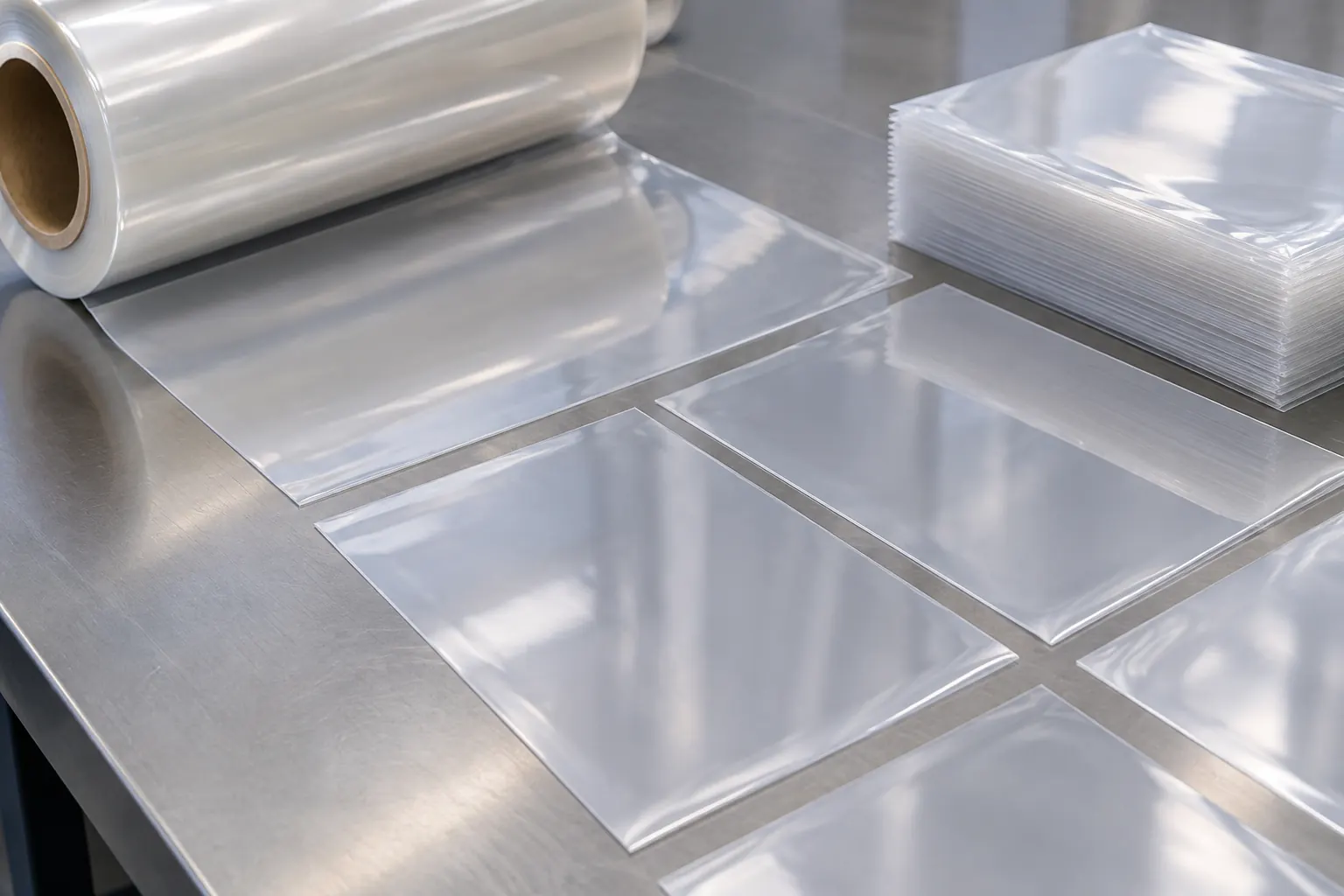
Cross-cut anti-fog film blanks are used for lidding, samples or preformed packaging components. Thin treated film can cling, curl or wrinkle when released from web tension, and contact during stacking may mark the active surface. Review should include blank collection, treated-face orientation and performance after sealing and chilling.
Updated
Where This Cutting Application Appears
Tray-lidding blanks
Prepare rectangular treated-film sheets for manual or specialized sealing workflows.
Cold-chain packaging samples
Cut controlled specimens for fog, seal and optical testing.
Transparent cover components
Produce flat film pieces where visibility and clean perimeter matter.
Transverse Cross Cutting process boundary
Transverse cross cutting separates material across the web into sheets or repeated lengths; it is distinct from longitudinal roll slitting.
Transverse Cross Cutting setup checkpoint
Confirm repeat length, registration reference, web speed, cut timing, support across the width and sheet transfer immediately after separation.
Transverse Cross Cutting acceptance checkpoint
Measure repeat length and squareness, then inspect leading and trailing edges, registration error, sheet curl and stacking consistency.
Define the Required Cut Result
- Hold blank length and squareness after relaxation.
- Protect the active anti-fog face from rubbing and transfer.
- Avoid wrinkled, drawn or particle-shedding edges.
- Separate and stack lightweight blanks without static clinging.
Problems to Diagnose Before Changing the Knife
Finished blanks cling in a stack
- Measure static and ambient humidity.
- Review anti-fog surface tack.
- Check discharge and stacking pressure.
Transverse edge wrinkles during cutoff
- Review web restraint and support.
- Check cross-web tension profile.
- Inspect cutting sequence and film gauge.
Treated surface shows contact marks
- Document face orientation.
- Map guides and collection surfaces.
- Compare marks before and after stacking.
Blank length changes after conditioning
- Record cutoff tension and temperature.
- Measure after agreed relaxation.
- Check web draw and resin orientation.
Knife Forms That May Be Considered
| Possible knife form | When it may be considered | What must be confirmed |
|---|---|---|
| Straight cross-cut arrangement | For roll-to-sheet cutting against a compatible support or counter-edge. | Confirm motion, support, rake, holder, treated face, width and speed. |
| Rotary cutoff arrangement | For repeated high-speed production of anti-fog film lengths. | Confirm repeat range, synchronization, cylinder interface, delivery and static control. |
Information to Send for Technical Review
You do not need to know the exact blade name. Send the available workpiece, machine, current-knife and cut-result information so the application can be reviewed against a drawing or sample.
- Film resin, gauge, layers and anti-fog treatment type
- Treated-face orientation through cutoff and stacking
- Roll width, blank dimensions, squareness and relaxed tolerance
- Speed, feed, tension, temperature, humidity and static
- Cutting motion, support, holder drawing and used sample
- Blank discharge, stacking, interleaving and packing method
- Limits for marks, particles, wrinkles, curl and blocking
- Sealing process, chilled fog test, food-use requirements and volume
Questions About This Cutting Application
Why do anti-fog sheets stick together?
Static, treatment tack, humidity and stacking pressure can all increase cling.
Should the active face touch the collection table?
Only if the material specification and trial confirm that contact does not mark or transfer the treatment.
How should cutoff length be accepted?
Define a tension-free conditioning and measurement method suited to the thin film.
Does edge appearance prove anti-fog performance?
No. The treated sample must also be tested under intended humidity and temperature conditions.
What downstream test is most useful?
Seal representative blanks and evaluate clarity, fogging, contamination and seal integrity after chilling.
Related product and service information
- Anti-Static Protective Film Rotary Die Cutting - anti-static protective film · rotary die cutting
- Window Tint Film Cross Cutting - window tint film · transverse cross cutting
- Holographic Transfer Film Cross Cutting - holographic transfer film · transverse cross cutting
Request a Custom Cutting-Knife Review
Send the workpiece details, machine or holder information, current knife photos or sample, required quantity and examples of the present cut problem. Final dimensions, material, edge geometry and tolerances are confirmed from the approved requirements.