
Blade Application Guides / Application Guide / Technical films
Anti-Static Protective Film Rotary Die Cutting
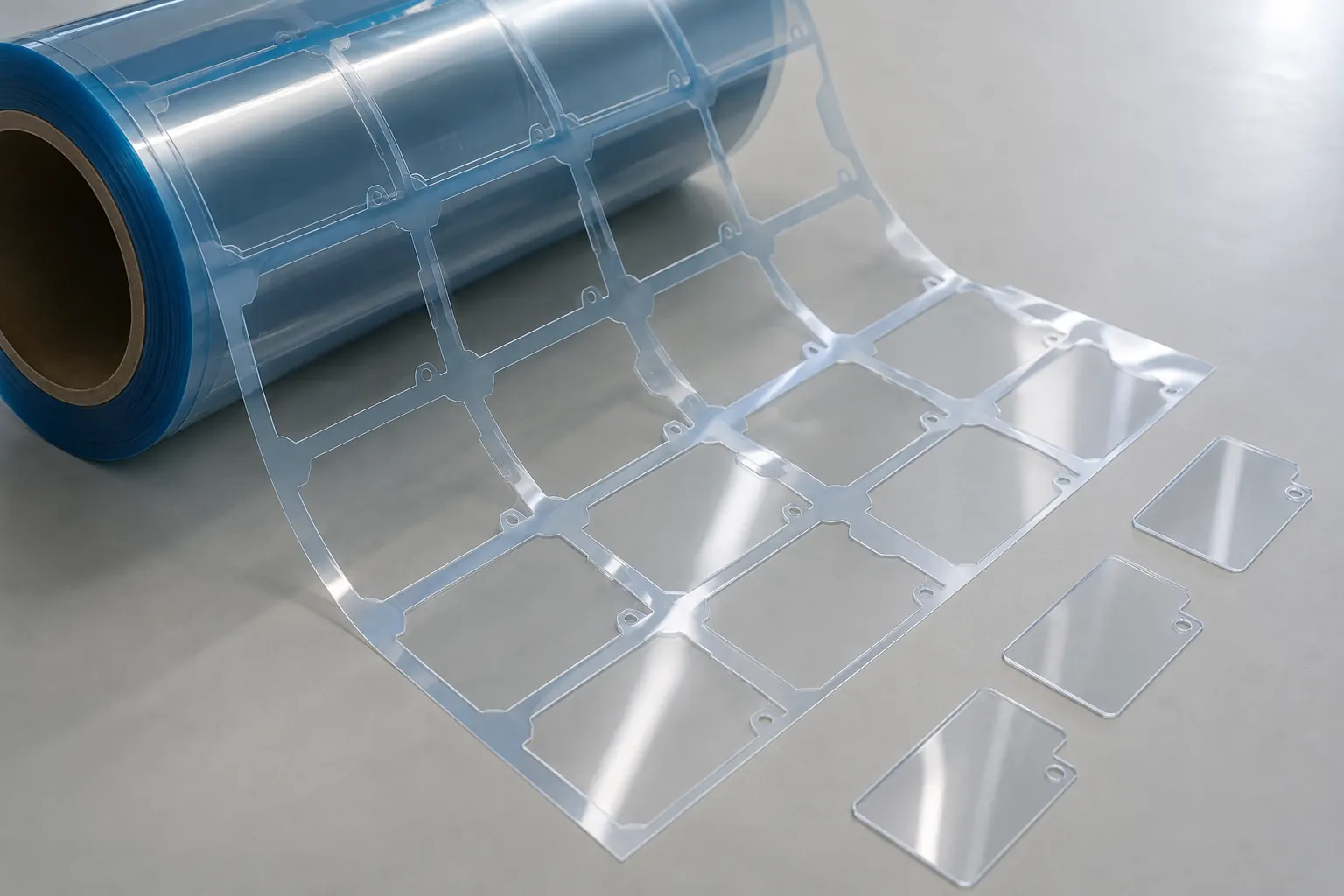
Rotary die cutting anti-static protective film creates masks, protective patches, windows and process components for sensitive products. The cut may need to stop at a release liner or pass through the full stack. Static, low-tack adhesive and lightweight slugs influence waste removal, so electrical and cleanliness performance should be tested after conversion.
Updated
Where This Cutting Application Appears
Display and electronics masks
Create protective shapes and windows registered to sensitive component geometry.
Antistatic adhesive patches
Kiss cut reusable or process-protection pieces retained on a liner.
Cleanroom protective components
Convert discrete film parts with controlled particles, charge and release.
Rotary Die Cutting process boundary
Rotary die cutting repeats registered profiles with a rotating tool across a moving web; it differs from straight slitting, cross cutting and simple edge trimming.
Rotary Die Cutting setup checkpoint
Confirm repeat pitch, registration marks, anvil condition, web tension, cutting depth and the waste path for every profile and internal feature.
Rotary Die Cutting acceptance checkpoint
Inspect registration, profile dimensions, corner quality, complete separation or controlled depth, liner condition and continuous waste removal.
Define the Required Cut Result
- Hold profile dimensions and registration after release.
- Preserve antistatic surface performance around the perimeter.
- Control liner depth, adhesive strings and part lifting.
- Remove matrix and slugs without particle redistribution.
Problems to Diagnose Before Changing the Knife
Small slugs cling to usable parts
- Measure static and review ionization.
- Check slug retention and extraction.
- Inspect feature density and geometry.
Protective shape lifts with the matrix
- Review release level and stripping angle.
- Check low-tack adhesive and corner orientation.
- Control web tension and charge.
Liner is cut through intermittently
- Map liner and total gauge variation.
- Define acceptable liner witness.
- Inspect support consistency.
Surface resistance changes after converting
- Standardize conditioning and measurement.
- Check rubbing, contamination and treatment face.
- Compare center and perimeter results.
Knife Forms That May Be Considered
| Possible knife form | When it may be considered | What must be confirmed |
|---|---|---|
| Rotary kiss-cut die arrangement | For antistatic adhesive shapes that must remain on a release liner. | Confirm all layers, required depth, liner witness, release, repeat, support and trial method. |
| Rotary through-cut profile arrangement | For discrete antistatic parts separated through the complete stack. | Confirm profile, part retention, slug control, delivery, station interface and approved drawing. |
Information to Send for Technical Review
You do not need to know the exact blade name. Send the available workpiece, machine, current-knife and cut-result information so the application can be reviewed against a drawing or sample.
- Carrier, gauge, antistatic treatment and target electrical property
- Adhesive, release liner and protected-surface compatibility
- Required kiss-cut or through-cut layer relationship
- Profile, radii, web direction, repeat and dimensional tolerance
- Speed, tension, humidity, grounding, ionization and cleanliness
- Rotary station interface, support and current cut sample
- Matrix layout, stripping direction, slug retention and collection
- Particle, liner, adhesive, electrical and application acceptance tests
Questions About This Cutting Application
Can a converted edge remain antistatic?
It depends on treatment coverage and handling; test defined perimeter and face positions after conditioning.
Why do slugs cling despite anti-static treatment?
Treatment reduces charge accumulation but does not eliminate all electrostatic forces, especially during fast separation.
How is kiss-cut depth specified safely?
Define the layers that must separate, allowable liner witness and functional release test rather than assuming a numeric depth.
Can low-tack adhesive still lift during weeding?
Yes. Release level, geometry, stripping direction, tension and static may lift the finished piece.
What should a cleanroom trial report?
Report profile quality, particle results, charge or resistance, matrix release, liner condition and end-use protection performance.
Related product and service information
- Anti-Static Protective Film Cross Cutting - anti-static protective film · transverse cross cutting
- Window Tint Film Rotary Die Cutting - window tint film · rotary die cutting
- Laser-Printable Film Rotary Die Cutting - laser-printable film · rotary die cutting
Request a Custom Cutting-Knife Review
Send the workpiece details, machine or holder information, current knife photos or sample, required quantity and examples of the present cut problem. Final dimensions, material, edge geometry and tolerances are confirmed from the approved requirements.