
Blade Application Guides / Application Guide / Technical films
Holographic Transfer Film Cross Cutting
Cross cutting holographic transfer film creates sheets or foil lengths whose optical pattern may need a defined relationship to the cut. Thin PET carriers retain roll curl and attract particles through static. The review should specify the optical datum, acceptable coating fracture and how reflective sheets will be supported and collected.
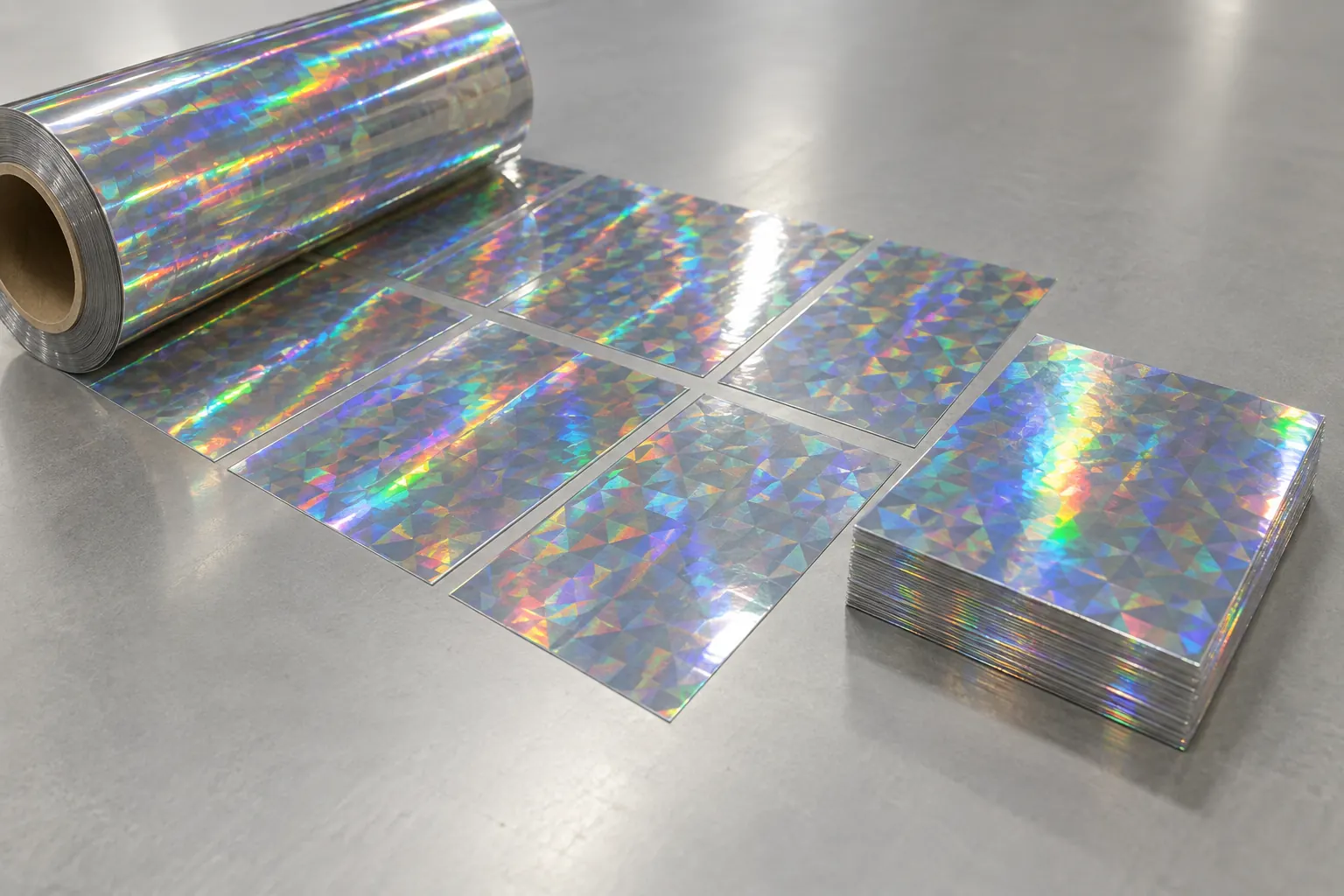
Where This Cutting Application Appears
Transfer foil sheets
Cut roll material into controlled lengths for platen or sheet-fed transfer operations.
Security-feature blanks
Register optical motifs to rectangular blanks for later integration.
Decorative sample panels
Prepare reflective sheets while preserving visible surface condition.
Common Ways to Describe This Cutting Problem
- holographic transfer film cross-cutting blades
- holographic foil transverse cutoff knife
- registered hologram repeat sheet cutting
- roll to sheet cutting diffractive PET film
- clean cross edge on metallized transfer foil
- control curl in holographic film sheets
- security foil length cutting application
- optical transfer web cutoff defect analysis
Define the Required Cut Result
- Register the transverse edge to the optical repeat where required.
- Avoid coating cracks, flakes and visible edge whitening.
- Control roll curl and keep sheets flat enough for handling.
- Discharge sheets without static clinging, scratching or creasing.
Problems to Diagnose Before Changing the Knife
Optical motif is cut at inconsistent positions
- Define the optical datum and repeat.
- Check sensor contrast and web stretch.
- Separate repeat variation from cutoff timing.
Transverse edge sheds coating particles
- Inspect layer stack and coating adhesion.
- Review support and cut progression.
- Compare both web orientations.
Sheets roll back into tight curls
- Record roll diameter and winding age.
- Check carrier gauge and coating balance.
- Define conditioning before measurement.
Reflective surfaces scratch during stacking
- Map face orientation and contact surfaces.
- Control particles and static.
- Review interleaving or stacking pressure.
Knife Forms That May Be Considered
| Possible knife form | When it may be considered | What must be confirmed |
|---|---|---|
| Straight cross-cut arrangement | For sheet cutoff against a defined counter-edge or support. | Confirm motion, rake, support, holder, coated-face orientation and required length. |
| Rotary cutoff arrangement | For repeated high-speed lengths with synchronized optical registration. | Confirm repeat, sensor control, cylinder interface, speed and delivery method. |
Information to Send for Technical Review
You do not need to know the exact blade name. Send the available workpiece, machine, current-knife and cut-result information so the application can be reviewed against a drawing or sample.
- PET carrier gauge and complete holographic transfer coating stack
- Optical motif, repeat length, datum and web direction
- Roll width, cutoff length and dimensional tolerance
- Speed, tension, registration sensor and feed method
- Cutoff motion, support, holder drawing and existing sample
- Coated-face orientation, static control and sheet collection
- Allowed coating flakes, edge haze, curl and scratches
- Downstream transfer method, packing and production quantity
Questions About This Cutting Application
Can the holographic pattern serve as a cutoff mark?
Only if its selected feature is detectable and stable enough for the registration system; a defined datum is essential.
Why does the cut edge look different by viewing angle?
Coating fracture and embossed structure scatter directional light differently, so inspection conditions must be standardized.
How should curl be measured?
Define sheet size, conditioning time, orientation and whether gentle restraint is permitted.
Can static damage the coating?
Static mainly attracts particles and disrupts handling, but resulting rubbing can scratch a sensitive surface.
What should be supplied for a registered review?
Provide repeat samples, mark details, cut-position tolerance, web direction and accepted finished blanks.
Request a Custom Cutting-Knife Review
Send the workpiece details, machine or holder information, current knife photos or sample, required quantity and examples of the present cut problem. Final dimensions, material, edge geometry and tolerances are confirmed from the approved requirements.