
Blade Application Guides / Application Guide / Foil converting
Aluminum Foil Roll Slitting Without Edge Cracks
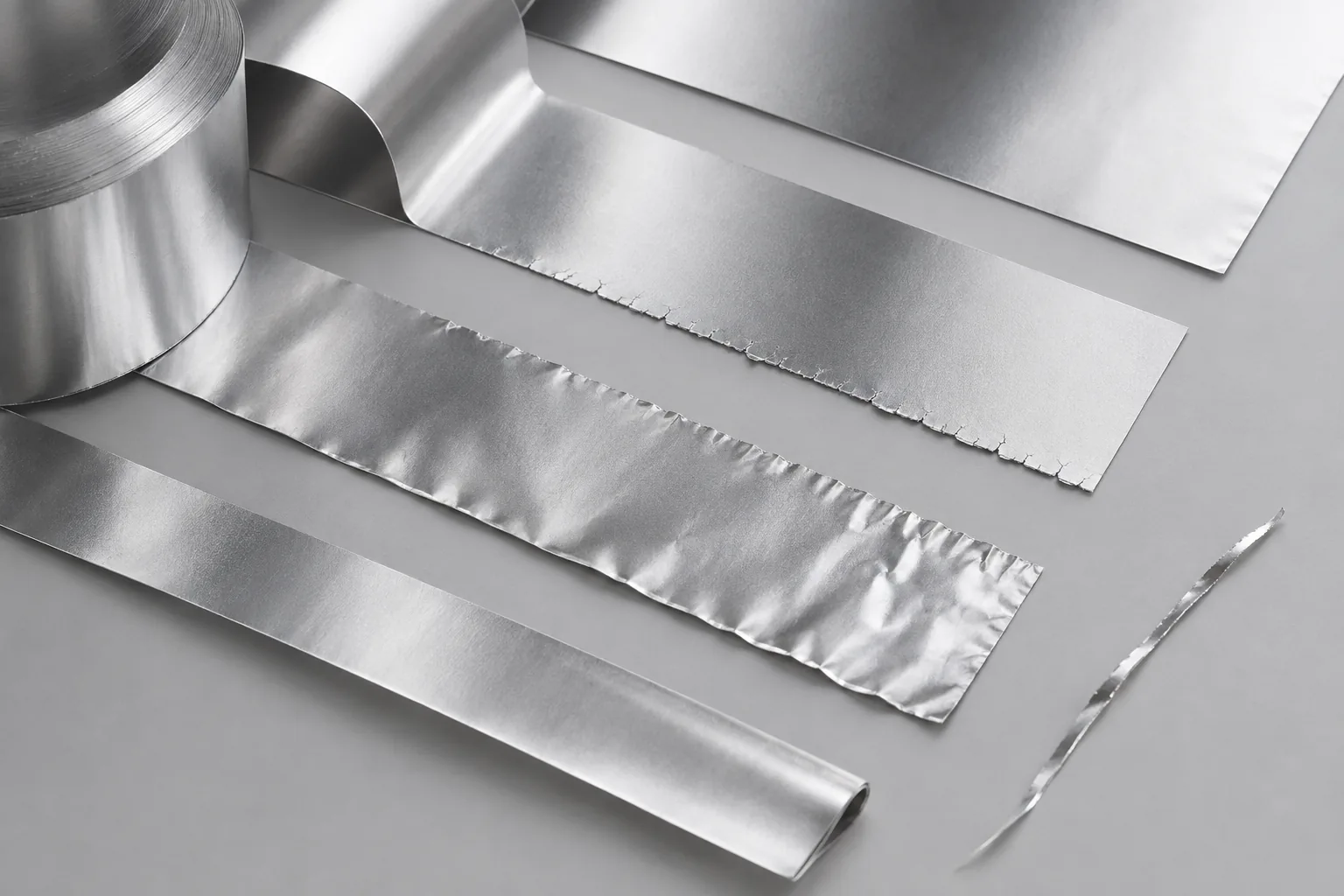
Thin aluminum foil can wrinkle, tear from small edge cracks, or retain a raised edge after slitting. Foil temper, thickness, incoming edge condition, web tension, support, cleanliness, and rewind pressure must be evaluated together.
Updated
Where This Cutting Application Appears
Household foil roll conversion
Master foil is slit into consumer-roll widths where edge cracks must not propagate during rewinding and later dispensing.
Lidding and packaging foil preparation
Plain or coated foil is width-converted before printing, laminating, or lid forming with clean edges and controlled particles.
Insulation and technical foil reel sizing
Thin foil webs are divided for composite and insulation processes where wrinkles and unstable narrow reels hinder lamination.
Roll Slitting process boundary
Roll slitting divides a master roll longitudinally into narrower rolls; it does not separate the web transversely into sheets or fixed lengths.
Roll Slitting setup checkpoint
Confirm unwind and rewind tension, slit widths, knife positions, core alignment, trim removal and the winding behavior of every daughter roll.
Roll Slitting acceptance checkpoint
Inspect roll width, edge condition, telescoping, interleaving, debris and whether each rewound roll remains stable at the required diameter.
Define the Required Cut Result
- Create continuous foil edges without crack starters or projecting slivers
- Keep thin web flat through separation and rewind
- Control metallic particles around coated and packaging surfaces
- Hold narrow-reel width, face alignment, and winding firmness
Problems to Diagnose Before Changing the Knife
Microcracks propagate from the slit edge
Inspect foil alloy and temper, thickness, incoming edge, tension, wrinkle history, cutting-side condition, and crack direction.
Wrinkles enter or leave the slit point
Review roller alignment, web tension profile, unsupported span, guide correction, roll hardness, and whether wrinkles are upstream or generated after separation.
Raised edge lip or fine aluminum slivers
Compare overlap or penetration, side load, support, holder runout, foil temper, speed, and which side carries the deformation.
Loose narrow reels or shifted layers
Check core alignment, winding torque, tension taper, nip, lane width, air entrainment, and handling after rewind.
Knife Forms That May Be Considered
| Possible knife form | When it may be considered | What must be confirmed |
|---|---|---|
| Circular shear slitting | Consider for supported foil separation with precise overlap and side-load control. | Confirm foil thickness and temper, rotation, overlap, holder accuracy, web path, and approved interface drawing. |
| Razor-style slitting | Consider only for foil constructions and support paths that have been proven not to tear or wrinkle. | Confirm entry support, tension, coating, speed, particle limits, and production foil samples. |
Information to Send for Technical Review
You do not need to know the exact blade name. Send the available workpiece, machine, current-knife and cut-result information so the application can be reviewed against a drawing or sample.
- Aluminum alloy, temper, thickness range, and supplier specification
- Plain, lacquered, printed, laminated, or embossed condition
- Master-roll width, diameter, core, roll hardness, and incoming edge state
- Required slit widths, tolerances, reel diameter, and face criteria
- Line speed, tension zones, guiding, support span, and web direction
- Rewind method, torque or tension taper, nip, and core alignment
- Magnified photos of cracks, lips, slivers, particles, and wrinkles by lane
- Current slitting geometry, holder interface, cleaning controls, and downstream process
Questions About This Cutting Application
How can a microcrack at a foil edge be documented?
Use consistent magnification, mark lane and side, record crack direction and length, and retain the reel section without folding the edge.
Why can foil wrinkle only after lanes separate?
Individual lanes may lose lateral support or receive different tension and air entrainment. Compare web flatness before the slit point with each rewind lane.
Does foil temper matter to the slitting review?
Yes. Temper affects ductility, tearing, edge deformation, and wrinkle response. Provide the actual alloy-temper designation and samples.
What should be checked before approving packaging foil reels?
Review edge cracks, particles, width, face alignment, wrinkles, winding firmness, coating integrity, and behavior in the next printing or laminating step.
Can a household foil sample represent every technical foil?
No. Thickness, temper, coating, embossing, surface limits, and downstream process can differ. Confirm each intended foil construction and drawing.
Related product and service information
- Blister Lidding Foil Cutting Without Wrinkle Damage - blister lidding foil · profile cutting
- Pharmaceutical Strip-Pack Foil Slitting - pharmaceutical strip-pack laminate foil · laminate slitting and rewinding
- Nonwoven Packaging Web Cutting Without Fiber Drag - nonwoven packaging webs · web cutting
Request a Custom Cutting-Knife Review
Send the workpiece details, machine or holder information, current knife photos or sample, required quantity and examples of the present cut problem. Final dimensions, material, edge geometry and tolerances are confirmed from the approved requirements.