
Blade Application Guides / Application Guide / Wind-turbine blade manufacturing
Wind-Blade Structural Adhesive Film Shear Slitting Blades
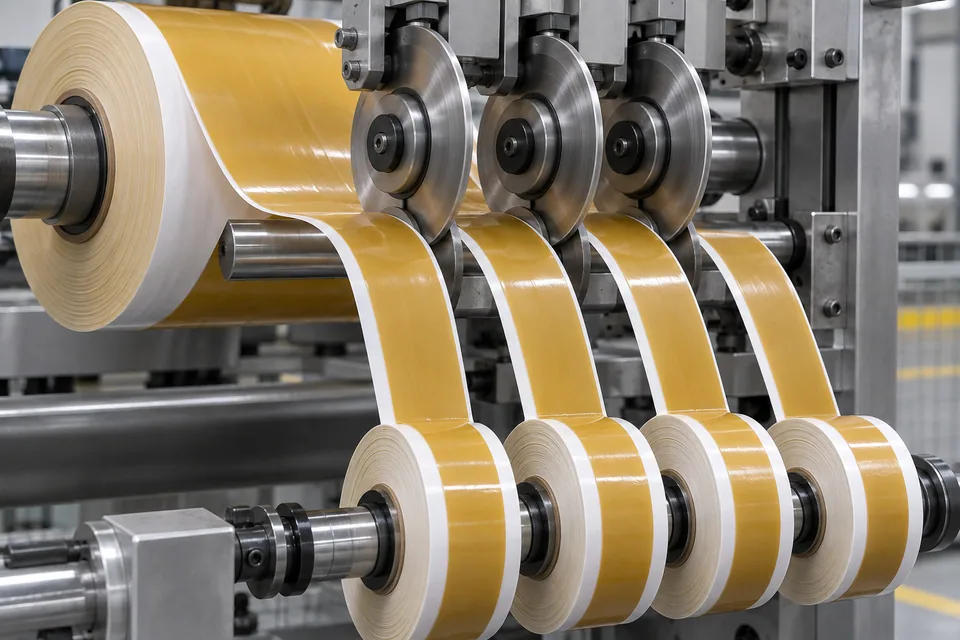
Notus Composites identifies adhesive films for wind-energy composites, while Hexcel documents structural film adhesives supplied as rolls. A SAERTEX blade-preforming study describes film placed at defined local regions, but does not prove structural film use in a production blade. This guide applies only when the buyer specifies a qualified structural film for a named local blade bond area and supplies a wide roll. DIENES describes paired circular knives for shear slitting; their suitability for the actual film-and-liner stack needs a trial. The knife pair must sever the stack without squeeze-out or roll blocking. Sika's two-component shell adhesive is a different workpiece.
Updated
Where This Cutting Application Appears
Define a blade-detail film stack
Confirm the approved film grade, named local blade bond area, liner count, carrier or reinforcement and target lane width. Set acceptance criteria for adhesive edge, exposed tack, liner continuity and core orientation. The bond engineer must authorize the film form; a converter should not select an adhesive based only on slitting convenience.
Trial upper and lower circular knives
Use a shear-slitting station with controlled knife engagement and web path. Set overlap and contact according to equipment rules, then adjust by observing the real adhesive stack. Too much compression can force adhesive sideways, while insufficient engagement can leave liner or carrier bridges. A film that cuts when chilled or at one handling state may behave differently at its approved application state.
Inspect the composite edge
Examine both retained lanes and waste for liner fibers, adhesive strings, displaced scrim, exposed tack and resin transfer to knife faces. Measure lane width with the material in the specified state and examine any edge deformation after relaxation. Keep a sample of the incoming roll so manufacturing and incoming defects can be compared.
Wind and unwind a narrow trial roll
Monitor tension and side-to-side tracking. Look for adhesive squeeze-out at the roll face and blocking between turns. The receiving station should peel the liner and place the film without tearing the carrier or stretching the adhesive. A good shear edge at the knife is insufficient if the roll cannot unwind cleanly.
Keep bond qualification separate
Record film lot, tool arrangement, handling history and inspection result with the converted roll. The blade maker must continue to apply the approved bond schedule and test the bonded joint. This guide makes no claim about cured joint strength, environmental endurance or flight-like certification; it addresses only an intermediate shear conversion. Compare the first and last winding turns because accumulated adhesive residue can change a shear edge during a production-length run. Keep any rejected trial strip segregated from approved production material.
Define the Required Cut Result
- Sever approved film, carrier and liner with a paired shear set.
- Avoid adhesive squeeze-out and liner bridging.
- Deliver stable narrow rolls that unwind cleanly.
- Preserve handling and lot records.
Problems to Diagnose Before Changing the Knife
Shear pair drives adhesive into roll face
- Review engagement and web support.
- Inspect blade pickup and wound turns.
- Trial only within supplier handling controls.
Carrier or liner remains bridged
- Inspect waste and both cut faces.
- Check knife condition and relative position.
- Reject rolls that tear during unwinding.
Knife Forms That May Be Considered
| Possible knife form | When it may be considered | What must be confirmed |
|---|---|---|
| Upper/lower circular shear pair | For a specifically qualified adhesive film stack. | Confirm full-stack severance without edge bleed. |
Information to Send for Technical Review
You do not need to know the exact blade name. Send the available workpiece, machine, current-knife and cut-result information so the application can be reviewed against a drawing or sample.
- Approved film adhesive and local bond detail
- Carrier, liner and adhesive thickness stack
- Shear machine and knife engagement limits
- Handling, storage and exposure controls
- Edge, blocking and downstream peel criteria
Questions About This Cutting Application
Can this process cut blade-bonding paste?
No. Paste adhesive is dispensed, not shear slit as a roll.
What distinguishes shear slitting?
Interacting upper and lower circular knives create the longitudinal cut.
Is a clean edge enough?
No. Narrow rolls must rewind, unwind and release liners correctly.
Does the knife trial approve the blade bond?
No. Bond qualification and cured performance are separate.
Public references and scope
These public sources provide material, cutting-method or safety context for this guide. Supplier pages describe their own materials or equipment; they do not establish a MEIRENTE blade specification or performance claim. Confirm the actual grade, machine setup and required cut with a drawing or sample.
Related product and service information
- End-Grain Balsa Core Sheet Cut-To-Size Blades - end-grain balsa core sheet · cut to size
- Blade-Root Reinforcement Fabric Shear Slitting Blades - blade-root reinforcement fabric · shear slitting
- Blade Leading-Edge Protection Tape Shear Slitting Blades - blade leading-edge protection tape · shear slitting
Request a Custom Cutting-Knife Review
Send the workpiece details, machine or holder information, current knife photos or sample, required quantity and examples of the present cut problem. Final dimensions, material, edge geometry and tolerances are confirmed from the approved requirements.