
Blade Application Guides / Application Guide / Wind blade manufacturing
End-Grain Balsa Core Sheet Cut-To-Size Blades
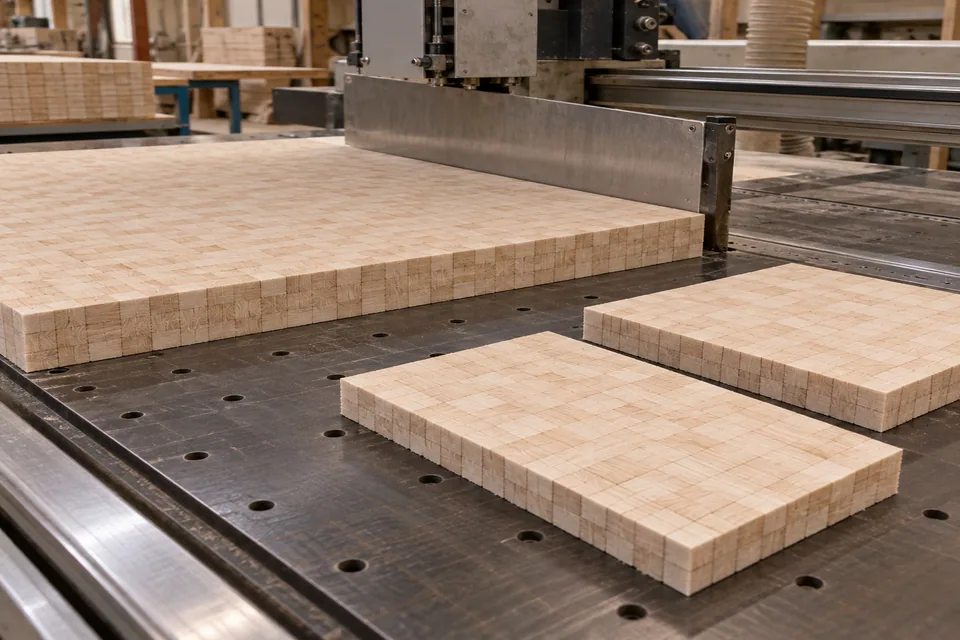
Gurit's Balsaflex data sheet documents end-grain balsa core for wind energy in rigid sheet and flexible contour-scrim formats, with coating, groove and perforation options. Gurit separately describes core kitting, while 3A Composites manufactures balsa core and kit parts for wind applications. These sources support sheet cut-to-size as an intermediate operation. This page concerns a simple blank from a larger sheet, not milling a cured blade shell or fitting a complex blade contour. Tooling must be selected for the actual block, scrim and surface format.
Updated
Where This Cutting Application Appears
Read the core map before sizing
Match each rectangle to the blade shell or shear-web core kit drawing. Record sheet grade, density class, thickness, grain direction and any coating, kerfing, perforation or scrim. Those features can influence where the stock cut may fall. Reserve drawing-defined margin if a later contour operation will form the final blade-core shape.
Support blocks and backing together
For a rigid plain panel, hold the wood sheet flat without crushing the end-grain cells. For a flexible contour-scrim format, support individual blocks so they do not fold away from the tool while the scrim stretches. Trial a real edge containing grooves or perforations if they are present in production stock. Do not assume a thin-film slitter is appropriate for a thick segmented core.
Inspect the entire thickness
Measure length, width and squareness, then inspect block edges for splinters, loose wood dust, crushed corners and torn scrim. Check whether coating was lifted near the edge or whether a groove became bridged by debris. Look at both faces because the front may appear sound while backing damage is visible only from below.
Kit by position and orientation
Label the blank for its blade-core location and protect it from contamination before infusion. Separate natural density or moisture concerns from cutter defects under the core supplier’s acceptance method. The blade maker validates resin uptake, bonding and structural performance after the core is installed; a rectangular blank is not a finished sandwich panel.
Evaluate a representative curved-layup handoff
Give an accepted blank to the kitting team to verify that it nests in the intended blade region without losing an edge block. The actual final kit may need a curved profile, relief or local density transition. Record how a cut through a scrim-backed region behaves during transfer. If blocks detach when the blank is handled, the tool route needs revision even if the measured rectangle is correct. The inspection record should note whether the defect began at an existing kerf or at the newly cut sidewall, because the remedy differs.
Define the Required Cut Result
- Create identified stock blanks from end-grain balsa sheets.
- Keep blocks, scrim and surface treatment intact.
- Control wood dust and splintered edges.
- Preserve core location and later machining allowance.
Problems to Diagnose Before Changing the Knife
Edge blocks detach during lifting
- Inspect backing and block support.
- Review cut through grooves and scrim.
- Compare handling route after sizing.
Wood dust remains in infusion grooves
- Check tool and extraction method.
- Examine both faces and full thickness.
- Apply supplier-approved cleaning only.
Knife Forms That May Be Considered
| Possible knife form | When it may be considered | What must be confirmed |
|---|---|---|
| Core-compatible straight blade or saw | For rigid balsa sheet stock after edge trials. | Check splinter, dust and full-depth dimensions. |
| Supported segmented-sheet cutter | For flexible scrim-backed formats if accepted. | Verify blocks stay attached and grooves remain open. |
Information to Send for Technical Review
You do not need to know the exact blade name. Send the available workpiece, machine, current-knife and cut-result information so the application can be reviewed against a drawing or sample.
- Balsa grade, thickness and sheet format
- Rigid or scrim-backed segmented construction
- Core kit map and grain orientation
- Groove, coating and perforation details
- Splinter, dust and block-adhesion criteria
Questions About This Cutting Application
Is this ordinary plywood cutting?
No. End-grain balsa core may be segmented or surface-treated for infusion.
Does this make the final blade-core shape?
Not necessarily; cut to size creates stock for later kitting.
Why inspect the underside?
A scrim or backing can tear while the top blocks appear sound.
Can a clean rectangle prove blade bond performance?
No. Infusion and bonded sandwich acceptance are downstream.
Public references and scope
These public sources provide material, cutting-method or safety context for this guide. Supplier pages describe their own materials or equipment; they do not establish a MEIRENTE blade specification or performance claim. Confirm the actual grade, machine setup and required cut with a drawing or sample.
Related product and service information
- PET Structural Foam Core Cut-To-Size Blades - PET structural foam core · cut to size
- Silicone Rubber Sheet Cut To Size Blades - silicone rubber sheet · cut to size
- Fluoroelastomer Rubber Sheet Cut To Size Blades - fluoroelastomer rubber sheet · cut to size
Request a Custom Cutting-Knife Review
Send the workpiece details, machine or holder information, current knife photos or sample, required quantity and examples of the present cut problem. Final dimensions, material, edge geometry and tolerances are confirmed from the approved requirements.