
Blade Application Guides / Application Guide / Wind-turbine blade manufacturing
Wind-Blade Structural Adhesive Film Rotary Die-Cutting Blades
Notus Composites identifies adhesive film as a wind-energy composite material and describes carrier options, while Hexcel documents structural adhesive films supplied as rolls. Adhesive-film converter Krückemeyer describes continuous rotary die cutting and liner-preserving kiss cuts. These sources establish the material form and a possible converting method, but do not prove that any particular wind-blade adhesive grade is rotary-die compatible. This guide addresses repeated, drawing-defined small film patches or local bond shapes from a qualified roll, not an entire long blade-shell bond line. The bond engineer must first approve the film, geometry, carrier and cure route.
Updated
Where This Cutting Application Appears
Identify a real repeat part
Start with a blade-joint drawing that calls for discrete adhesive-film pieces and gives shape, pitch and placement orientation. Confirm the selected grade can be supplied in a processable roll width with its protective liner. A continuous shell-bonding paste bead cannot be substituted into a rotary die press. Large or irregular film plies may be better suited to a flat cutting table; process choice follows the actual part.
Choose through cut or liner-retained cut
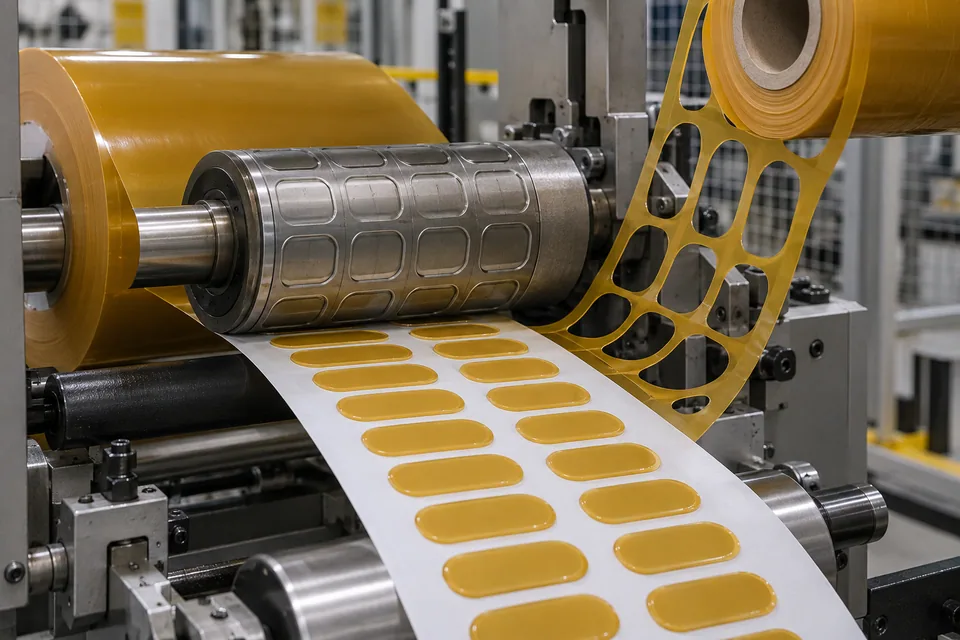
Decide whether finished film pieces remain on a release web for application or are fully separated. Trial die depth on the complete adhesive, carrier and liner stack. In a liner-retained kiss cut, the film outline must separate while the intended release layer remains continuous. In a through cut, inspect the support and transfer method so tacky pieces do not distort during removal.
Run repeated die impressions
Set die registration and web tracking to the approved shape layout. Observe adhesive pickup on cylindrical tooling, compression at narrow corners and carrier fibers that bridge between repeated cavities. Stop if a slug stays attached or transfers back onto the film. Record quality at start and after enough cycles to reveal buildup; one attractive sample is insufficient.
Inspect and package the film pieces
Measure outline, cut completeness and location on liner. Check adhesive squeeze-out, exposed tack, distorted corners, carrier displacement and clean matrix stripping. Confirm each piece can be peeled and placed without stretching. Segregate rejected pieces and preserve the original film lot, handling controls and die revision.
Validate downstream application
Use a trial sheet or roll at the specified blade-joint station. Confirm pieces sit in the intended location and that liner removal does not bring up adhesive. The blade maker still verifies bond-surface preparation, cure and final joint properties. A successful die-cut pattern establishes conversion repeatability, not a certified wind-blade bond.
Define the Required Cut Result
- Produce repeatable approved film shapes from a compatible roll.
- Preserve release liner or make a verified through cut.
- Avoid adhesive buildup, bleed and carrier bridges.
- Keep the qualified bond process and lot identity.
Problems to Diagnose Before Changing the Knife
Adhesive accumulates on the rotary die
- Inspect impressions over a production-like run.
- Review tool release and handling within supplier limits.
- Check shape edges after buildup.
Matrix removal pulls a film patch off the liner
- Revisit die depth and web support.
- Check shape geometry and release balance.
- Test real pickup at application.
Knife Forms That May Be Considered
| Possible knife form | When it may be considered | What must be confirmed |
|---|---|---|
| Rotary die cylinder | For repeated small shapes on a qualified roll. | Confirm stable registration and clean full-stack outline. |
| Rotary kiss-cut die | When pieces must remain on a release liner. | Verify liner continuity and clean matrix stripping. |
Information to Send for Technical Review
You do not need to know the exact blade name. Send the available workpiece, machine, current-knife and cut-result information so the application can be reviewed against a drawing or sample.
- Qualified adhesive-film grade and wind-blade joint drawing
- Repeat shape, pitch and orientation
- Carrier, liner and adhesive stack
- Die depth and matrix-removal route
- Handling limits, edge and pickup criteria
Questions About This Cutting Application
Is this a blade-shell paste adhesive process?
No. It requires a film roll approved for the specific bond detail.
Why choose rotary die cutting?
It can repeat a defined outline along a moving web when the film stack tolerates it.
Can the liner be left uncut?
Yes, if a qualified kiss-cut process keeps it intact.
Does die cutting approve the adhesive joint?
No. Joint placement and cured properties require separate validation.
Public references and scope
These public sources provide material, cutting-method or safety context for this guide. Supplier pages describe their own materials or equipment; they do not establish a MEIRENTE blade specification or performance claim. Confirm the actual grade, machine setup and required cut with a drawing or sample.
Related product and service information
- Wind-Blade Structural Adhesive Film Shear Slitting Blades - wind-blade structural adhesive film · shear slitting
- Blade Leading-Edge Protection Tape Rotary Die-Cutting Blades - blade leading-edge protection tape · rotary die cutting
- Blade-Root Reinforcement Fabric Roll Slitting Blades - blade-root reinforcement fabric · roll slitting
Request a Custom Cutting-Knife Review
Send the workpiece details, machine or holder information, current knife photos or sample, required quantity and examples of the present cut problem. Final dimensions, material, edge geometry and tolerances are confirmed from the approved requirements.