
Blade Application Guides / Application Guide / Wind-turbine blade manufacturing
Blade Leading-Edge Protection Tape Rotary Die-Cutting Blades
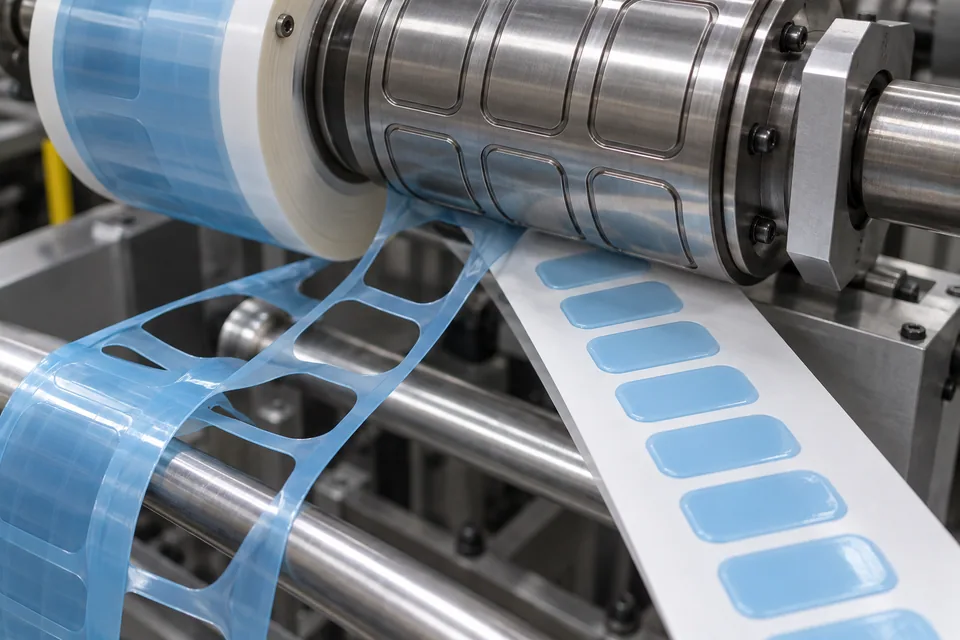
3M supplies wind-blade leading-edge protection tape as a polyurethane/acrylic adhesive roll. 3M also describes converter-partner die-cutting of protective films, and specialist converter Krückemeyer documents rotary die cutting of adhesive films. These facts support a conditional process for repeated short tape shapes on a qualified liner-backed source roll. They do not imply that a rotary cylinder can cut full blade-length protection strips or that an existing 3M wind tape is approved for this conversion. Limit this route to a blade owner’s approved localized protection or repair-piece drawing and verify the exact grade in a die trial.
Updated
Where This Cutting Application Appears
Define a short repeat shape
Read the installation drawing for the protection patch outline, direction and edge radius. Confirm that the selected wind tape grade may be supplied and converted in the required width. Full-length leading-edge strips are usually handled as lengths from a roll; a short repeating die shape must have a specific use. The blade owner controls overlap and placement against adjacent protection.
Choose liner-retained or through-cut output
Decide whether pieces remain on a carrier liner for transfer or are fully separated. For a kiss cut, the rotary die must sever polyurethane and adhesive while leaving the release layer sound. For a through cut, provide a way to remove tacky patches without stretching them. Trial narrow corners where compression or adhesive migration is most likely.
Test registration and waste removal
Track web pitch and inspect each impression for backing nicks, adhesive strings and incomplete cuts. Strip the surrounding matrix slowly enough to reveal patches that lift from the liner or distort. Check cylindrical tooling for adhesive accumulation through a production-like sequence, not only on the first good-looking patch.
Inspect application-ready pieces
Measure outline and liner presentation. Verify that a patch peels intact, keeps its adhesive protected and conforms to the intended curved fixture. Look for squeezed adhesive at the perimeter and cut-through marks in the release liner. Separate rejected shapes and keep grade, lot and die version traceable.
Use the qualified installation method
Place trial pieces on the specified blade location under the tape maker’s surface-preparation and application instructions. Confirm edge laydown and any approved sealing step. Die cutting creates a repeatable geometry; erosion and weathering performance require the complete validated protection system. Preserve the drawing revision and the roll orientation on each output strip. A geometrically correct patch can still be unusable if its liner presentation forces the installer to touch the acrylic adhesive before placement. Confirm the peel tab or matrix layout with the receiving team.
Define the Required Cut Result
- Repeat approved short protection-tape outlines.
- Control backing, adhesive and release-liner depth.
- Keep matrix stripping and patch pickup clean.
- Preserve product qualification and installation traceability.
Problems to Diagnose Before Changing the Knife
Patch lifts with waste matrix
- Review kiss-cut depth and liner support.
- Check outline and release balance.
- Test manual pickup.
Adhesive accumulates at patch corners
- Inspect die over repeated cycles.
- Review tool pressure and film state.
- Reject compressed edges.
Knife Forms That May Be Considered
| Possible knife form | When it may be considered | What must be confirmed |
|---|---|---|
| Rotary die cylinder | For repeated short shapes on compatible approved tape. | Verify outline and web registration. |
| Rotary kiss-cut die | When adhesive pieces remain on an intact liner. | Confirm liner continuity and clean matrix stripping. |
Information to Send for Technical Review
You do not need to know the exact blade name. Send the available workpiece, machine, current-knife and cut-result information so the application can be reviewed against a drawing or sample.
- Approved wind-tape grade and conversion authorization
- Short repeat-part drawing and application location
- Backing/adhesive/liner construction
- Die depth and waste-removal route
- Patch pickup and edge-laydown acceptance
Questions About This Cutting Application
Does rotary die cutting make a full-length blade strip?
This guide covers repeated short shapes; long strips need their own conversion route.
Is any protection tape automatically die-cuttable?
No. Test the approved backing, adhesive and liner.
Can a liner remain intact?
A qualified kiss cut can leave the specified release layer continuous.
Does a clean patch certify field performance?
No. The installed protection system requires separate acceptance.
Public references and scope
These public sources provide material, cutting-method or safety context for this guide. Supplier pages describe their own materials or equipment; they do not establish a MEIRENTE blade specification or performance claim. Confirm the actual grade, machine setup and required cut with a drawing or sample.
Related product and service information
- Blade Leading-Edge Protection Tape Shear Slitting Blades - blade leading-edge protection tape · shear slitting
- Wind-Blade Structural Adhesive Film Rotary Die-Cutting Blades - wind-blade structural adhesive film · rotary die cutting
- Blade-Root Reinforcement Fabric Roll Slitting Blades - blade-root reinforcement fabric · roll slitting
Request a Custom Cutting-Knife Review
Send the workpiece details, machine or holder information, current knife photos or sample, required quantity and examples of the present cut problem. Final dimensions, material, edge geometry and tolerances are confirmed from the approved requirements.