
Blade Application Guides / Application Guide / Wind-turbine blade manufacturing
Blade-Root Reinforcement Fabric Roll Slitting Blades
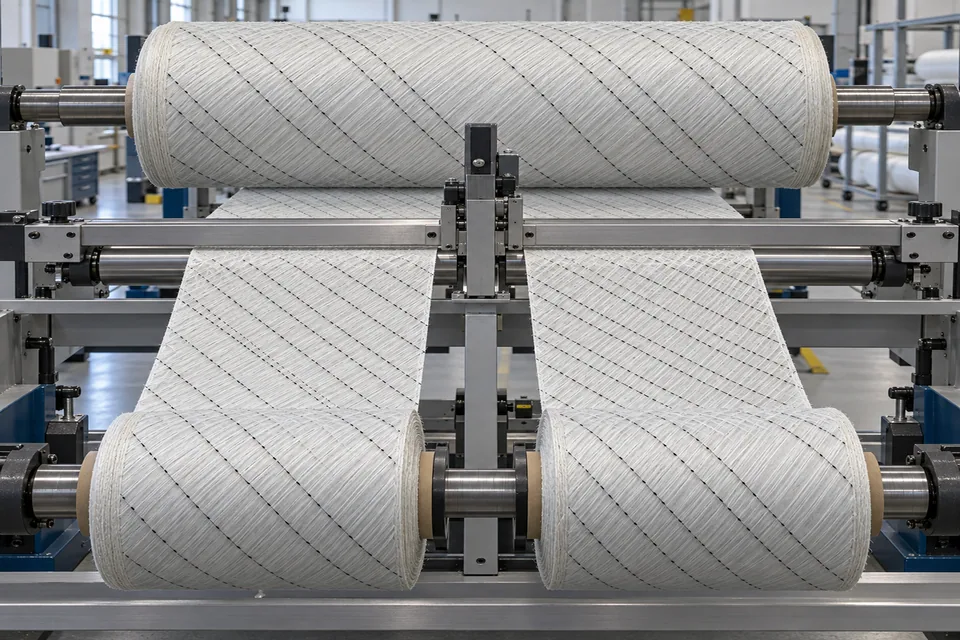
SAERTEX identifies multiaxial non-crimp reinforcement textiles for wind-turbine blade roots and offers cutting and kitting of reinforcement plies. For a dry blade-root fabric delivered as a continuous roll, roll slitting can prepare narrower feed rolls for later ply cutting. This page concerns the roll-to-roll conversion layout, not the final curved root ply. A stitched multiaxial construction differs from an ordinary single-layer woven fabric: the specified fiber axes, stitching, areal weight and width all matter. The exact textile and roll format must be confirmed before choosing a slitting mode.
Updated
Where This Cutting Application Appears
Plan lanes from the root layup
Start with the blade-root ply schedule and incoming master-roll usable width. Allocate each target lane, edge waste and any permitted handling margin without changing the designed fiber orientation. Note whether the roll includes a scrim, veil or stitched combination of glass and carbon. A narrower roll is useful only if the subsequent cutting station can identify its material and direction.
Run a controlled unwind and rewind
Support the full incoming web and set winding conditions by trials on the actual fabric. A dry non-crimp textile can distort if side pull shifts one fiber layer against another. Capture the edge waste before it tangles with the retained lanes. This broad roll-slitting route does not prescribe shear, crush or razor cutting; compare candidate modes on samples before fixing the knife specification.
Inspect lane edges and winding
Check width along the roll and examine both edges for liberated filaments, pulled stitch loops and loose outer layers. Look for telescoping, wrinkles or uneven edge build after rewinding, not just at the cutter. The resulting roll must feed smoothly into final ply nesting. Document any difference between a cut parallel to a principal fiber direction and one that intersects angled fibers.
Preserve identity through kitting
Identify each slit roll by original lot, reinforcement architecture, target width and fiber direction. Protect rolls from contamination and accidental edge compression. SAERTEX describes separate cutting and kitting services; those later operations form the root ply geometry. A narrow roll does not establish root laminate fit, infusion or cured strength.
Approve with a downstream feed trial
Run a representative slit roll through the actual ply-cutting or layup-feed system. Check whether stitch loss increases after unwinding and whether the lane tracks without skew. Measure usable width after relaxation instead of relying on the knife spacing alone. Retain a master-roll sample so incoming defects are not misdiagnosed as slitting damage.
Define the Required Cut Result
- Prepare continuous, identifiable root-fabric lanes.
- Keep fiber axes, stitching and usable width intact.
- Build stable rolls for later ply cutting.
- Control loose filament and edge-waste handling.
Problems to Diagnose Before Changing the Knife
Stitch loops unravel at lane edge
- Compare cutting modes on actual fabric.
- Inspect both retained edge and waste.
- Check handling after rewind.
Narrow roll telescopes
- Review winding tension and web tracking.
- Check edge-waste removal.
- Measure width after relaxation.
Knife Forms That May Be Considered
| Possible knife form | When it may be considered | What must be confirmed |
|---|---|---|
| Qualified web-slitting knife set | For continuous dry fabric after an architecture-specific trial. | Confirm clean lane edges and stable roll build. |
| Paired shear knives | One candidate when textile and machine support shear cutting. | Check stitch retention and filament tails; do not assume universal suitability. |
Information to Send for Technical Review
You do not need to know the exact blade name. Send the available workpiece, machine, current-knife and cut-result information so the application can be reviewed against a drawing or sample.
- Actual dry fabric specification and stitched architecture
- Master and target lane widths
- Fiber-axis and later ply-nesting plan
- Winding core and tension limits
- Edge-fray and downstream feed criteria
Questions About This Cutting Application
Does slitting make the final blade-root ply?
No. It creates narrow continuous rolls for later geometry cutting and layup.
Is every blade-root fabric a woven cloth?
No. A non-crimp fabric can have separately oriented stitched layers.
Must the knife be a shear pair?
No. Roll slitting describes the conversion; the blade mode needs a material trial.
What proves the lane is usable?
Stable downstream feeding plus acceptable width, fibers and stitches.
Public references and scope
These public sources provide material, cutting-method or safety context for this guide. Supplier pages describe their own materials or equipment; they do not establish a MEIRENTE blade specification or performance claim. Confirm the actual grade, machine setup and required cut with a drawing or sample.
Related product and service information
- Blade-Root Reinforcement Fabric Shear Slitting Blades - blade-root reinforcement fabric · shear slitting
- Wind-Blade Structural Adhesive Film Roll Slitting Blades - wind-blade structural adhesive film · roll slitting
- Blade Leading-Edge Protection Tape Roll Slitting Blades - blade leading-edge protection tape · roll slitting
Request a Custom Cutting-Knife Review
Send the workpiece details, machine or holder information, current knife photos or sample, required quantity and examples of the present cut problem. Final dimensions, material, edge geometry and tolerances are confirmed from the approved requirements.