
Blade Application Guides / Application Guide / Wind-turbine blade manufacturing
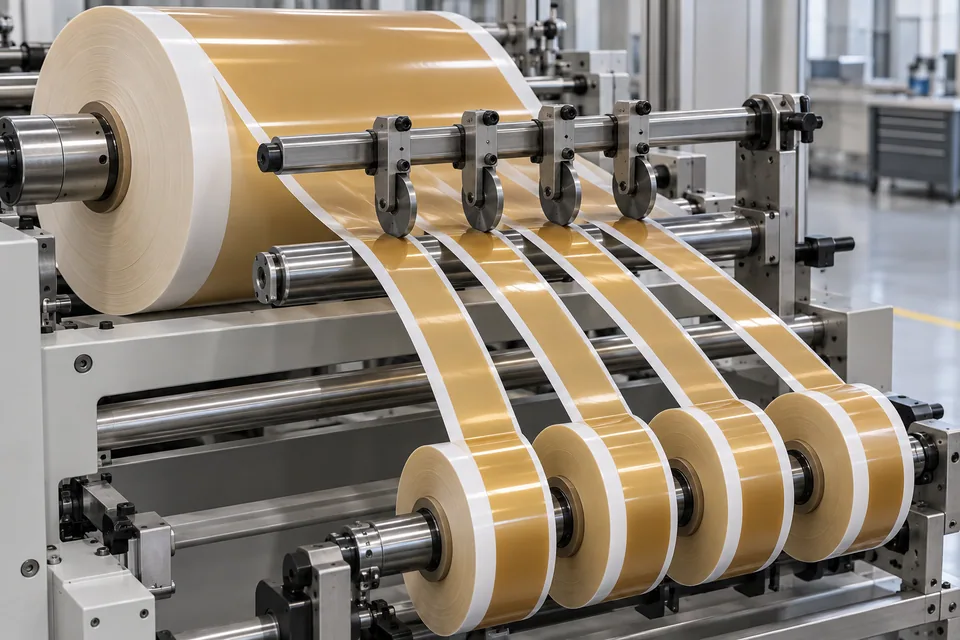
Wind-Blade Structural Adhesive Film Roll Slitting Blades
Notus Composites lists adhesive films among its wind-energy materials, and Hexcel supplies structural film adhesives in roll form. A SAERTEX blade-preforming study describes film placed at defined local regions, but does not prove structural film use in a production blade. This page applies only when the buyer's blade design actually specifies a qualified structural film at a named local bond area and supplies it as a wide roll. Sika describes two-component adhesives for blade shell bonding, a different workpiece that cannot be roll slit. Obtain the approved film grade, liner arrangement and local drawing detail before selecting knives.
Updated
Where This Cutting Application Appears
Confirm the film exists in this blade design
Read the approved bonding drawing and adhesive material specification. Check the film grade, carrier or scrim, release liners, width and intended placement at the named local film-bond area. If the production instruction instead calls for a two-part paste bead, stop this roll-slitting route. Do not infer that every blade shell uses adhesive film.
Lay out narrow roll widths
Calculate lanes from the bond detail and incoming usable roll width, including any protected edges and permitted waste. Keep the adhesive and liner together if the material instruction requires it. Plan the winding core and orientation so the downstream applicator can expose the correct side without touching the adhesive surface.
Trial a clean roll-to-roll cut
Unwind under the film maker’s handling and storage controls. Compare knife approaches on the exact adhesive and liner stack; roll slitting itself does not dictate shear or razor. Monitor blade pickup, squeeze-out at the edge, liner wrinkles and residue transfer to adjacent layers. Record any material exposure history under the qualified manufacturing procedure; do not invent a universal out-time.
Inspect converted rolls after winding
Measure width and examine both edges for adhesive strings, liner bridges, exposed tack and displaced carrier. Check whether the narrow roll telescopes or sticks across turns. A neat cut at the station can become unusable when wound or when the release liner is peeled at the application fixture.
Validate the receiving bond process
Pass a representative roll to the qualified local film-bond application step. Verify liner removal, placement and specified coverage without changing the approved cure or bond procedure. The blade maker owns mechanical qualification, environmental exposure and joint acceptance. A slit roll is only a converted input, not evidence of bonded-joint performance. Reject a width plan that forces operators to peel away the protective liner simply to locate a narrow roll on its core.
Define the Required Cut Result
- Create specified continuous adhesive-film widths.
- Keep release liner, carrier and tack condition controlled.
- Prevent edge bleed and interlayer blocking.
- Maintain approved grade and handling traceability.
Problems to Diagnose Before Changing the Knife
Adhesive squeezes beyond the liner
- Review knife pressure and film support.
- Inspect wound turns for blocking.
- Check actual film state within supplier controls.
Liner bridges while adhesive separates
- Inspect both faces and waste.
- Trial another qualified knife arrangement.
- Test downstream liner peel.
Knife Forms That May Be Considered
| Possible knife form | When it may be considered | What must be confirmed |
|---|---|---|
| Qualified roll-slitting knife system | For specified film and liner after a full-stack trial. | Check width, adhesive edge and roll unwind. |
| Paired shear knives | A candidate only if the actual film/carrier/liner stack cuts cleanly. | Check squeeze-out and liner integrity. |
Information to Send for Technical Review
You do not need to know the exact blade name. Send the available workpiece, machine, current-knife and cut-result information so the application can be reviewed against a drawing or sample.
- Approved local film-bond detail and adhesive-film grade
- Carrier, liner and adhesive stack drawing
- Roll widths, winding orientation and cores
- Supplier handling and exposure procedure
- Edge bleed, blocking and peel acceptance
Questions About This Cutting Application
Does this guide cover a two-component blade-shell paste bond?
No. This guide applies only where an approved film adhesive is specified.
Does roll slitting choose a knife mechanism?
No. It defines narrow roll conversion; the knife is qualified separately.
Why inspect after winding?
Adhesive may block or bleed between turns after a clean-looking cut.
Does a slit film qualify the joint?
No. Bond design, application, cure and testing remain with the blade maker.
Public references and scope
These public sources provide material, cutting-method or safety context for this guide. Supplier pages describe their own materials or equipment; they do not establish a MEIRENTE blade specification or performance claim. Confirm the actual grade, machine setup and required cut with a drawing or sample.
Related product and service information
- Wind-Blade Structural Adhesive Film Rotary Die-Cutting Blades - wind-blade structural adhesive film · rotary die cutting
- Blade-Root Reinforcement Fabric Roll Slitting Blades - blade-root reinforcement fabric · roll slitting
- Blade Leading-Edge Protection Tape Roll Slitting Blades - blade leading-edge protection tape · roll slitting
Request a Custom Cutting-Knife Review
Send the workpiece details, machine or holder information, current knife photos or sample, required quantity and examples of the present cut problem. Final dimensions, material, edge geometry and tolerances are confirmed from the approved requirements.