
Blade Application Guides / Application Guide / Wind-turbine blade manufacturing
Wind-Blade Lightning-Protection Foil Shear Slitting Blades
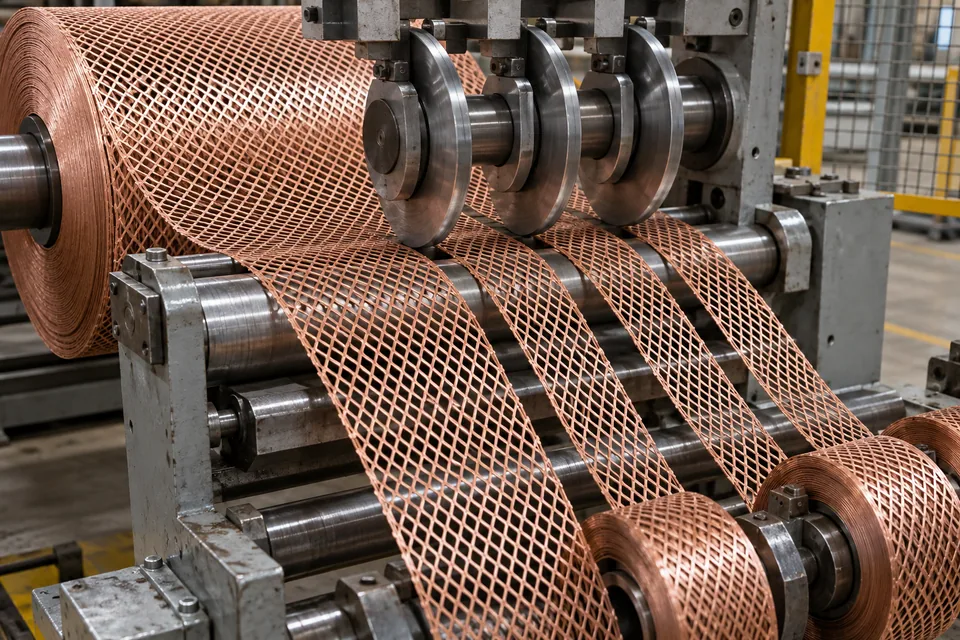
CThru and PPG document expanded copper and aluminum mesh foil for wind-blade lightning protection. CThru also describes coil slitting of expanded metal, while DIENES identifies shear slitting as a paired-knife method for nonferrous foils and wide webs. These facts justify a controlled shear-slitting trial, not an assertion that every open mesh pattern can be sheared cleanly. The workpiece is an expanded network with diamond openings; the aim is a longitudinal lane without hooks, broken strands or pattern stretch. Lightning function must be assessed in the blade system after conversion.
Updated
Where This Cutting Application Appears
Select the actual mesh zone
Use the blade maker’s drawing to specify metal, expanded-cell pattern, strand orientation and target width. Identify overlap and conductor-connection regions that must survive cutting. A tip-zone material can differ from a root-zone material, so one shear setting should not be generalized to the entire blade.
Establish paired-knife engagement
Mount upper and lower circular knives with web support and controlled registration. DIENES notes that thin metal foils can be sensitive to slip between driven and undriven knives. Trial knife drive, overlap and side contact within the equipment specification, then examine the actual mesh. A tool that cuts solid foil well may catch an open strand at a diamond point.
Compare edges under handling load
Inspect both lane sides and waste for bent wires, burrs, hooks and missing cells. Gently unwind and place samples over the intended layup support to see whether damage grows when the mesh flexes. Record whether cut path traverses open cells or repeatedly intersects junctions; this geometry can change the edge even at the same nominal width.
Track production-length quality
Measure width and observe roll-face build through repeated winding. Check for metal fragments, strand pieces on machine surfaces and knife wear. Compare samples from the beginning and end of the trial. Keep a control from the incoming coil so flaws caused by expansion can be separated from shear-cut effects.
Hand off with system boundaries
Identify lot, metal, pattern, shear setup and inspection record. The laminate team confirms integration, overlap and conductor attachment; the blade owner qualifies lightning-current performance. A continuous-looking lane by eye does not prove the expanded mesh will carry its intended current in service. Test the same sample with the mesh strand direction reversed only if the production route could actually feed it that way. The goal is to understand direction sensitivity without violating the approved orientation at layup. Do not average two different edge conditions into one acceptance result.
Define the Required Cut Result
- Test a true upper/lower shear mechanism on expanded foil.
- Avoid hooked or severed strands beyond the cut path.
- Control fragments and width drift.
- Retain lightning-system material traceability.
Problems to Diagnose Before Changing the Knife
Knife catches an open diamond junction
- Review overlap, drive and web support.
- Compare cut paths through the pattern.
- Inspect waste and both edges.
Edge looks sound but tears during layup
- Run an unwind-and-drape sample.
- Look for microhooks and bent strands.
- Review winding tension.
Knife Forms That May Be Considered
| Possible knife form | When it may be considered | What must be confirmed |
|---|---|---|
| Driven upper/lower rotary shear pair | For a pattern-specific qualified foil trial. | Confirm metal-strand and roll quality. |
| Configured circular shear inserts | Where machine design permits geometry selection. | Recheck both edges and fragment count after changes. |
Information to Send for Technical Review
You do not need to know the exact blade name. Send the available workpiece, machine, current-knife and cut-result information so the application can be reviewed against a drawing or sample.
- Approved expanded-metal mesh and strand orientation
- Target lane and overlap widths
- Shear machine drive and engagement limits
- Metal fragment and burr inspection method
- Downstream layup and conductor connection checks
Questions About This Cutting Application
How is shear slitting distinct from generic roll slitting?
It specifies interacting upper and lower circular knives.
Is the workpiece a solid foil?
No. The lightning foil discussed here is an expanded open mesh.
Why is knife slip relevant?
Thin metal and open strands can be pulled or burred if knife motion is poorly controlled.
Does a sheared lane qualify lightning protection?
No. The complete blade protection system needs separate testing.
Public references and scope
These public sources provide material, cutting-method or safety context for this guide. Supplier pages describe their own materials or equipment; they do not establish a MEIRENTE blade specification or performance claim. Confirm the actual grade, machine setup and required cut with a drawing or sample.
Related product and service information
- Wind-Blade Structural Adhesive Film Edge-Trimming Blades - wind-blade structural adhesive film · edge trimming
- Blade-Root Reinforcement Fabric Shear Slitting Blades - blade-root reinforcement fabric · shear slitting
- Blade Leading-Edge Protection Tape Shear Slitting Blades - blade leading-edge protection tape · shear slitting
Request a Custom Cutting-Knife Review
Send the workpiece details, machine or holder information, current knife photos or sample, required quantity and examples of the present cut problem. Final dimensions, material, edge geometry and tolerances are confirmed from the approved requirements.