
Blade Application Guides / Application Guide / Cable manufacturing
Water-Blocking Cable Yarn Transverse Cutting Blades
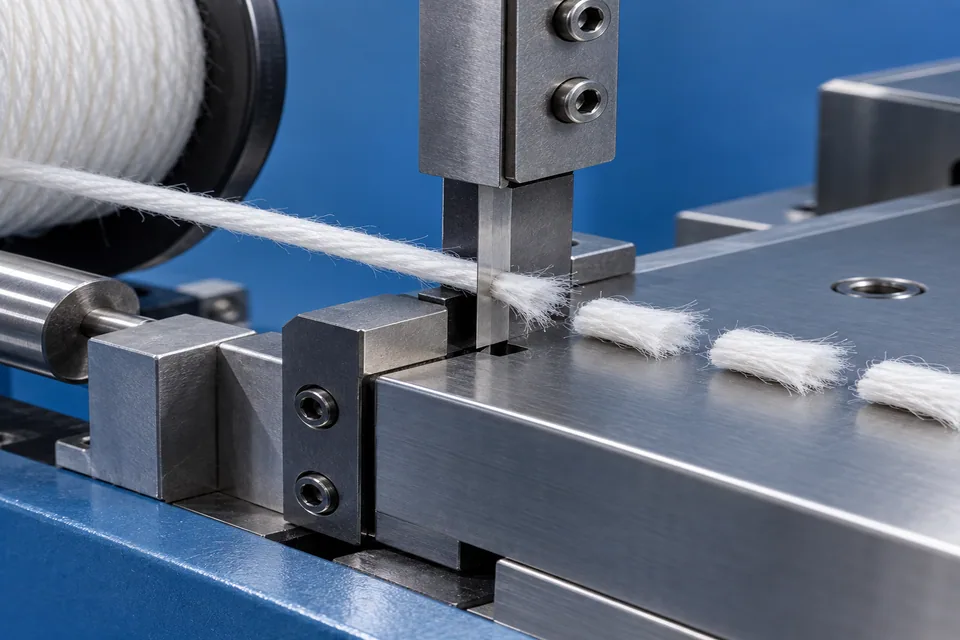
Water-blocking cable yarn is a continuous textile strand carrying water-swellable chemistry. Tex Tech describes cable yarn that can be cut with ordinary scissors; Avient documents wound water-blocking yarn packages for cable designs. This article covers transverse separation only when the cable process specifies a strand end at a start, splice or finished cable length. A separate discrete-length operation needs an actual cut schedule from the buyer. It is not longitudinal web slitting and it does not prescribe chopping the yarn into short staple fiber. First confirm whether the cable process actually needs discrete lengths; many cable lines feed a continuous yarn. The strand’s tensile members and swelling treatment must survive the cut and subsequent handling. The cable maker, not the blade maker, qualifies water-blocking performance in the finished design.
Updated
Where This Cutting Application Appears
Determine where a cut belongs
Map the strand from supply package through tension guides into the cable layup. If it is continuously served, define only the start, splice or finished cable-end cut. Specify individual piece lengths only when the cable maker provides a discrete-length assembly drawing; record the required strand grade and end allowance.
Support multiple filaments at the transverse edge
Hold the yarn near the cut without crushing its coated bundle. Trial a sharp crossing knife and counteredge or a short-stroke shear with the actual strand diameter. Compare severed ends for broken filaments, fused treatment, loose powder and an elongated tail.
Measure after release, not just feed
A stretched yarn can retract after separation. Measure the free length under the buyer’s stated low tension and inspect both ends. Check whether a partial cut leaves a strength filament that later snags in the winding path.
Handle the cut pieces dry and clean
Separate cut ends from loose swelling powder and label lot and orientation if the product has a special construction. Trial insertion into the cable path; the buyer should test any change in tensile and water-blocking behavior using its own method.
Define the Required Cut Result
- Deliver defined strand lengths only where the cable process requires them.
- Sever every filament without excessive fray or coating shed.
- Avoid cutting tension that changes released length.
- Maintain grade and lot identity for cable assembly.
Problems to Diagnose Before Changing the Knife
Released length is shorter than feed setting
- Check yarn stretch during feeding.
- Measure under the stated relaxed condition.
- Inspect clamp pressure near the knife.
One filament remains attached
- Review edge overlap and yarn support.
- Check blade sharpness and bundle diameter variation.
- Inspect both ends before collecting pieces.
Swelling powder accumulates at the cutter
- Compare incoming and cut-end treatment.
- Inspect blade friction and guide contact.
- Use the buyer contamination limit for trial samples.
Knife Forms That May Be Considered
| Possible knife form | When it may be considered | What must be confirmed |
|---|---|---|
| Short-stroke transverse shear blade | For a supported single or grouped yarn cut at a defined length. | Confirm complete filament severance and minimal treatment loss on buyer strand. |
| Matched scissor-action cross-cut pair | Where an installed cable line cuts the strand at a finished cable length or splice. | Confirm space, timing and tension release on that line. |
Information to Send for Technical Review
You do not need to know the exact blade name. Send the available workpiece, machine, current-knife and cut-result information so the application can be reviewed against a drawing or sample.
- Water-blocking yarn maker and exact strand grade
- Package form, strand diameter and filament construction
- Whether continuous feed or discrete length is actually required
- Cut length and low-tension measurement condition
- Cutter, clamp and counteredge drawings
- Accepted fray and swelling-powder shed samples
- Cable-line feed and end-termination sequence
- Buyer tensile and water-blocking validation method
Questions About This Cutting Application
Should every cable yarn be chopped to length?
No. Many cable designs use continuous yarn; cut only at a specified start, splice or cable end, or for buyer-documented discrete pieces.
Why measure after release?
Feed tension can stretch the strand so a machine setting differs from the relaxed delivered length.
Can an ordinary scissors example set production tooling?
No. It only shows the strand is cuttable; the installed cutter and quality require a trial.
Is a frayed end automatically acceptable?
The buyer must set a limit for free filaments and swelling-treatment loss.
Does a good cut prove water blocking?
No. The cable manufacturer tests its assembled water-blocking system.
Public references and scope
These public sources provide material, cutting-method or safety context for this guide. Supplier pages describe their own materials or equipment; they do not establish a MEIRENTE blade specification or performance claim. Confirm the actual grade, machine setup and required cut with a drawing or sample.
Related product and service information
- Wire-Harness Cloth Tape Shear Slitting Blades - wire-harness cloth tape · shear slitting
- Cable Shielding Laminate Shear Slitting Blades - cable shielding laminate · shear slitting
- Semiconductive Cable Tape Shear Slitting Blades - semiconductive cable tape · shear slitting
Request a Custom Cutting-Knife Review
Send the workpiece details, machine or holder information, current knife photos or sample, required quantity and examples of the present cut problem. Final dimensions, material, edge geometry and tolerances are confirmed from the approved requirements.