
Blade Application Guides / Application Guide / Biopharmaceutical manufacturing
Virus-Filtration Membrane Rotary Die-Cutting Blades
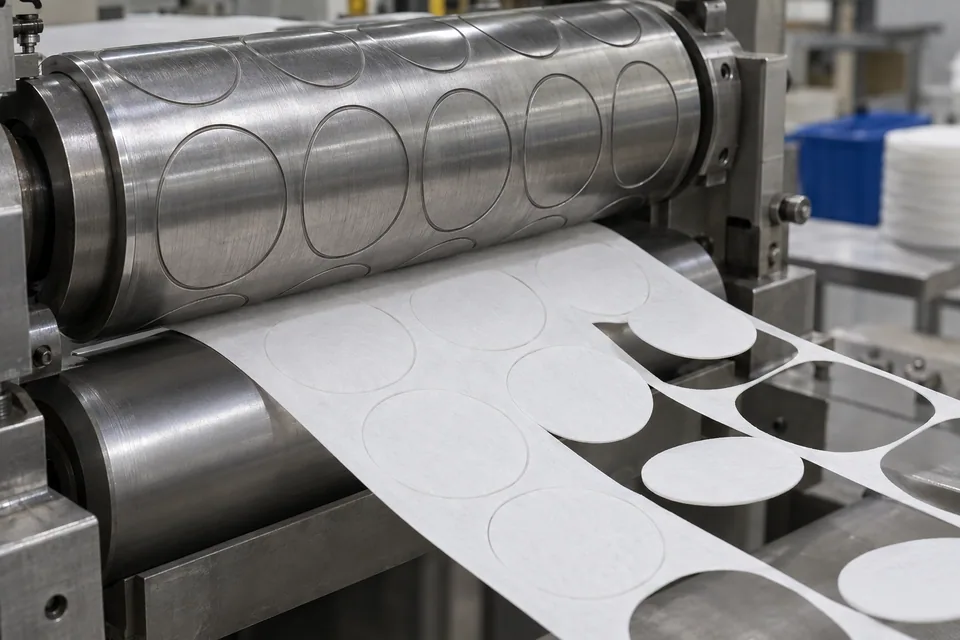
Some virus filtration devices use flat porous membrane layers; Merck describes a two-layer asymmetric PES virus-filter construction. I.W. Tremont describes OEM conversion of supplied membranes and separately lists die cutting among its converting services. BMP Filtration documents rotary die cutting for filter media generally, and RotoMetrics documents die stations for flexible webs. None establishes rotary cutting of a specific virus-grade membrane. These sources support a possible manufacturing method, not an assertion that a named virus-filter product is routinely die cut. This guide is restricted to unassembled flat virus-filtration media that its owner has approved for repeated rotary blanks or openings. It excludes hollow fibers and complete filter cartridges. A die impression may crush pores, alter a support layer or leave a tiny slug near the active area. Only the device maker can approve geometry, media integrity and viral retention after assembly.
Updated
Where This Cutting Application Appears
Confirm the format and repeat
Obtain a released die line for the membrane shape, usable filtration area, seal allowance and any internal opening. Confirm that a continuous flat web and repeated pitch exist; a sheet-fed or non-repeating route may call for another tool.
Support without over-compressing
Record die cylinder, anvil, pressure, backing and membrane face. Trial one actual media lot and compare the uncut control. Full cut-through must release the blank while preserving porous area outside the seal margin.
Remove parts and slugs cleanly
Count all blanks, perimeter matrix and internal slugs. Inspect for crushed bands, dragged fibers, curled edges and loose particles on both faces. Check whether static carries tiny waste pieces into useful media.
Qualify assembled filters separately
Feed trial blanks into the filter maker’s normal layering and sealing process. Measure active area and inspect any new crease or peel after transfer. The filter maker qualifies the final device’s integrity and retention; the bioprocess owner validates viral clearance under its actual process conditions.
Define the Required Cut Result
- Place repeated blanks to the owner’s membrane and seal drawing.
- Protect the porous active zone and support layers.
- Release all waste without particles on useful media.
- Provide traceable blanks for device-maker qualification.
Problems to Diagnose Before Changing the Knife
A ring of compressed pores borders the blank
- Review die/anvil pressure and edge sharpness.
- Check support surface.
- Compare with permitted seal-margin width.
One small slug remains on a blank
- Inspect die ejection and static.
- Check complete cut at that feature.
- Review collection before filter assembly.
Blank curls after matrix removal
- Compare tension and web direction.
- Inspect unsupported span.
- Measure after the owner’s recovery condition.
Knife Forms That May Be Considered
| Possible knife form | When it may be considered | What must be confirmed |
|---|---|---|
| Matched rotary die and anvil | Only for owner-approved repeating flat-membrane blanks. | Confirm pitch, pressure, active-area preservation and complete scrap removal. |
| Flexible rotary die on supported cylinder | When the installed line and membrane grade allow a shallow or complex repeat. | Verify full layer cut, backside condition and pore integrity in a qualified trial. |
Information to Send for Technical Review
You do not need to know the exact blade name. Send the available workpiece, machine, current-knife and cut-result information so the application can be reviewed against a drawing or sample.
- Media-owner approval for die cutting
- Exact flat virus-filtration membrane and support stack
- Blank, active area and seal-land drawing
- Cylinder, die, anvil and ejection details
- Cleanliness and static-control requirements
- Accepted compressed-edge and particle samples
- Assembly transfer and layer registration method
- Final filter integrity and viral-retention responsibility
Questions About This Cutting Application
Does a rotary die make a finished virus filter?
No. It releases a membrane component before assembly.
Can any virus-filter membrane be die cut?
No. Hollow-fiber and assembled formats are excluded; the owner must approve a flat web.
Why count slugs?
A retained waste piece can damage the active region or contaminate assembly.
Is a good-looking blank enough?
No. Pore effects may require microscopic and device-level qualification.
Who validates viral clearance?
The filter maker qualifies the assembled device; the bioprocess owner validates viral clearance for its process, using justified process-specific or platform evidence.
Public references and scope
These public sources provide material, cutting-method or safety context for this guide. Supplier pages describe their own materials or equipment; they do not establish a MEIRENTE blade specification or performance claim. Confirm the actual grade, machine setup and required cut with a drawing or sample.
Related product and service information
- Virus-Filtration Membrane Shear Slitting Blades - virus-filtration membrane · shear slitting
- Single-Use Bioreactor Bag Film Rotary Die-Cutting Blades - single-use bioreactor bag film · rotary die cutting
- Chromatography Membrane-Adsorber Media Rotary Die-Cutting Blades - chromatography membrane-adsorber media · rotary die cutting
Request a Custom Cutting-Knife Review
Send the workpiece details, machine or holder information, current knife photos or sample, required quantity and examples of the present cut problem. Final dimensions, material, edge geometry and tolerances are confirmed from the approved requirements.