
Blade Application Guides / Application Guide / Biopharmaceutical manufacturing
Chromatography Membrane-Adsorber Media Rotary Die-Cutting Blades
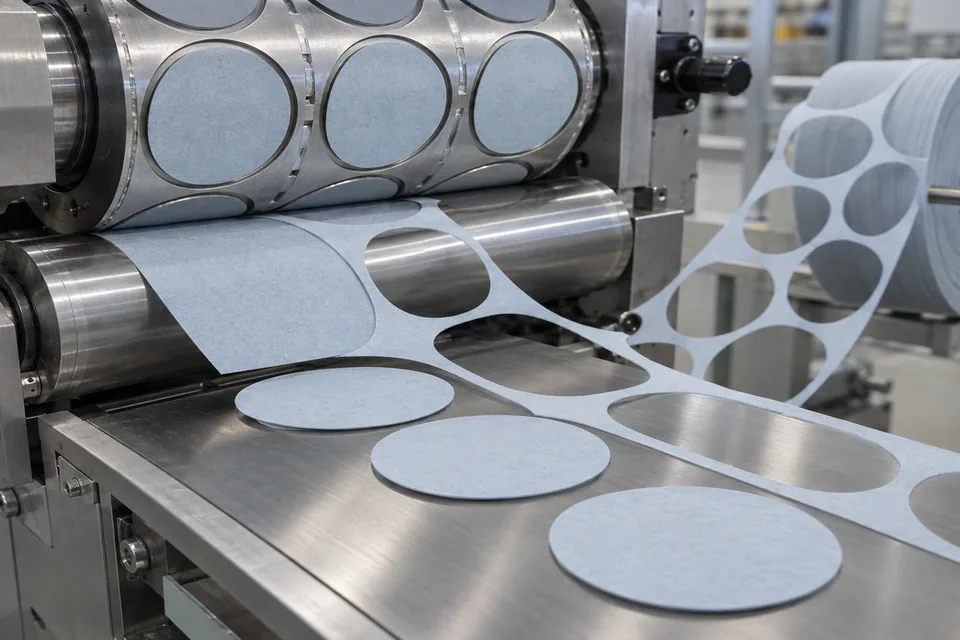
Pall offers Mustang ion-exchange membranes in custom roll, sheet and disc forms, so a buyer may need repeated flat shapes before an adsorber is built. Merck’s chromatography literature distinguishes a flat-sheet device from pleated formats. This topic is the cutting of supplied, unassembled media; it does not describe cutting a completed capsule or pleated stack. A rotary die is a proposed web-conversion option, not a claim that every charged or hydrogel-based membrane can tolerate that route. The supplier must approve the actual material condition and the buyer must verify the intended membrane shape and performance after assembly.
Updated
Where This Cutting Application Appears
Separate media from device drawings
Obtain the flat membrane blank outline, rather than copying the outer housing outline. Mark the active region, any stacking registration features and the edge that will later be captured by a gasket. Clarify whether the cutter receives dry stock, a protected liner construction or preconditioned material.
Trial full-depth versus supported cuts
A rotary die can repeat a contour along a web, but the anvil contact, web backing and waste matrix depend on the delivered material. Use short qualification runs to check whether the edge is fully separated without indenting usable surface. Do not assume a generic label die is acceptable for a porous chromatography medium.
Inspect lift-off and matrix removal
After die engagement, remove the surrounding waste without peeling or stretching a functional blank. Check tight corners for bridged fibers and exposed coating. Inspect both blank and matrix; a damaged waste edge can signal that the die is dragging through the active layer.
Validate assembly-facing geometry
Stack or position sample blanks in the buyer’s intended fixture, then compare alignment and sealing land to the drawing. Retain cut and uncut controls for buyer testing of adsorption, pressure and extractables where required by its process.
Define the Required Cut Result
- Produce the buyer’s flat blank contour and registration features.
- Separate blanks cleanly without distorting the active media.
- Remove matrix waste without lifting functional layers.
- Keep dimensional and functional acceptance as distinct tests.
Problems to Diagnose Before Changing the Knife
Blank stays attached at a corner
- Review die height and local anvil contact.
- Check a material stack-up section.
- Inspect wear at tight radii.
Functional face marks during extraction
- Check matrix peel path and liner orientation.
- Reduce handling contact with the active side.
- Compare hand-released and machine-released samples.
Stack misregisters despite acceptable blank dimensions
- Review datum choice against assembly fixture.
- Check humidity or conditioning state.
- Examine registration marks after handling.
Knife Forms That May Be Considered
| Possible knife form | When it may be considered | What must be confirmed |
|---|---|---|
| Rotary full-cut die | Only for supplier-approved roll stock and a qualified backing/anvil combination. | Confirm complete contour separation and no active-area indentation. |
| Flatbed sample die | For feasibility trials or sheet stock unsuited to continuous rotary feed. | Compare identical blank outline, edge and lift-off criteria. |
Information to Send for Technical Review
You do not need to know the exact blade name. Send the available workpiece, machine, current-knife and cut-result information so the application can be reviewed against a drawing or sample.
- Membrane maker and exact functional chemistry
- Supplier-approved handling and conversion state
- Blank and active-area drawings
- Roll, sheet, backing and liner details
- Die station, anvil and web-path layout
- Matrix removal route
- Edge, surface and particle criteria
- Buyer stack-fit and adsorption tests
Questions About This Cutting Application
Does a rotary die cut a finished membrane adsorber?
No. The candidate operation forms unassembled flat media before a buyer builds a device.
Are all chromatography membranes dry-convertible?
No universal handling state applies; obtain the supplier’s instructions for the exact grade.
Why inspect the removed matrix?
Its torn or bridged edges can reveal incomplete penetration and damage to nearby useful media.
What proves the flat blank is acceptable?
The buyer checks outline, edge condition, fixture fit and functional test results separately.
Can a standard flexible die be selected by thickness alone?
No. Backing, functional layer, contamination and release behavior must be trialed on the actual construction.
Public references and scope
These public sources provide material, cutting-method or safety context for this guide. Supplier pages describe their own materials or equipment; they do not establish a MEIRENTE blade specification or performance claim. Confirm the actual grade, machine setup and required cut with a drawing or sample.
Related product and service information
- Chromatography Membrane-Adsorber Media Shear Slitting Blades - chromatography membrane-adsorber media · shear slitting
- Single-Use Bioreactor Bag Film Rotary Die-Cutting Blades - single-use bioreactor bag film · rotary die cutting
- Virus-Filtration Membrane Rotary Die-Cutting Blades - virus-filtration membrane · rotary die cutting
Request a Custom Cutting-Knife Review
Send the workpiece details, machine or holder information, current knife photos or sample, required quantity and examples of the present cut problem. Final dimensions, material, edge geometry and tolerances are confirmed from the approved requirements.