
Blade Application Guides / Application Guide / Biopharmaceutical manufacturing
Virus-Filtration Membrane Shear Slitting Blades
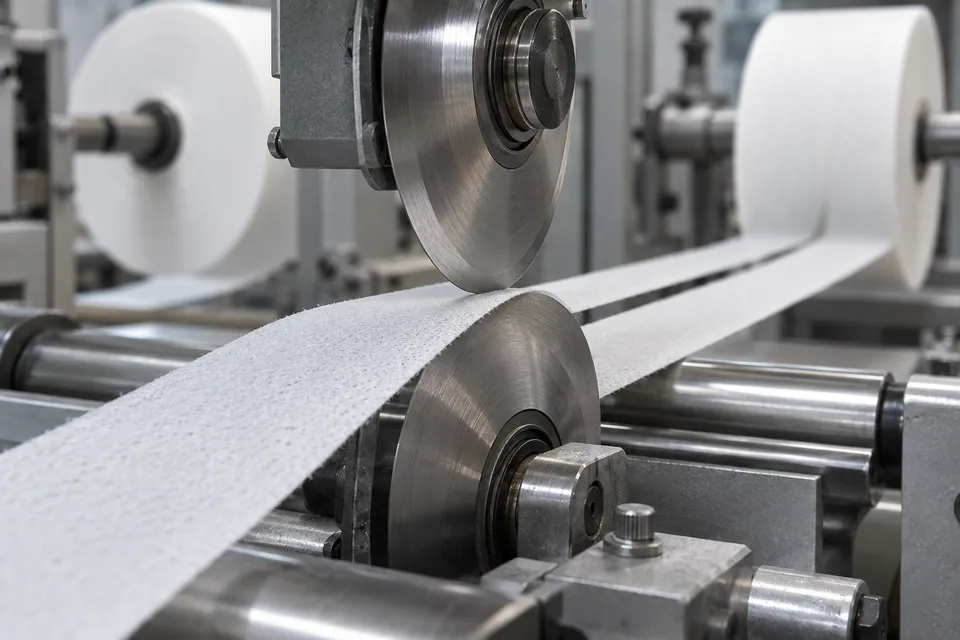
Merck describes virus filters containing two asymmetric PES membrane layers; Sartorius also identifies specialized asymmetric virus-filtration membranes. Neither claim means a finished filter can be cut after assembly. This guide is for a manufacturer-approved, unassembled flat membrane web only. DIENES describes paired upper/lower edges for rotary shear slitting. On sensitive porous media, blade overlap and local pressure can crush edge structure, generate particles or shift support layers. The process is justified only when the media owner permits shear conversion and can assess the result with qualified tests. A visually sound slit says nothing by itself about virus retention, pressure integrity or process suitability of a finished device.
Updated
Where This Cutting Application Appears
Identify the exact cut stack
Confirm whether the feed is one membrane sheet, a temporary support carrier or a qualified multi-layer stack. Mark active and support faces. Derive lane positions from the eventual pleat, stack or seal layout without claiming that all products share the two-layer example.
Set shear engagement cautiously
Record upper/lower knife material, edge condition, overlap, clearance, drive and guide arrangement. Trial on the owner’s production-grade media. Compare the two adjacent edges produced by one knife pair, because one may show more compression or peeling.
Inspect pore-adjacent damage
Check both edges for compressed band, tearing, fibers, coating dust and support offset under approved microscopy or optical methods. Separate knife-made particles from incoming defects by preserving uncut controls and tool-station labels.
Verify assembly transfer
Rewind and move sample lanes through the filter maker’s normal pleating or membrane-stack process. Reinspect after handling. The filter manufacturer determines whether converted media can enter assembly and qualifies the finished device. The bioprocess owner validates viral clearance in its own process.
Define the Required Cut Result
- Meet device-media lane dimensions.
- Limit local pore collapse, loose particles and support shift.
- Preserve media face and lot traceability.
- Provide cut and control samples for owner approval.
Problems to Diagnose Before Changing the Knife
One side has a compressed edge band
- Compare upper/lower overlap and clearance.
- Inspect local backing and knife wear.
- Review both edges from the same slit.
Support layer shifts
- Check feed tension and knife contact.
- Inspect carrier bond before cutting.
- Measure layer registration after winding.
Fine particles appear near the cut
- Sample tool and guide locations.
- Inspect edge wear and media coating.
- Apply manufacturer cleanliness criteria.
Knife Forms That May Be Considered
| Possible knife form | When it may be considered | What must be confirmed |
|---|---|---|
| Matched rotary shear knife pair | Only on a media-owner-approved flat web and compatible machine. | Confirm geometry and edge effects with actual membrane and owner inspection. |
| Supported outer-margin shear trim pair | When the drawing calls for a sacrificial edge removal. | Confirm retained active area and waste takeoff. |
Information to Send for Technical Review
You do not need to know the exact blade name. Send the available workpiece, machine, current-knife and cut-result information so the application can be reviewed against a drawing or sample.
- Owner release for shear conversion and exact membrane grade
- Layer stack and active/support face designation
- Target lanes and device seal allowance
- Upper/lower knife, holder and arbor drawings
- Approved handling tension and environmental condition
- Accepted compressed-edge and particle examples
- Winding and later filter-assembly path
- Qualified integrity and viral-retention test responsibility
Questions About This Cutting Application
Why is shear slitting a separate topic from roll slitting?
Shear specifies paired rotating edges and their overlap; roll slitting describes the resulting narrow reels.
Can the paired blades cut an assembled filter?
No. Only unassembled owner-approved flat media is in scope.
Is visual inspection enough?
No. The maker may require microscopic, particulate and functional qualification.
Could a support layer move while membrane appears intact?
Yes. Inspect every supplied layer and its position after cutting and winding.
Who claims viral clearance?
The filter maker qualifies its finished device; the bioprocess owner validates virus clearance for its process, using justified process-specific or platform evidence.
Public references and scope
These public sources provide material, cutting-method or safety context for this guide. Supplier pages describe their own materials or equipment; they do not establish a MEIRENTE blade specification or performance claim. Confirm the actual grade, machine setup and required cut with a drawing or sample.
Related product and service information
- Dry-Process Battery Electrode Film Contour-Cutting Blades - dry-process battery electrode film · contour cutting
- Single-Use Bioreactor Bag Film Shear Slitting Blades - single-use bioreactor bag film · shear slitting
- Chromatography Membrane-Adsorber Media Shear Slitting Blades - chromatography membrane-adsorber media · shear slitting
Request a Custom Cutting-Knife Review
Send the workpiece details, machine or holder information, current knife photos or sample, required quantity and examples of the present cut problem. Final dimensions, material, edge geometry and tolerances are confirmed from the approved requirements.