
Blade Application Guides / Application Guide / Biopharmaceutical manufacturing
Single-Use Bioreactor Bag Film Rotary Die-Cutting Blades
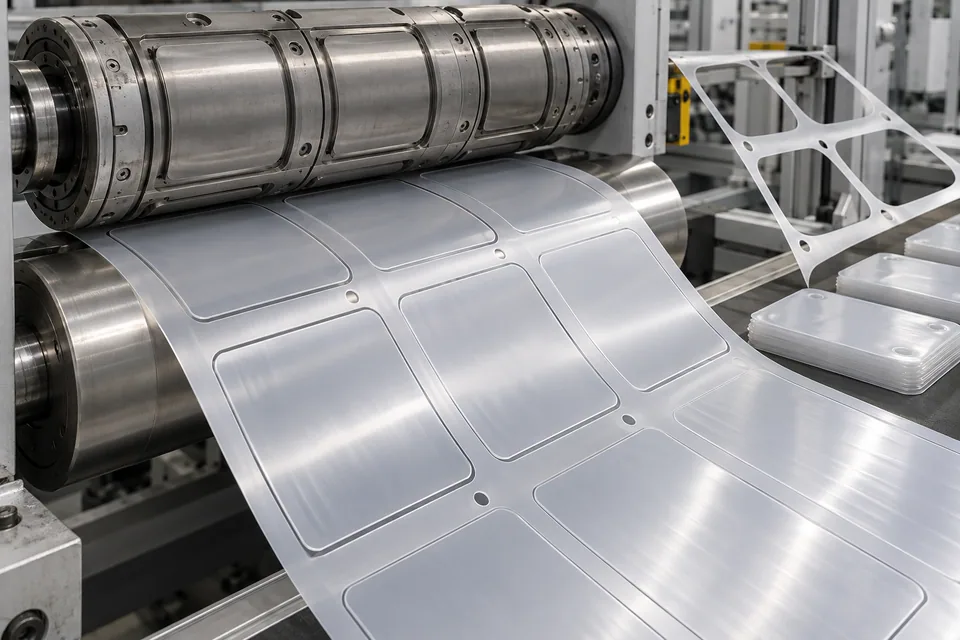
Single-use bioreactor bags contain ports and engineered film panels, but their geometry is controlled by the bag maker. Corning and Sartorius describe film-based bag assemblies; RotoMetrics documents rotary die stations for flexible webs. Here rotary die cutting is a conditional pre-assembly operation on flat, unfilled film to create repeated approved panel blanks or local features. It is not punching through an already sealed sterile bag. Any port opening is considered only if the bag maker’s released assembly sequence calls for it before port welding; weld regions and sensor areas follow that drawing. Many bag designs instead use sheet cutting or a local punch. The die action may crush layers or leave tiny slugs that compromise downstream cleanliness. A neat feature cannot prove a fluid-tight port, sterile bag or biological suitability; those belong to the bag manufacturer’s qualification.
Updated
Where This Cutting Application Appears
Confirm a repeating die feature is justified
Provide the panel outline, feature repeat, port or handling-hole location and weld margins. A rotary die is appropriate only if the film is web-fed and the feature repeats at a compatible pitch. Keep a complete cut separate from a shallow score in the drawing.
Register and support the film
Map printed marks if present, machine direction and product-contact face to the die cylinder and anvil. Record pressure and backing. Trial actual multilayer film because a thin barrier layer can be punctured or stressed even if the outer polymer releases cleanly.
Remove all cut waste
Inspect every port slug, perimeter matrix and cut feature for complete release, ragged sealant, loose particles and layer delamination. A slug carried into a weld or fluid-contact surface is a serious assembly defect. Review suction or mechanical ejection without touching the designated inner face.
Qualify in bag assembly
Trial cut film through the intended port weld and panel weld sequence. Inspect location, sealing land and handling after forming. Final bag leak testing, extractables, sterilization and process-fluid suitability remain with the bag maker.
Define the Required Cut Result
- Place approved repeated features within drawing datums.
- Protect all film layers and intended seal lands.
- Eject slugs without contaminating fluid-contact surfaces.
- Supply traceable cut blanks for bag-maker assembly validation.
Problems to Diagnose Before Changing the Knife
Port slug remains attached
- Check die-to-anvil engagement and ejection.
- Inspect sealant strings at the cut.
- Review feature pitch across the web.
Barrier layer is marked below a shallow score
- Check die pressure and anvil high spots.
- Inspect the opposite face and layer cross-section.
- Reject any unapproved partial penetration.
Feature shifts toward a weld
- Compare cylinder repeat and web registration.
- Review tension after unwind.
- Measure first and last repeats.
Knife Forms That May Be Considered
| Possible knife form | When it may be considered | What must be confirmed |
|---|---|---|
| Matched rotary die and anvil | For a repeated pre-assembly panel or port feature on a compatible film web. | Confirm cylinder repeat, full layer cut and slug control with actual film. |
| Flexible rotary die on matched cylinder | Only for a buyer-approved repeated pre-assembly feature on a compatible web and matched cylinder. | Verify the specified full cut or explicitly authorized partial depth, protected layers and waste release on actual film. |
Information to Send for Technical Review
You do not need to know the exact blade name. Send the available workpiece, machine, current-knife and cut-result information so the application can be reviewed against a drawing or sample.
- Approved film grade and layer/face diagram
- Released panel, port and weld drawings
- Whether feature is full cut, score or opening
- Cylinder repeat, anvil and registration drawings
- Accepted particle, burr and layer-damage samples
- Matrix/slug removal and cleanroom procedure
- Actual downstream port and panel welding sequence
- Bag maker integrity and biological qualification plan
Questions About This Cutting Application
Can a rotary die cut a completed sterile bag?
This guide does not address that operation; it concerns unassembled film before welding.
Must every bag use a rotary die?
No. The process is conditional on repeating geometry and an approved web-fed machine.
Why is slug control critical?
Loose pieces can enter a port weld or fluid-contact region.
Can visual feature accuracy prove a leak-tight port?
No. The finished port weld and bag require manufacturer validation.
What should the buyer send first?
Supply the actual film and released panel, port and weld drawings, including whether each feature is a full cut or an explicitly authorized score.
Public references and scope
These public sources provide material, cutting-method or safety context for this guide. Supplier pages describe their own materials or equipment; they do not establish a MEIRENTE blade specification or performance claim. Confirm the actual grade, machine setup and required cut with a drawing or sample.
Related product and service information
- Single-Use Bioreactor Bag Film Shear Slitting Blades - single-use bioreactor bag film · shear slitting
- Virus-Filtration Membrane Rotary Die-Cutting Blades - virus-filtration membrane · rotary die cutting
- Chromatography Membrane-Adsorber Media Rotary Die-Cutting Blades - chromatography membrane-adsorber media · rotary die cutting
Request a Custom Cutting-Knife Review
Send the workpiece details, machine or holder information, current knife photos or sample, required quantity and examples of the present cut problem. Final dimensions, material, edge geometry and tolerances are confirmed from the approved requirements.