
Blade Application Guides / Application Guide / Biopharmaceutical manufacturing
Virus-Filtration Membrane Roll Slitting Blades
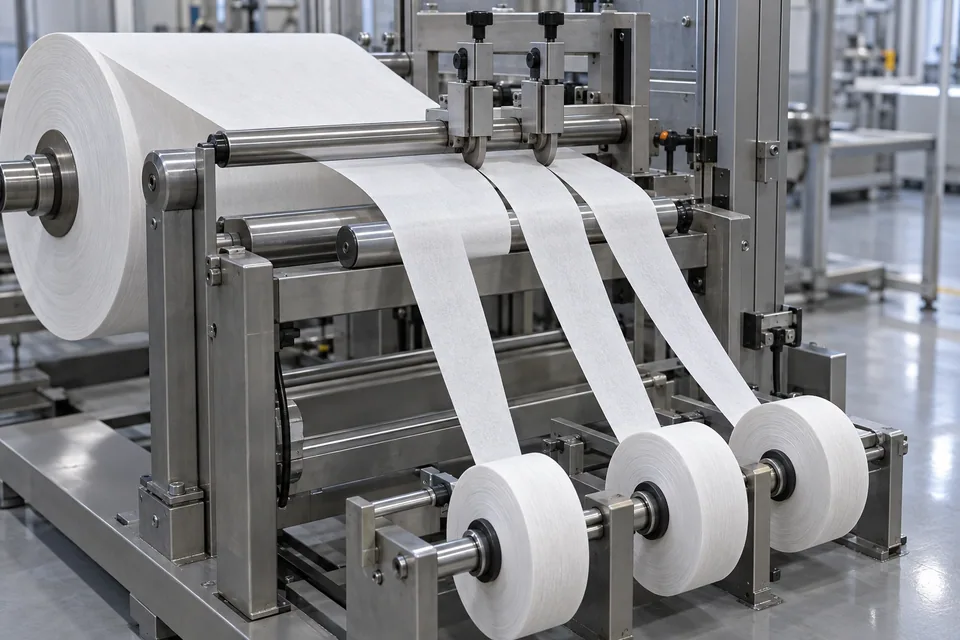
Virus filtration devices may use specialized flat-sheet membranes. Merck describes asymmetric PES layers in one device; Sartorius describes asymmetric virus-filtration membranes in multiple finished formats. Those sources describe qualified filters, not unrestricted rolls sold for outside conversion. This guide addresses only an unassembled membrane web that its owner has explicitly released for roll slitting during device manufacture. Pyradia documents roll-based membrane production and tension handling for delicate substrates. A longitudinal slit creates narrower media rolls for a later filter layout; it does not create a finished filter, sterilize media or demonstrate virus retention. The owner must specify membrane face, supported layers, allowable contact and cleanliness. Even an invisible pore or coating defect can matter, so blade choice, environment and inspection require a grade-specific trial and device-maker approval.
Updated
Where This Cutting Application Appears
Confirm the membrane is truly roll stock
Ask the media owner whether the input is flat porous web, supported laminate or another supplied form. Do not apply this operation to hollow-fiber virus filters or assembled capsules. Derive each lane width from the device’s membrane area, edge seal and assembly layout.
Control web tension and face contact
Record unwind direction, support film, guides and takeoff. Use the manufacturer’s permitted handling condition. A thin asymmetric membrane may stretch or crease when a narrow lane pulls more strongly than the parent roll; preserve lot and active-face identification.
Inspect both slit margins
Measure widths under a stated condition and examine each new edge for nicks, crushed pores, delaminated support, loose particles and folded corners. Compare uncut control and cut lanes using the owner’s qualified optical or integrity method.
Rewind for device fabrication
Check tension and roll edges after winding, then trial lane transfer into the intended filter assembly. Any post-cut hold time, storage and cleanliness belong to the membrane owner. The filter maker separately qualifies device integrity and retention; the bioprocess owner validates virus clearance under its own process conditions.
Define the Required Cut Result
- Supply lane widths for the specified device build.
- Avoid damage to asymmetric membrane, support and pore region.
- Limit particles and handling creases at new edges.
- Maintain membrane lot, face and conversion records.
Problems to Diagnose Before Changing the Knife
A narrow lane wrinkles
- Review differential tension and guide alignment.
- Compare supported and released measurements.
- Inspect roll build and separator contact.
Edge shows crushed or torn pores
- Inspect tool edge and local backing.
- Compare incoming web under owner inspection.
- Reject settings that abrade the active membrane.
Particles increase after rewinding
- Sample knife exit and wound roll separately.
- Review separator and core contact.
- Apply the maker’s cleanliness method.
Knife Forms That May Be Considered
| Possible knife form | When it may be considered | What must be confirmed |
|---|---|---|
| Manufacturer-approved longitudinal slitter knife set | For a supported flat membrane web explicitly cleared for roll conversion. | Confirm material face, geometry and qualified cut-edge inspection. |
| Paired rotary shear station | Only if the owner’s membrane grade and machine support this method. | Trial overlap, contact, particles and retained membrane function. |
Information to Send for Technical Review
You do not need to know the exact blade name. Send the available workpiece, machine, current-knife and cut-result information so the application can be reviewed against a drawing or sample.
- Exact virus-filter membrane grade and whether it is flat-sheet roll stock
- Manufacturer-approved contact face and support layers
- Parent roll and target lane dimensions
- Filter assembly edge-seal drawing
- Cleanliness and environmental handling specification
- Knife, web-guide and rewind drawings
- Accepted edge-defect and particle samples
- Device maker integrity and viral-clearance validation plan
Questions About This Cutting Application
Can a virus filter capsule be roll-slit?
No. This guide is limited to unassembled flat membrane web.
Does a clean slit prove virus retention?
No. The filter maker must qualify the assembled device; the bioprocess owner separately validates virus clearance for its process.
Are all virus-filtration membranes PES rolls?
No. Confirm the exact membrane chemistry and supplied physical form.
Why keep active-face orientation?
Asymmetric or supported media can have different faces and assembly requirements.
What is the first feasibility gate?
Written confirmation from the membrane owner that the supplied web can be converted by the proposed method.
Public references and scope
These public sources provide material, cutting-method or safety context for this guide. Supplier pages describe their own materials or equipment; they do not establish a MEIRENTE blade specification or performance claim. Confirm the actual grade, machine setup and required cut with a drawing or sample.
Related product and service information
- Virus-Filtration Membrane Rotary Die-Cutting Blades - virus-filtration membrane · rotary die cutting
- Single-Use Bioreactor Bag Film Roll Slitting Blades - single-use bioreactor bag film · roll slitting
- Chromatography Membrane-Adsorber Media Roll Slitting Blades - chromatography membrane-adsorber media · roll slitting
Request a Custom Cutting-Knife Review
Send the workpiece details, machine or holder information, current knife photos or sample, required quantity and examples of the present cut problem. Final dimensions, material, edge geometry and tolerances are confirmed from the approved requirements.