
Blade Application Guides / Application Guide / Energy storage manufacturing
Vanadium Redox-Flow Membrane Contour-Cutting Blades
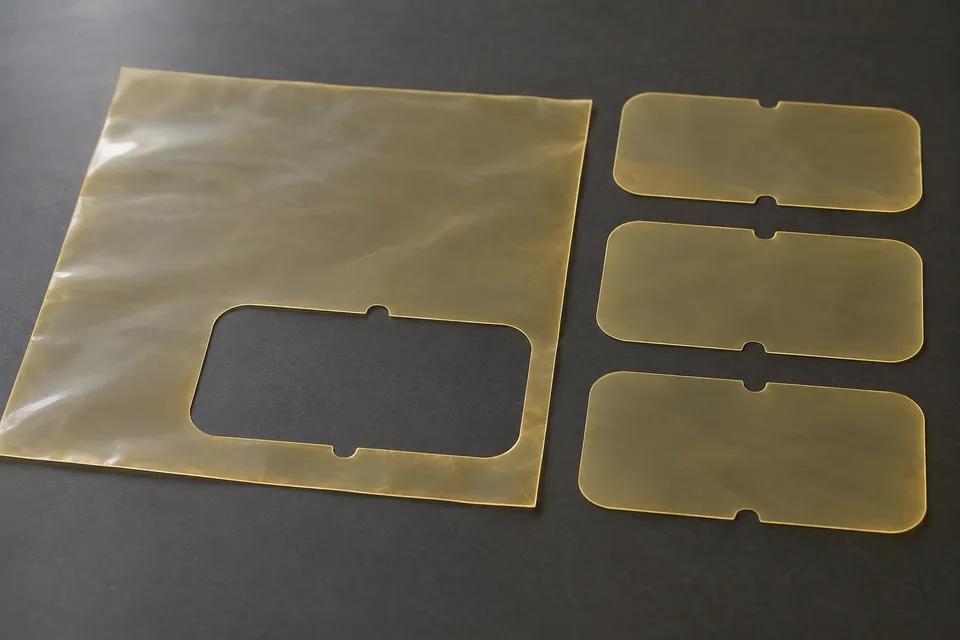
Contour cutting turns a vanadium redox-flow battery membrane sheet into an individual cell profile with specified ports, corners and sealing margins. Membrane chemistries and reinforcement vary, and some products have a designated side. The buyer must provide the actual grade, its conditioning state and the finished-part drawing before a blade or path can be chosen.
Updated
Where This Cutting Application Appears
Define the cell profile
Provide a dimensioned membrane outline with ports, corners, radii and sealing-land margins. Identify the membrane face and any reinforcement orientation. The final profile must be checked after release, not inferred from the knife outline.
Support the full perimeter
Record backing surface, hold-down and cut sequence. Small openings and narrow bridges need special attention because a thin membrane can stretch or retain cutout fragments.
Inspect released parts
Measure the profile and inspect each corner, opening and seal-land edge for tears, pinholes, pulled reinforcement and trapped slugs. Apply the buyer’s defect method to both faces.
Separate matrix and part
Record how the surrounding skeleton is removed and how accepted parts are collected. Avoid new creases or contamination during ejection and stacking. Final electrochemical and sealing performance require separate assembly tests.
Examine release and seal-land condition
Measure the released membrane rather than only the die outline. Inspect narrow seal lands, internal openings, residual slugs, tears and pulled reinforcement on both faces using the buyer’s method. Keep any supplier-marked face traceable through matrix removal. The contour trial cannot establish membrane crossover, conductivity or assembled-cell sealing.
Define the Required Cut Result
- Meet the buyer cell outline, ports and seal-land drawing.
- Release all internal cutouts without tears or retained slugs.
- Preserve reinforcement, face identity and supplied handling condition.
- Inspect finished profiles after matrix removal and conditioning.
Problems to Diagnose Before Changing the Knife
An internal opening tears
- Inspect blade tip, backing and hold-down at the opening.
- Review cut sequence and slug removal.
- Compare the released part with a control from the same lot.
Profile dimensions shift after release
- Check registration and material tension before the cut.
- Measure immediately and under the buyer-approved condition.
- Review stretching during matrix takeoff.
A slug sticks to the membrane
- Inspect incomplete blade engagement and waste exit.
- Review static or tack at the cut surface.
- Check every released part using the buyer inspection method.
A seal-land edge is damaged
- Map the defect to the part drawing.
- Inspect ejection contact and stacking, not just the blade.
- Reject any profile that violates buyer-defined seal allowance.
Knife Forms That May Be Considered
| Possible knife form | When it may be considered | What must be confirmed |
|---|---|---|
| Profile die or shaped knife | For repeated cell profiles on a compatible press. | Confirm finished-part drawing, die mounting, backing and slug ejection. |
| Programmable contour blade | For a compatible controlled-path cutter or changing profiles. | Verify corners, openings, support and part release on the actual membrane. |
Information to Send for Technical Review
You do not need to know the exact blade name. Send the available workpiece, machine, current-knife and cut-result information so the application can be reviewed against a drawing or sample.
- Membrane grade, reinforcement and marked-face instruction
- Finished cell outline with ports, radii and seal lands
- Supplier handling and dimensional measurement condition
- Backing, hold-down and profile cutter drawing
- Internal slug and surrounding matrix removal plan
- Buyer tear, pinhole and particle limits
- Accepted released-part sample and stack-test owner
Questions About This Cutting Application
How does contour cutting differ from sheet slitting?
It makes individual profiles with corners or openings; sheet slitting makes straight strips.
Can the tool drawing replace the finished-part drawing?
No. Membrane stretch and release can alter the part.
Why inspect cutouts?
An attached slug or torn opening may interfere with sealing or fluid paths.
Does contour quality prove cell efficiency?
No. Electrochemical performance is validated on the assembled cell.
When is the contour dimension final?
Measure the released part under the buyer’s stated condition; the die drawing does not capture stretching during hold-down or matrix takeoff.
Public references and scope
These public sources provide material, cutting-method or safety context for this guide. Supplier pages describe their own materials or equipment; they do not establish a MEIRENTE blade specification or performance claim. Confirm the actual grade, machine setup and required cut with a drawing or sample.
Related product and service information
- Vanadium Redox-flow Membrane Edge-trimming Blades - vanadium redox-flow membrane · edge trimming
- Zinc-Air Battery Separator Paper Contour-Cutting Blades - zinc-air battery separator paper · contour cutting
- AGM Battery Separator Mat Contour-Cutting Blades - AGM battery separator mat · contour cutting
Request a Custom Cutting-Knife Review
Send the workpiece details, machine or holder information, current knife photos or sample, required quantity and examples of the present cut problem. Final dimensions, material, edge geometry and tolerances are confirmed from the approved requirements.