
Blade Application Guides / Application Guide / Electrical equipment manufacturing
Transformer Electrical Pressboard Cut-to-Size Blades
Weidmann describes high-density transformerboard supplied as sheets sized to customer requirements, and Vantape lists electrical pressboard sheets and cut blanks. This guide concerns rectangular flat pressboard pieces with both length and width set by a transformer drawing, such as barrier blanks that may be machined or formed later. It differs from sheet slitting, which makes long parallel strips. Pressboard is a cellulose insulation material whose grade, board thickness and moisture condition need to be identified before choosing a blade and support. A supported board shear or sheet cutting station can be trialed on a representative panel. Cut faces must be inspected for crushed fibers and delamination as well as dimension; final oil-filled or dry transformer performance belongs to the equipment maker.
Updated
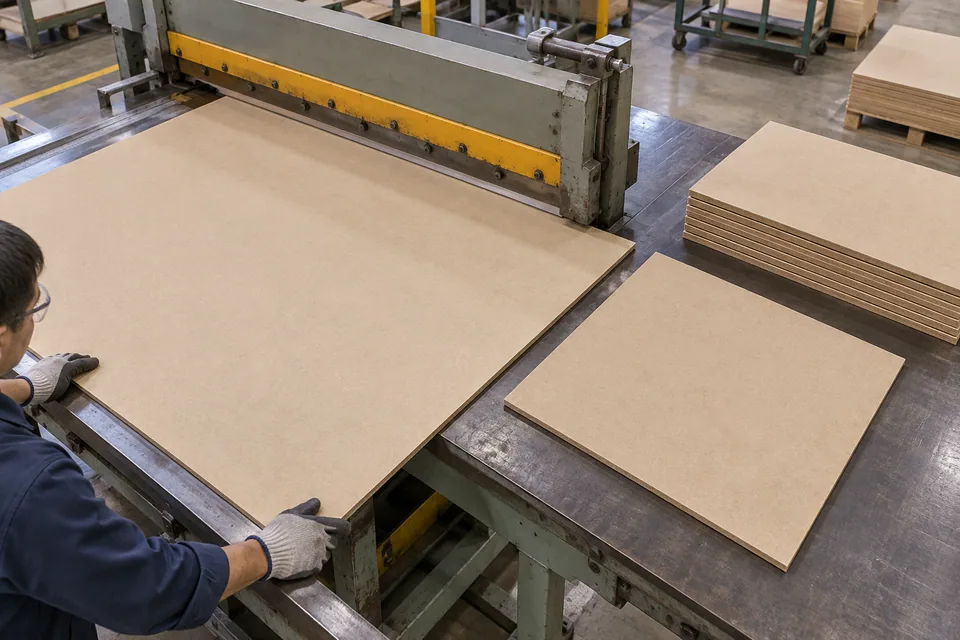
Where This Cutting Application Appears
Translate the transformer drawing into sheet blanks
List length, width, thickness and orientation for each barrier or spacer blank. Identify any later holes, rounded corners or forming operations so sufficient material is retained. Confirm the specified pressboard grade rather than substituting a visually similar packaging board.
Support the transverse and longitudinal cuts
Trial a sheet cutting sequence on the actual board with flat support. Check how the material behaves at blade entry and exit, including whether a corner crushes where two cuts meet. Use a stable datum for squareness instead of repeatedly referencing a frayed edge.
Inspect dimensions and cellulose structure
Measure length, width, diagonals and flatness after the board rests under the buyer’s method. Examine all four edges for lifted fibers, cracks or internal layer separation. Compare first and later blanks to detect blade wear or sheet movement.
Store pieces for the transformer process
Keep grade and lot with every stack and use the owner’s approved moisture barrier. Avoid loading or bending the pieces in a way that damages corners. The transformer builder then verifies fit, drying or oil impregnation route and final electrical acceptance on the completed apparatus.
Define the Required Cut Result
- Produce released rectangular pressboard blank sizes.
- Maintain squareness and flatness without crushed corners.
- Detect edge fiber pullout and internal delamination.
- Protect stock identity and moisture condition.
Problems to Diagnose Before Changing the Knife
A corner crushes at the second cut
- Review cut sequence and edge support.
- Check board grade and blade condition.
Rectangle is out of square
- Inspect datum and sheet movement.
- Compare diagonal measurements through the run.
Layers lift at a cut face
- Review support, blade load and incoming sheet condition.
- Retain a cross-section specimen.
Knife Forms That May Be Considered
| Possible knife form | When it may be considered | What must be confirmed |
|---|---|---|
| Supported straight sheet shear | For rectangular pressboard blanks within a validated board grade and thickness. | Confirm four-edge integrity, dimensions and flatness. |
| Router or profile cutter for later features | When the released drawing adds holes or contours beyond a plain rectangle. | Qualify debris and feature geometry separately. |
Information to Send for Technical Review
You do not need to know the exact blade name. Send the available workpiece, machine, current-knife and cut-result information so the application can be reviewed against a drawing or sample.
- Pressboard material grade and lot
- Sheet thickness, length and width
- Final rectangle drawing and orientation
- Later holes, forming and machining allowance
- Allowed fiber, delamination and corner damage
- Cut sequence, blade and datum plan
- Moisture-protective packing
- Transformer fit and electrical test owner
Questions About This Cutting Application
Is cut to size the same as strip slitting?
No. This operation establishes both length and width of a rectangular blank.
Why identify board grade?
Different density and construction can cut and condition differently.
Can a blade also make the final transformer barrier?
Only if the drawing is a plain rectangle; other features need separate qualification.
Does a dry-looking piece meet moisture requirements?
No. Follow the buyer’s measured conditioning and packing plan.
What should be provided for a trial?
Send the exact pressboard grade, sheet sample, blank drawing and edge limits.
Public references and scope
These public sources provide material, cutting-method or safety context for this guide. Supplier pages describe their own materials or equipment; they do not establish a MEIRENTE blade specification or performance claim. Confirm the actual grade, machine setup and required cut with a drawing or sample.
Related product and service information
- Transformer Electrical Pressboard Precision-Trimming Blades - transformer electrical pressboard · precision trimming
- NMN Motor-Insulation Laminate Cut-to-Size Blades - NMN motor-insulation laminate · cut to size
- Polyimide-Mica Insulation Laminate Cut-to-Size Blades - polyimide-mica insulation laminate · cut to size
Request a Custom Cutting-Knife Review
Send the workpiece details, machine or holder information, current knife photos or sample, required quantity and examples of the present cut problem. Final dimensions, material, edge geometry and tolerances are confirmed from the approved requirements.