
Blade Application Guides / Application Guide / Electrical equipment manufacturing
NMN Motor-Insulation Laminate Cut-to-Size Blades
Coveme identifies the NMN aramid/PET/aramid build and motor-insulation uses. Hauler & Hermann says flat insulating cut parts may be made directly from roll or sheet, including NMN laminate. This guide concerns simple rectangular pieces with both width and length fixed by a buyer drawing. A transverse cut may follow a supplier-slit roll or flat sheet; it is not a shaped die-cut phase barrier. The exact laminate grade, adhesive and orientation matter because a coarse paper surface, a polyester core and a bonded edge can react differently to blade entry. Trial the sample on a supported shear and inspect each of the three layers. Final slot insertion, forming and electrical acceptance remain with the motor manufacturer.
Updated
Where This Cutting Application Appears
Translate motor-part schedule into rectangles
List blank width and length, machine direction, paper-face identification and quantity by slot or phase location. If a later fold consumes material, use the developed flat dimension rather than a finished curved-wall measurement. Separate sizes into labeled batches before cutting.
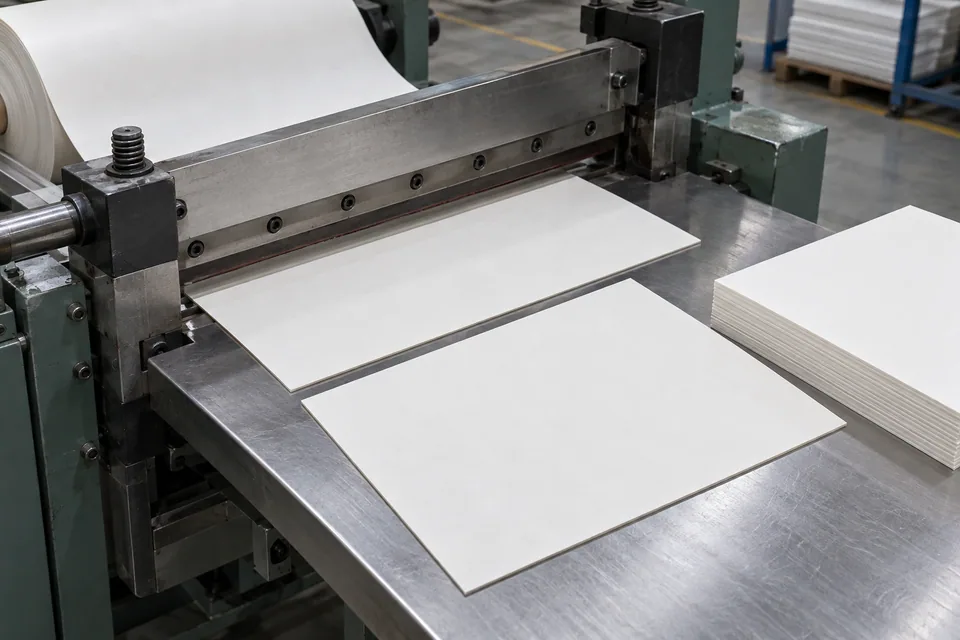
Control the transverse cut on supported stock
Hold the roll or sheet flat at the blade entry and check registration before every trial stroke. Observe whether a Nomex face stretches, the PET core snaps back or the blank tail curls. Inspect the outgoing part and the leading edge left for the next blank.
Measure after piece relaxation
Check length and squareness in a flat fixture without pulling the paper plies. Inspect aramid fibers, film protrusion and adhesive lift at both new ends. Measure first, middle and last pieces from a sequence so feeder slip and tool wear are visible.
Protect pieces for the liner operation
Stack blanks in orientation-marked packets without crushing the cut ends. The buyer should trial fold, insert or crease on its actual motor geometry and test the finished electrical system. A cut-to-size dimensional pass cannot establish impregnation or dielectric performance.
Define the Required Cut Result
- Produce released rectangular NMN blanks.
- Keep both transverse ends free of ply lift and film lips.
- Maintain blank flatness and orientation.
- Supply traceable parts for later forming and testing.
Problems to Diagnose Before Changing the Knife
One paper face tears at the crosscut
- Review hold-down and blade entry.
- Check whether the damaged face is always on the exit side.
Lengths drift in a batch
- Inspect feed registration and material slip.
- Sample across the full run.
Corners curl after stacking
- Compare incoming curl and stack pressure.
- Measure after a defined relaxation period.
Knife Forms That May Be Considered
| Possible knife form | When it may be considered | What must be confirmed |
|---|---|---|
| Supported transverse shear | For straight rectangular NMN pieces from a verified roll or sheet. | Check length, squareness, three-layer end condition and curl. |
| Guided sheet crosscutter | For indexed flat sheets or a previously slit roll requiring rectangular lengths. | Check both the released end and the next piece’s leading edge. |
Information to Send for Technical Review
You do not need to know the exact blade name. Send the available workpiece, machine, current-knife and cut-result information so the application can be reviewed against a drawing or sample.
- Exact NMN construction and grade
- Incoming roll or sheet dimensions
- Developed blank length and width
- Machine direction and paper-face convention
- Allowed fiber, PET lip and delamination
- Feed and transverse support plan
- Stack and packaging method
- Motor-part forming and electrical tests
Questions About This Cutting Application
Does cut to size mean a slot liner is finished?
No. It supplies a flat rectangle; folding or insertion comes later.
Why inspect the next piece’s leading edge?
The same shear stroke creates both a finished end and the next blank’s start.
Can a paper edge hide film damage?
Yes. Check the polyester middle ply separately.
Does the cut confirm insulation class?
No. Use the named grade data and motor-system qualification.
What information starts a trial?
Provide material grade, developed dimensions, orientation and edge examples.
Public references and scope
These public sources provide material, cutting-method or safety context for this guide. Supplier pages describe their own materials or equipment; they do not establish a MEIRENTE blade specification or performance claim. Confirm the actual grade, machine setup and required cut with a drawing or sample.
Related product and service information
- NMN Motor-Insulation Laminate Precision-Trimming Blades - NMN motor-insulation laminate · precision trimming
- Polyimide-Mica Insulation Laminate Cut-to-Size Blades - polyimide-mica insulation laminate · cut to size
- Transformer Electrical Pressboard Cut-to-Size Blades - transformer electrical pressboard · cut to size
Request a Custom Cutting-Knife Review
Send the workpiece details, machine or holder information, current knife photos or sample, required quantity and examples of the present cut problem. Final dimensions, material, edge geometry and tolerances are confirmed from the approved requirements.