
Blade Application Guides / Application Guide / Electrical equipment manufacturing
Transformer Electrical Pressboard Precision-Trimming Blades
Pressboard suppliers offer drawing-based sheets, strips and shaped transformer components. A precision trim is a separate finishing decision when a cut barrier or spacer has a measured extra margin relative to its final fixture. It is not an instruction to shave every piece. The actual cellulose grade, thickness, edge condition and moisture state must be established before selecting a blade or datum. A trim that improves fit may still crush fibers, expose an internal split or reduce a required creepage or oil-duct clearance. This guide therefore records the original part, the exact surplus and the retained edge after a supported trial. Finished transformer electrical performance remains with its designer and assembler.
Updated
Where This Cutting Application Appears
Prove the need for a final correction
Place the already cut part against its released fixture and mark the measured surplus. Identify a stable reference edge or hole; a ragged margin should not set the trim position. Check how much insulating overlap must remain after the correction.
Support the narrow offcut
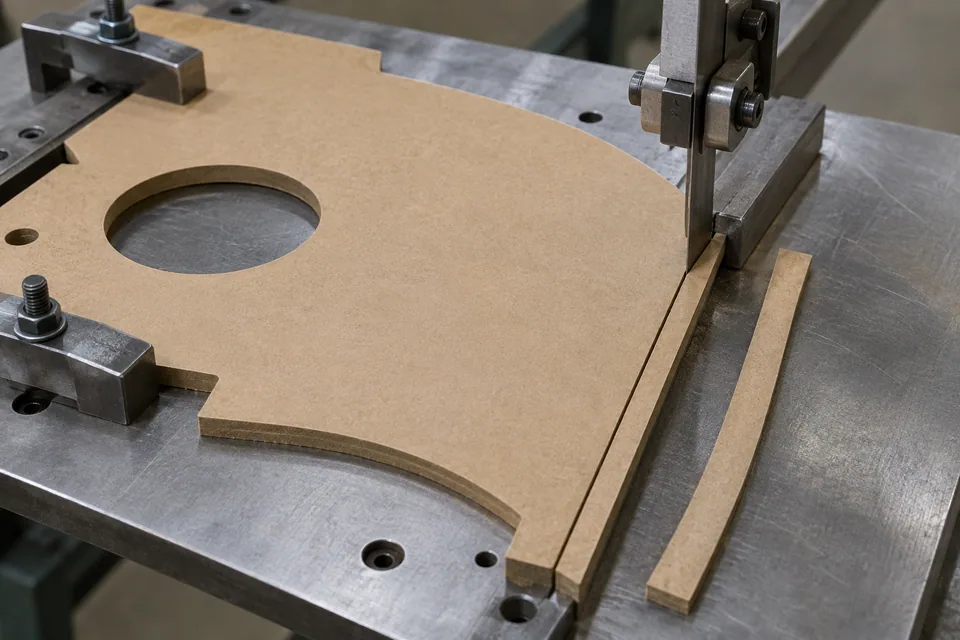
Clamp the board flat and test a guided trim blade or another owner-approved edge-finishing route. Capture slivers and fiber dust at the source. Observe whether a thin offcut tears into the retained part rather than separating cleanly.
Inspect the kept edge and dimensions
Measure final edge location, width at several points and corner squareness. Inspect compressed cellulose, ply lift and scratches on both faces. Compare before-and-after specimens from the same lot; a visually neater edge is not an improvement if required material was lost.
Refit under the final conditioning plan
Label the trimmed part and protect it from uncontrolled moisture pickup before assembly. Repeat the fixture check and let the transformer maker apply its drying, oil-processing and dielectric test procedure. The trim report should describe geometry and edge state only.
Define the Required Cut Result
- Remove only documented excess material.
- Keep required barrier overlap and clearance.
- Avoid fiber tearing and loose slivers.
- Demonstrate final fit with traceable part samples.
Problems to Diagnose Before Changing the Knife
Offcut tears into the useful piece
- Review part clamping and blade entry.
- Examine incoming cracks near the trim line.
Trimmed edge crushes or fuzzes
- Check tool sharpness and support.
- Compare board grade and moisture condition.
Part loses required overlap
- Review drawing and fixture datum.
- Hold the lot before assembly.
Knife Forms That May Be Considered
| Possible knife form | When it may be considered | What must be confirmed |
|---|---|---|
| Guided straight finishing shear | For a flat surplus edge with a stable datum on validated board. | Check kept-edge fiber state and final dimension. |
| Local profile trim tool | When only a curved or notched edge needs correction. | Verify location and dust removal. |
Information to Send for Technical Review
You do not need to know the exact blade name. Send the available workpiece, machine, current-knife and cut-result information so the application can be reviewed against a drawing or sample.
- Identified pressboard grade and thickness
- Original and final part drawings
- Measured surplus and stable datum
- Required retained insulation overlap
- Allowed crush, fray and delamination
- Blade, fixture and dust-control setup
- Before-and-after sample labels
- Transformer final-fit and test owner
Questions About This Cutting Application
Is this the same as making a new contour?
No. It corrects one measured edge on an existing part.
Should every pressboard part be trimmed?
No. Accept parts that already meet the released drawing.
Can trimming repair an internal split?
No. A split crossing the kept area needs material disposition.
Why inspect a thin offcut?
It can show where fibers tore back into the retained board.
What should be sent for a trial?
Provide the actual part, final fixture drawing and marked surplus edge.
Public references and scope
These public sources provide material, cutting-method or safety context for this guide. Supplier pages describe their own materials or equipment; they do not establish a MEIRENTE blade specification or performance claim. Confirm the actual grade, machine setup and required cut with a drawing or sample.
Related product and service information
- Transformer Electrical Pressboard Sheet Slitting Blades - transformer electrical pressboard · sheet slitting
- NMN Motor-Insulation Laminate Precision-Trimming Blades - NMN motor-insulation laminate · precision trimming
- Polyimide-Mica Insulation Laminate Precision-Trimming Blades - polyimide-mica insulation laminate · precision trimming
Request a Custom Cutting-Knife Review
Send the workpiece details, machine or holder information, current knife photos or sample, required quantity and examples of the present cut problem. Final dimensions, material, edge geometry and tolerances are confirmed from the approved requirements.